Baby and Child Digital Passport Photos — Official U.S. Rules
Table of contents:
- Overview of Official U.S. Photo Rules for Babies and Children
- Technical Digital Photo Requirements (U.S. Official Standards)
- Background and Lighting Rules for Baby & Child Passport Photos
- Rules for Baby, Infant, and Newborn Passport Photos
- Caregiver Presence and Support Restrictions (U.S. Official Rules)
- Rules for Exposure, Sharpness and Color (Digital Compliance)
- Common Rejection Reasons for Baby and Child Passport Photos
- Final Requirements Checklist: Technical and Baby-Specific
- Conclusion
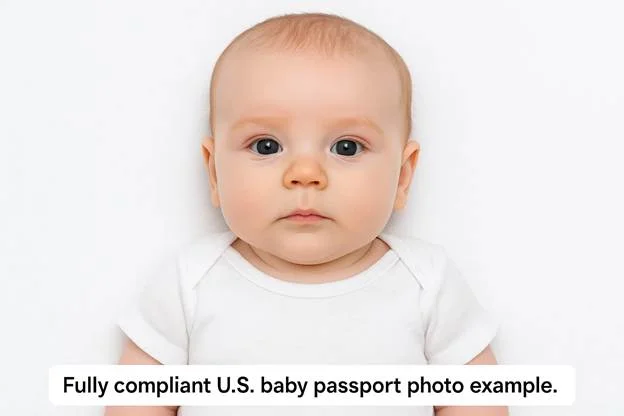
If you are wondering about the actual baby passport photo requirements in the USA, you have likely already come to know that there are some pretty strict official standards, which are even more rigid when the “model” is a newborn who can’t sit up, a toddler who won’t look at the camera, or a child who refuses to maintain a neutral expression.
And parents don’t realize this part, either:
Baby or child U.S. passport photos are still required to meet full biometric standards — the same ones used for adults. That means precise head positioning, full face visibility, uniform background, exposure consistency strictly, and zero tolerance for shadows, hands, wrinkles, patterns, or “just this once” exceptions.
This guide summarizes the U.S. Department of State regulations and how they pertain to babies, infants,
toddlers, and children. No tips. Not a tutorial. Just the actual requirements,
explained clearly, with examples that illustrate exactly what is acceptable in
a digital passport photo — and why.
Overview of Official U.S. Photo Rules for Babies and Children
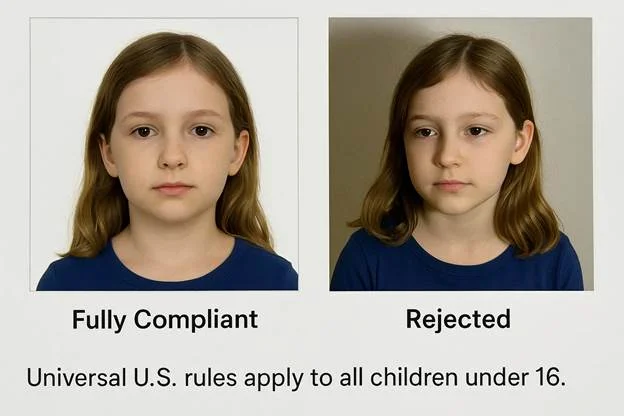
The U.S. child passport photo requirements are the same as the adult photo requirements in terms of being biometric with virtually no exceptions. Below is a simple explanation of what the Department of State demands for each photo.
Required (Need to Exist):
- The full face is visible without any occlusion
- Perfectly straight on (no pitch, no yaw)
- Neutral expression (closed mouth, relaxed face)
- Looking straight into the lens of the camera
- Uniform lighting with exposure uniformity
- A full uniform white background that meets the background requisites
Disqualified Submissions (Instant Rejection):
- Shadows (behind the head or under chin
- Background Patterns, Textures, Wrinkles, or Gradients in Color
- Too Bright or Too Dark
- Color cast or tinted lighting
- Hands, toys, patterned blankets or support devices that are visible
To demonstrate how rigorous these requirements are, here’s a quick reference table:
|
Requirement Category |
Must Follow |
Why It Matters |
|
Background |
Solid white, fully uniform |
Ensures background uniformity for biometric processing |
|
Lighting |
Even, shadow-free |
Preserves exposure consistency |
|
Head Orientation |
Fully frontal, centered |
Required for facial comparison algorithms |
|
Expression |
Neutral, relaxed |
Supports accurate landmark detection |
|
Face Visibility |
Unobstructed, full face |
Core requirement for all passport photos |
Age-Specific Exemptions for Babies and Infants
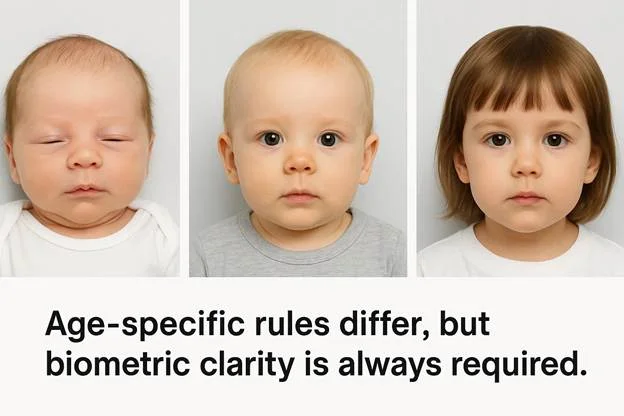
There is a bit of leeway, but it’s nowhere near as much as most parents think. A compliant newborn passport photo can violate one or two requirements for an adult passport photo — but never in a way that compromises the quality of biometric features.
Permitted Exceptions (Infants & Newborns Only):
- Eyes may be half opened
- Mild relaxation of facial muscles is allowed (not fully neutral, but relaxed)
- Temporary asymmetry is acceptable if the facial landmarks can still be identified
Non-Negotiable Rules (Still in effect for the oldies):
- Entire eye visible - one eye obviously open
- Head is straight and neutral for pose
- No hands, fingers, or props are visible
- The face must be completely unobstructed (teeth occlusion scoring rules apply)
Here is a comparison table to make the limitations clear:
|
Rule |
Newborn Flexibility |
Infant Flexibility |
Non-Negotiable |
|
Eye Opening |
Partially open permitted |
Must be mostly open |
Must be visible |
|
Expression Neutrality |
Some leniency |
Mild leniency |
No exaggerated expressions |
|
Head Stability |
Allowed if supported invisibly |
More controlled expected |
No visible support |
|
Background |
No exceptions |
No exceptions |
White, uniform only |
|
Shadows |
No exceptions |
No exceptions |
Rejection if present |
Even considering such exceptions, the
requirements for baby passport photos are still quite stringent. Babies must be
clearly visible and the full-face geometry must be accessible to automated
processing.
Technical Digital Photo Requirements (U.S. Official Standards)
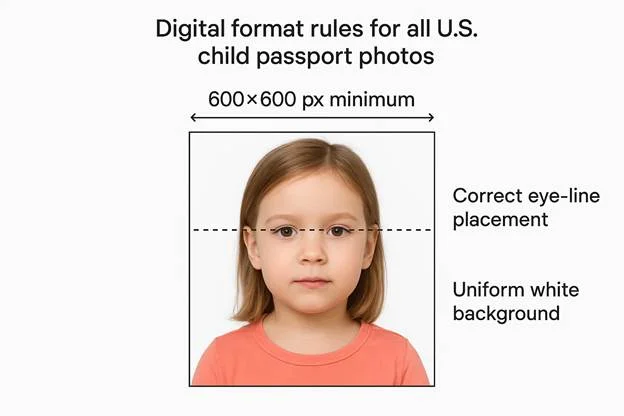
Digital passport photos for babies and
children need to comply with the same technical requirements as adult photos.
These are standards that exist because U.S. systems are heavily automated for
verification, so every pixel, color value and geometric proportion must reside
within a set of very tight federal parameters. Prior to reviewing specific
details, you should be aware that these technical rules are non-negotiable for
any age group.
Pixel Dimensions & Aspect Ratio
A U.S. digital passport photo that meets specifications must be within a very tight range of pixel dimensions. The file should be square, and between 600×600 px and 1200×1200 px in size, according to the Department of State. These standards are in place because digital systems require uniform pixel size, predictable framing, consistent image resolution to perform biometric analysis.
The 1:1 aspect ratio square frame is
non-negotiable. Any deviation will distort tones and will impact how
well the facial recognition software classifies a face. If captured or exported
at the wrong aspect ratio, the image will fail digital image validation,
even if the face appears sharp to the human eye.
Rule | Requirement |
Pixel Dimensions | 600×600 px to 1200×1200 px |
Aspect Ratio | 1:1 aspect ratio |
Resolution | High, with no distortion or pixelation |
Color Space & File Format
As of now, the US government only accepts
a JPEG passport photo and it needs to be in sRGB color space.
Other formats — such as PNG, HEIC, WebP — are not supported by the verification
process and often, they fail at the uploading stage.
This has the effect of keeping the image color
balanced, uniform, within the approved file format options, and compression
limit allowed. Photographs rendered with different color profiles or
excessively compressed output tend to break the standards for digital photos,
even when they are visually acceptable.
Head Size & Position Rules
The inner structure of the face is as
important as pixel dimensions. The official head position requirement
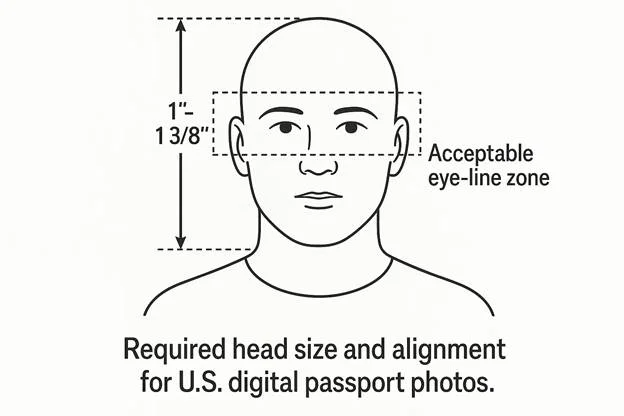
states that the head height must not be less than 1 inch and not more
than 1 3/8 inch from the bottom of the chin to the top of the head. This is
consistent with expectations for automated biometric measurements, as
well as to allow the system to correctly process the contour boundaries of
the face.
The eyes need to be located within the eye-line squared off-in the top half of the photo-frame. When the eyes are too high, too low or too far from the center, the photograph loses compatibility with US identity-matching systems, even if everything else is perfect.
Background and Lighting Rules for Baby & Child Passport Photos
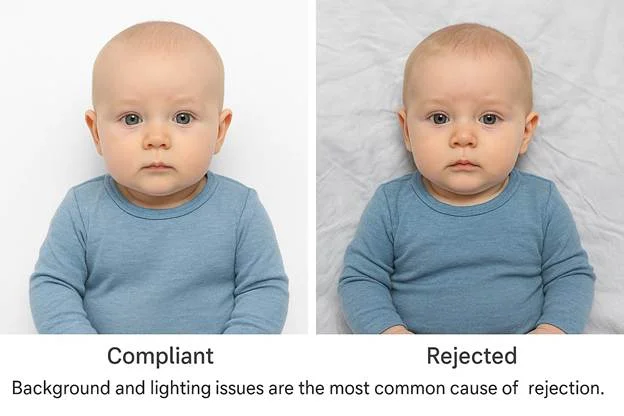
Most of the infant and toddler passport photo rejections are because of the lighting and the background issues. Since these considerations impact biometric reading, they are strictly applied in the US, with no exceptions, not even for infants.
Background Restrictions
Everything for a Canadian passport photo
must be taken against a white or light-coloured background. For babies,
they just place a white blanket for the background, but that blanket
must be smooth and solid in color.Federal guidelines apply a strict test for background
uniformity that can detect even the minutest imperfections that the human
eye might miss.
If a background contains folds, patterns,
bumps or fibers that can be seen, it is treated as a texture violation
by the automated systems. Those systems also conduct a shadow detection
analysis to identify any shadows on top of the head or on the left and right
sides of the subject. Even a minor gradation can break the consistency of the
necessary color and make the contrast go out of the limit, and
then it will be rejected due to technical reasons.
Background Attribute | Compliant | Rejected |
Color | Pure white or off-white | Gray, beige, blue, patterned |
Texture | Completely smooth | Visible fabric lines, fibers, patterns |
Surface Tone | Uniform | Gradients, two-tone areas |
Shadows | None | Any darkening behind head or shoulders |
Conditions of lighting
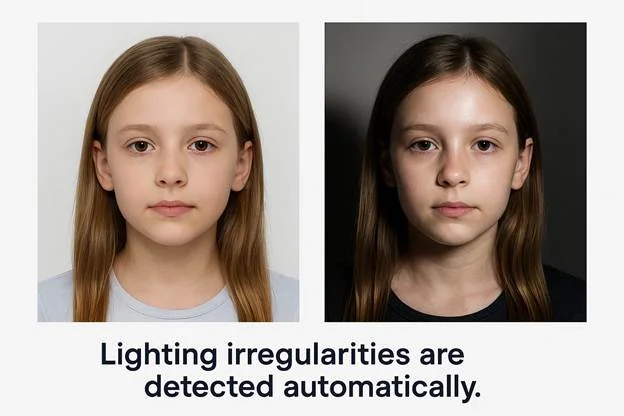
And good lighting is necessary because
the U.S. Every child’s passport photo is run through the system and compared to
stringent exposure standards. The image should not have any hotspots,
shading, dark regions or imbalance in the brightness to pass the uniformity of
exposure in the federal guidelines.
Even a tiny bit of shadowing breaks the no shadows rule and gives you automated glare alerts or underexposure threshold alerts. Conversely, for too bright images it is identified as a bright face, and the face image quickly loses important details used for biometric comparison. The skin tone will be natural as the color temperature accuracy obeys the proper illumination and there will be no verification error because of the changed skin tones.
Rules for Baby, Infant, and Newborn Passport Photos
Obstacles of this nature come up for every age group in the U.S. But the U.S. does require all those under 16 to meet strict biometric and technical requirements. The exceptions below represent minor concessions — not a watering down of requirements.
Regulations for Newborns
The requirements for a newborn passport
photo are a bit more lenient than for older children, but the exceptions are
very few and very specific. The main rule is that the face be unobstructed and
easily read by facial-recognition technology, which considers facial
landmark detection, head geometry, and symmetry – and this applies even to
infant applicants.
Newborns do not have to have their eyes
wide open, but some eye exposure is required. Pose must still
approximate pose neutrality: no overt tilt/rotation that would prevent
uniform measurement. Support may be provided but must be concealed behind the
background, an arm or hand holding the child above the background will cause an
automated occlusion scoring violation. Head support visibility is
also verified by the system and if anything is visible under the infant’s head.
Requirement | Allowed | Not Allowed |
Eyes | Partially open | Fully closed |
Expression | Slight variation | Crying, exaggerated expressions |
Support | Hidden only | Visible hands/props |
Landmark Detection | Must be possible | Obstructed or unclear |
Rules for an Infant
After a baby has aged out of the infant
stage, the U.S. passport standards become stricter. To be compliant, infant
passport photos must show full facial visibility (no toys, blankets,
fingers, straps or anything else can obscure any part of the baby’s face). The
background should be a plain uniform background as in the case of adults
without any texture, color variations or visible folding.
Lighting problems are no excuse for age.
Infants are required to satisfy these thresholds for consistency of exposure
under the federal standard to be presented with accurate skin tone. It also
verifies removal of adult occlusion — that no parent or caregiver is
captured on film. The hand visibility rule forbids even a tiny finger
you can't see from under the chin or cheek
Key Infant Requirements:
- Fully visible face with no obstruction
- No visible hands
- Background is white and uniformed
- Face is evenly lit
- Neutral or relaxed facial expression
Toddler Rules
The toddler passport photo must satisfy
almost all the same requirements as the adult photo. At this age, there are
very few exceptions as toddlers can hold still for the positioning and
visibility requirements. Their eyes need to be wide open and the head must stay
centered as per the official alignment requirement standards.
Biometric systems analyze the shape of
the face, looking for straight lines around the face without warping or
shading. Looks like movement can also result in rejection comments, toddlers
have a habit of causing soft blur that doesn’t pass motion blur detection
thresholds.
The image should have correct landmark
accuracy, and any bright spots or reflections - particularly on the
forehead - are detected via glare prevention routines.
Requirement | Must Meet | Why It Matters |
Eye Opening | Fully open | Required for biometric comparison |
Alignment | Straight and centered | Supports accurate measurement |
Expression | Neutral | Avoids distortion of landmarks |
Movement | None | Motion blur breaks detection systems |
Glare | Absent | Prevents loss of facial detail |
Caregiver Presence and Support Restrictions (U.S. Official Rules)
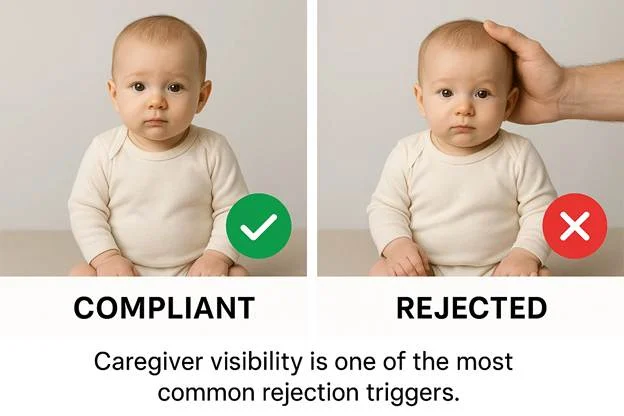
Since babies can't hold their own, the
U.S. government enforces strict regulations to keep any adult help from being
visible in the shot. These rules preserve the integrity of the biometric image
and prevent the image from being manipulated or interfering with facial
recognition systems.
No visibility of caregivers
There should be no evidence of adult
presence in any child passport photo taken in the U.S. The holding baby
passport picture rule is absolute: no hands, fingers, arms, edges of clothing
or shadows of parents may be visible in the photo. Such images are immediately
flagged by automated occlusion detection algorithms that analyze the
image for contours, shapes or textures that don’t belong to the face of the
child.
Even small indications of an adult being
in the room — like part of a sleeve, or the presence of a shadow — can lead to shadow
detection or caregiver visibility violations. Systems also detect
unintended support artifact signals, such as the corner of a pillow or
piece of fabric that seems to be holding up the baby.
If any of these items interfere with the
background they are automatically tagged as background interference and
the photo fails prior to human review.
Element | Allowed | Not Allowed |
Hands/Arms | Never allowed | Any visible fingers or palm |
Clothing | None visible | Shirt, sleeve, scarf in frame |
Shadows | None | Shadows cast by adult |
Support Items | Only if invisible | Pillows, hands, blankets used visibly |
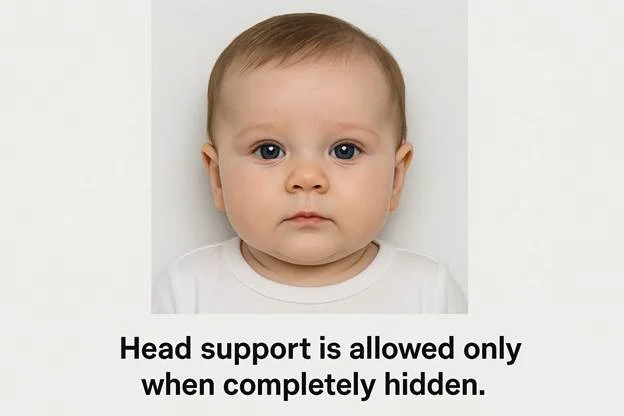
Head Support Visibility Rules
Support can be used to support a
baby’s head, but it can never be seen. The head support stipulation demands
that the whatsoever stabilization (a hand, a pillow, rolled fabric) must be out
of sight behind the back. If any part of the head cover becomes visible, the automated
obstruction detection will consider that as an interference.
The infant's face needs to be visible at all times, so the facial landmarks can be scanned without any hiccups. If any props are visible it will break the uniformity of the background and your submission will be rejected regardless of age. This regulation is to ensure the biometric is compliant — and what that means is the photo has to meet certain requirements to be clear, consistent and can't show anything that would cover, alter or obscure a person's face.
Rules for Exposure, Sharpness and Color (Digital Compliance)
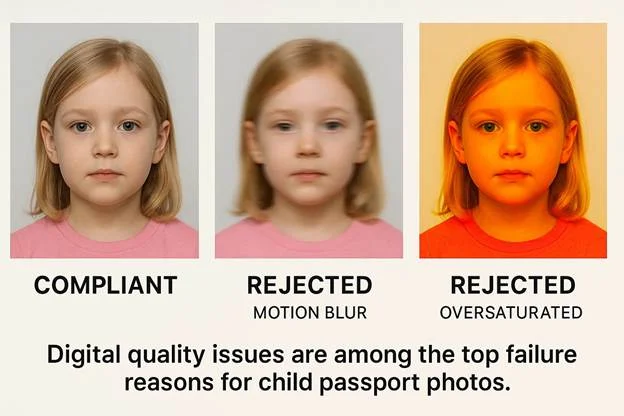
The digital quality of baby and child passport photos is one of the top reasons for rejection, particularly as infants are naturally moving and lighting can change unexpectedly. These regulations guarantee that all pictures are scannable by machines, irrespective of the age of the child.
Sharpness & Image Quality
A U.S. passport photo that meets U.S.
Department of State requirements must be clear, high resolution and free of any
blur, haze, distortion, or other motion effects. Infants are also a moving,
blinking, shifting target, so the probability is much higher that images will
not meet the sharpness requirements. These aspects are evaluated in the
automated consular procedures with severe technical rules.
The overall clarity is assessed by clarity
grading to ensure that the face exhibits a clean edge outline. Motion
blur detection, that looks for streaking or blurring in the eyes, around
the mouth and on the face, detects camera shake or subject motion. Too much
digital noise can also cause the accepted noise level to be exceeded,
and too little detail will cause the photo to be rejected for not meeting the
official resolution requirement.
However, the image may look “fine” to the
human eye, but poor quality in tone may cause the image to be discarded as
small tonal differences decrease the likelihood of a successful positive
biometric match.
Issue | How It Fails | Why It Matters |
Motion Blur | Detected by blur algorithms | Blurs eyes & mouth landmarks |
Grain/Noise | Exceeds noise threshold | Distorts skin and facial details |
Low Resolution | Violates resolution standard | Prevents accurate contour mapping |
Soft Focus | Reduces clarity scoring | Facial recognition becomes unreliable |
Color & Exposure Standards
The color and exposure values should look
natural and consistent throughout the entire frame. Systems for U.S. passports
evaluate color accuracy to confirm that the skin tone is similar to the
real-life color under standard lighting, not using any filters, tints, or
digital alterations.
Abrupt changes in brightness go against
the uniformity of exposure, and overexposure and underexposure can
obscure important biometric features, particularly on the eyes and nose. There
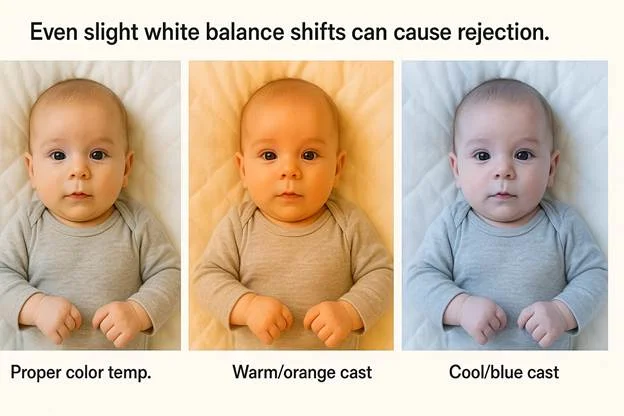
are also internal algorithms running white balance calculations to ensure that
the scene contains true whites and not warm or cool color tints. Any detectable
chromatic shift such as a blue, orange or a green cast indicates an
impermissible departure from natural color values.
All images shall be sRGB color space compatible to provide for consistent color rendition throughout the processing of images in the government environment.
Common Rejection Reasons for Baby and Child Passport Photos
And yet, even when rules are scrupulously followed, a healthy percentage of child passport photos are rejected for tiny technical violations that would be caught by machines in an instant. These denials are not subjective biases — they are the result of measurable anomalies on the surface of the image.
Violations That May Lead to Rejection
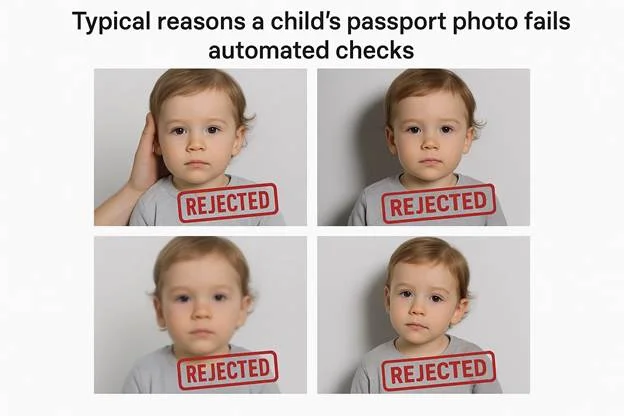
Assessments of U.S. child passport
photographs are made through a combination of automated and manual procedures.
Almost all rejections are because the photo does not meet certain biometric or
technical criteria. Understanding what causes your baby’s passport photo to be
rejected is helpful in knowing why the rejection notice is so common, it might
even help you to understand just how stringent the U.S. really is - particularly
when the system highlights problems that aren't always visible to the naked eye.
Many rejections begin with the mismatch
of facial landmarks, as the system is unable to precisely locate the
position of both eyes, nose, mouth or chin. This is often the result of the
child’s head not being fully straight on or the face turned to the side leading
to a measurable tilt of the head. The recognition requires a geometric
transformation, and an individual point inversion will deform this pattern of
points geometrically.
Background-related problems also cause
failures at high rates. Any shadow on background, uneven toning or
texture visibility will activate a background non-uniformity flag.
Automated occlusion detection also detects foreign objects, hands,
sleeves, blankets, stuffed animals, or straps covering any part of the face or
hanging in front of the face or background that may be partially covering face
or background.
Other failures are underexposure,
which occurs when the lighting is too dim or too bright/dark in some parts of
an image, noise adding granularity, which lowers image quality, and a color
cast, for example by a warm orange or a cold blue tinting the image. Bright
reflections or light spots are glare and it is rejected at capture.
Rejection Type | Triggered By | Example Indicators |
Facial Alignment Errors | Landmark mismatch | Head tilted, uneven pose |
Background Violations | Non-uniformity & shadows | Creases, gradients, patterns |
Obstruction Flags | Occlusion detection | Hands, toys, straps visible |
Exposure Problems | Inconsistency or glare | Hotspots, underexposed areas |
Image Quality Issues | Noise or low resolution | Grainy or soft face details |
Color Errors | Chromatic cast | Blue/orange tint, incorrect white balance |
Final Requirements Checklist: Technical and Baby-Specific
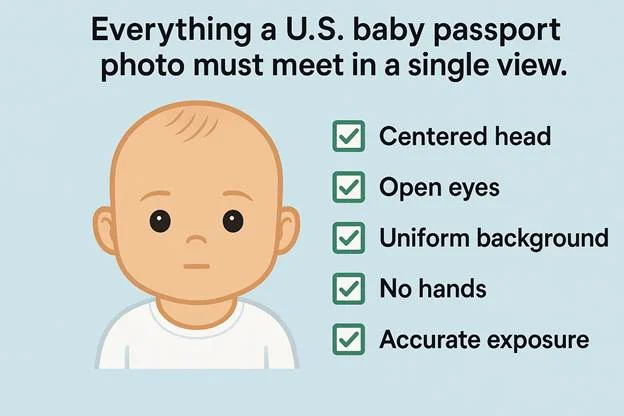
All the rules explained in this guide
merge in one cohesive compliance check that is applicable to all baby and child
passport photos. This final check is exactly what is tested by U.S. systems
before an image is accepted.
A U.S. passport photo for a child is
acceptable if it meets all the following criteria. These regulations are
stringent, quantifiable and enforced by automated compliance mechanisms. Here
is a summary of the most important baby passport photo requirements in the USA
in a checklist for your convenience.
Digital Technical Standards:
- Must use a 1:1 aspect ratio (square format)
- Pixel dimensions must comply with US digital image specifications
- The image should be in the sRGB color profile
- The color values must meet the federal color accuracy standards
- Exposure should be consistent and no hotspots or shadowed areas are present
Background Requirements:
- The background must exhibit excellent uniformity
- No gradients or folds, and no shadows detectable by shadow detection
- No objects, texture, fabrics or forms that could disrupt the uniformity of the background color
Facial & Biometric Standards:
- The face must have nothing that covers any facial landmarks, the face must be fully visible
- Eyes must have good visibility
- Head size shall be within the range of head height
- The neutral position should be maintained to keep the image in the biometric sense
Caregiver and Object Constraints:
- There is no adult involvement of any kind visible
- Automation of occlusion scoring should cause no interference
- The baby is not being touched or covered by any support tools, hands, or clothing edges
- There are no shadows, toys, straps, or other interruptions of the background visible in the frame
|
Category |
Requirement |
Entity Relevance |
|
Dimensions |
Square, correct pixel range |
1:1 aspect ratio, digital image compliance |
|
Background |
Pure, uniform white |
background uniformity, shadow detection |
|
Lighting |
Even, consistent |
exposure consistency, color accuracy |
|
Face Visibility |
Fully unobstructed |
facial landmarks, eye visibility |
|
Head Size |
Correct chin-to-crown ratio |
head height proportion, biometric compliance |
|
Color Space |
sRGB only |
sRGB |
|
Interference |
No hands, objects, or shadows |
occlusion scoring, shadow detection |
Conclusion
While there are challenges unique to
photographing infants and toddlers, the official baby passport photo
requirements in the USA are rigid and fully compliant with federal standards
for identity verification. Every child and adult must meet the same biometric
requirements as set by the U.S. Department of State, whether they are a
child or an adult, and no matter whether they are pose-able or not. This means
that the image must retain full biometric compliance and provide clear
and consistent facial visibility and must be processed through the same
channels and algorithms as those applied to images used in the national
passport system.
The background should exhibit perfect background
uniformity, the illumination should have a constant exposure consistency,
and the facial features of the child should be sufficiently clear for an
automated system to capture them without any error. There are a few exceptions
for newborns and infants, but nothing that undermines the core biometric
standards or the quality of the image.
So, these are the kinds of things that these requirements exist to do, to make sure that the passport photo for every child is handled accurately, securely and consistently — and that families have a well-defined, reliable expectation of what the U.S. government looks for.
Authored by:
Nathaniel K. RowdenApproved by Association of Visa center
On this page:
- Overview of Official U.S. Photo Rules for Babies and Children
- Technical Digital Photo Requirements (U.S. Official Standards)
- Background and Lighting Rules for Baby & Child Passport Photos
- Rules for Baby, Infant, and Newborn Passport Photos
- Caregiver Presence and Support Restrictions (U.S. Official Rules)
- Rules for Exposure, Sharpness and Color (Digital Compliance)
- Common Rejection Reasons for Baby and Child Passport Photos
- Final Requirements Checklist: Technical and Baby-Specific
- Conclusion