Glasses and Head Covering Rules for Passport Photos
Table of contents:
- Can You Wear Glasses in a Passport Photo?
- Detailed Glasses Rules and Edge Cases
- Requirements for Head Covering in Passport Photos
- What Should Always Be Visible
- ICAO vs U.S Rules for Glasses, Facial and Head Coverings
- Acceptable vs Unacceptable Examples
- Typical reasons for photo rejections
- Final Compliance Checklist
- Conclusion
Is It OK to wear glasses or headwear in your U.S. Passport Photo? Many people get confused about glasses and headwear and I hope to clear things up for you. The criteria are strict, and even small things - like a slight glare on a pair of glasses or a shadow cast by a scarf on a person’s face - can cause an image to be rejected, even if it looks fine to the naked eye. Having these rules in mind beforehand may really save you some time and frustration and spare you a couple of trips to the photo booth.
The Department of State uses the same biometric-based methodologies as ICAO 9303 standards. Full face frontal view, normal lighting and both eyes open and visible without any cover are required. Glasses, a religious head covering, or a medical condition - the guidelines cover how clear the face needs to be for automated systems and human reviewers to get a look.
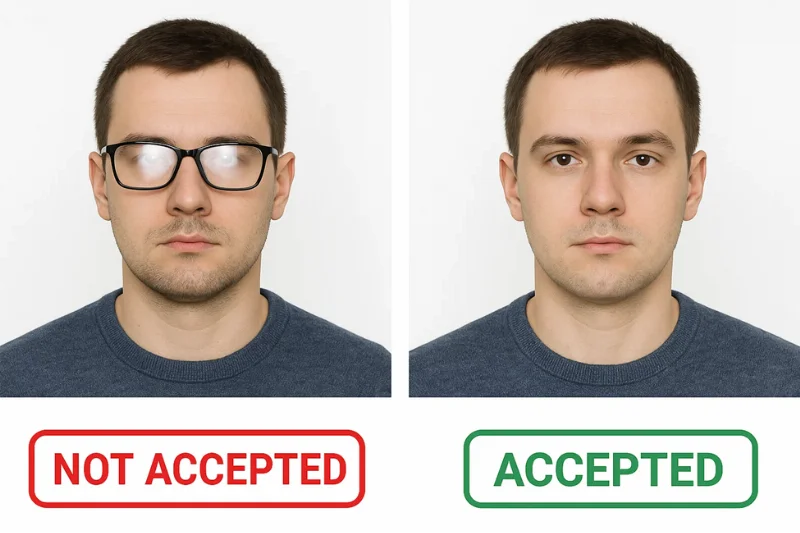
Small obstructions like thick glasses frames, glare on lenses, shadows from deep folds of cloth, or partially covered eyebrows can interfere with the biometric compliance and the system may also reject the photo. The passport photo glasses rules and head cover regulations are to prevent those issues and there is very little latitude for interpretation.
Can You Wear Glasses in a Passport Photo?
Eyeglasses are not allowed in a U.S. passport photo. This is a strict rule and applies to all, unless a medical condition makes removal impossible. The U.S. Department of State insists on a clear, unobstructed view of the eyes because even small obstructions compromise the accuracy of identity verification.
The two issues that matter most are:
- eye visibility
- glare/reflection
If any of these are off - even a little - the image fails passport photo glasses rules and wear glasses passport photo standards. The system requires constant clarity to ensure successful biometric capture.
Facts to keep in mind:
- All types of eyeglasses need to be taken off.
- Thin or rimless frames do still cause rejections.
- Anti-glare coatings do not remove reflections.
- There are only a few rare medical exceptions.
Why Glasses Are Restricted
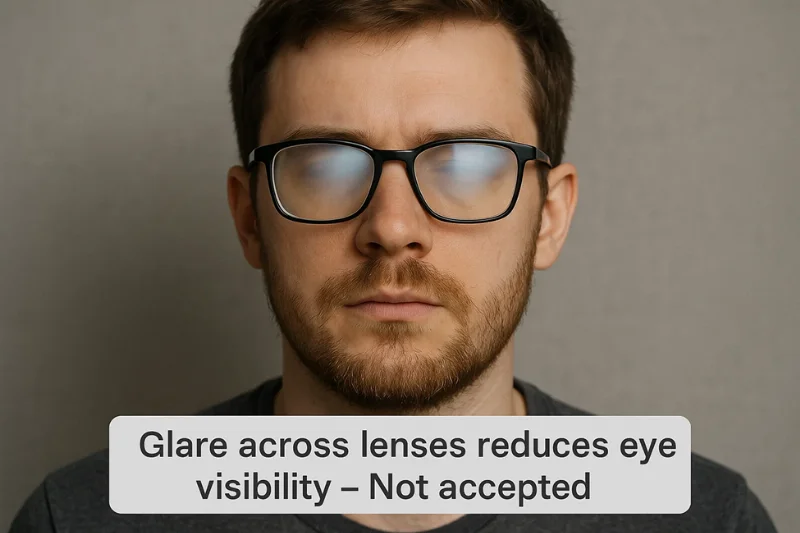
The limitation applies as glasses interfere with the analysis of biometrics. There may be cases where the camera and biometric reader is able to detect issues that the human eye cannot see even though the lenses may appear to be clear.
The following are the key technical issues:
Glasses glare
Bright spots blind the pupils and hinder iris visibility.
Reflection
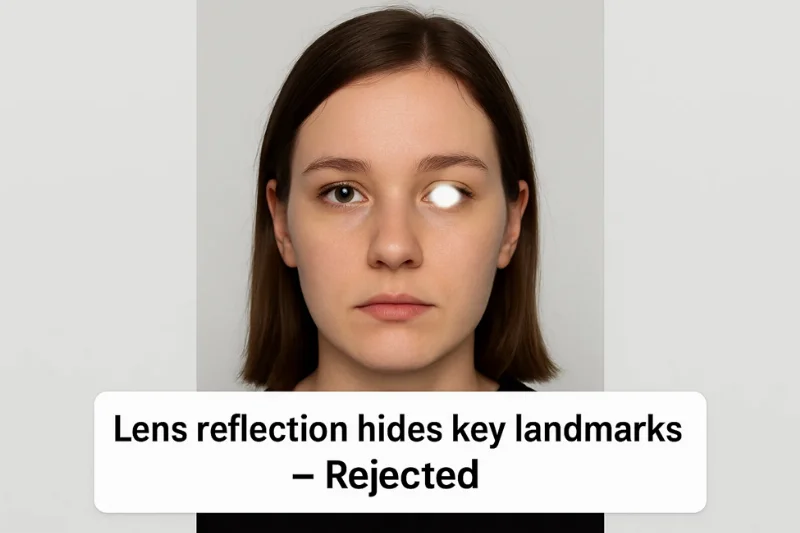
Lenses reflect windows, ceiling lights, or the camera’s light source. These reflections interfere with face landmark detection, particularly near the eyelids and the outer boundary of the iris.
Occlusion
Frames occlude the eye region and lead to less accurate landmark localization. Even a slight occlusion may lead to system failure.
Poor lighting balance
Poor lighting balance iвs a common problem in color document image capture.
These problems are not infrequent at all in most photos with glasses, that's why the rule is rigidly applied unless there's a medical necessity.
Detailed Glasses Rules and Edge Cases
Although they may be harmless, the
prescription lenses cause a few problems in a glasses passport photo. Even
plain, clear lenses bend and reflect light, and these light phenomena interfere
with biometric reading more than one might expect.
The major problems are caused by:
- Subtle reflections on the lens that obscure part of the iris
- Lens curvature limits the amount of visible sclera
- Changes in iris contrast ratio when color values are modified by coatings or lens tints
- Minor visual distortions from the edge of a plate or lens thickness
These disfigurements do not impact appearance alone - they also interfere with biometric tracking. The shape of the eye, the whites of the eyes, and the natural gradient from sclera to iris should be visible to the system.
Why prescription lenses usually fail:
|
Problem |
How It Interferes |
|
Glare from overhead lights |
Hotspots cover the pupil |
|
Lens curvature |
Distorts eye geometry |
|
Frame edges |
Block eyelid/eyebrow landmarks |
|
Tint or coating |
Alters iris shading |
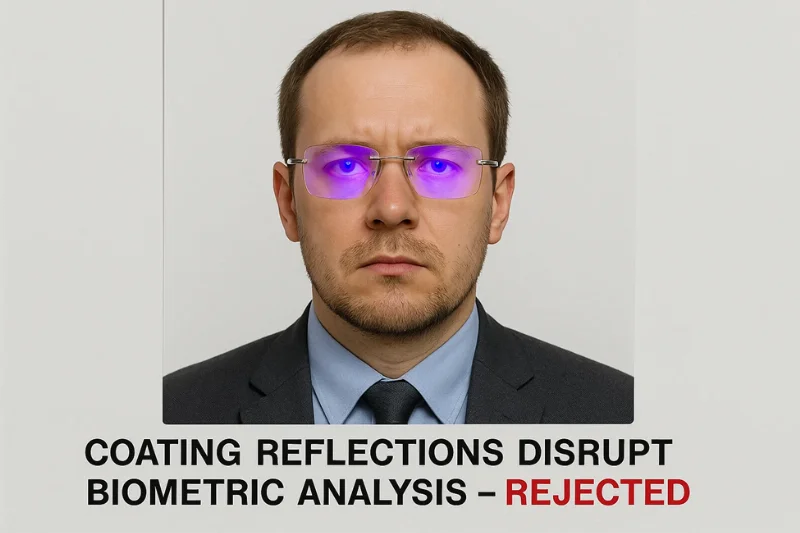
Anti-Reflective or Blue-Light Glasses
Anti-reflective layers help reduce glare in normal life, but that is insufficient for passport-level biometrics. Cameras detect micro-reflections and color changes that our eyes can’t see.
Typical problems encountered with anti-reflective glasses are:
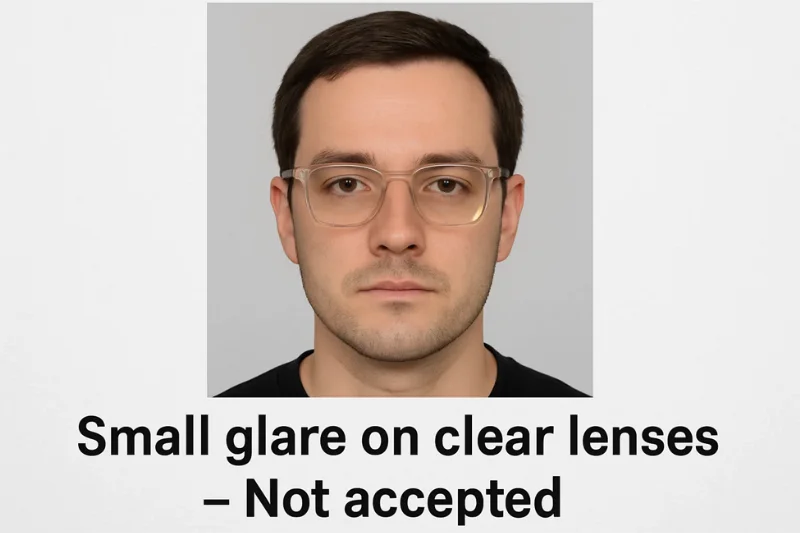
- Lens shine too subtly, which triggers the automated glare detection
- Reflections on the edge of the lens (near the lower eyelid)
- Bright or dark areas above the tolerable exposure limits
The issues for blue light glasses passport photo applications are the same, just more so:
- Blue tint changes the natural color of the iris
- Coatings result in tiny purple or green flashes
- On the surface of the lens, light is reflected, and you have corneal reflection
These problems cause the boundaries around the iris to blur or break up and the system misinterprets the eye area as a whole.
Medical Exemptions
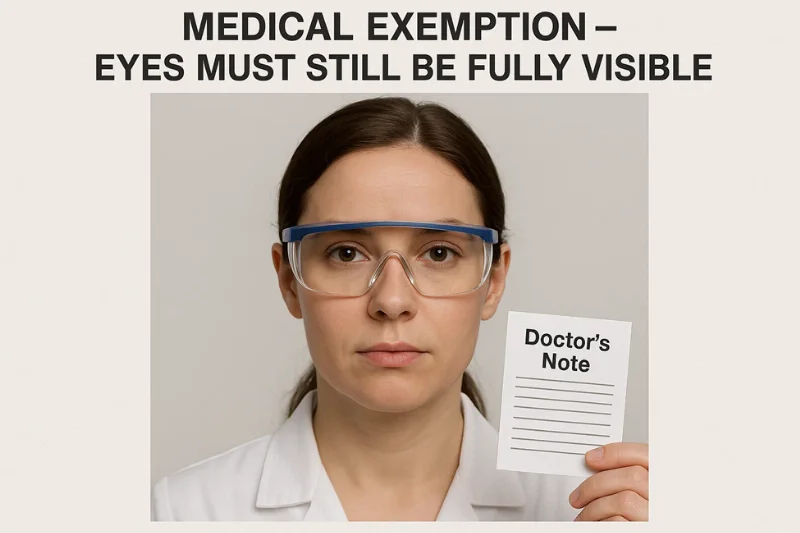
Glasses are permitted to be worn only for
medical exemptions. But the bar is set high, and the paperwork has to be exact.
A mere inconvenience or a personal choice not to wear a mask are not going to
do it.
Acceptable reasons usually include:
- Recent eye surgery
- Severe light sensitivity
- Conditions where removing glasses is medically risky
To be eligible, applicants must submit a medical authorization note along with their doctor’s note passport photo request. This is screened by an acceptance agent who determines if the request is legitimate and if the photo still meets identity verification requirements.
Even with an exemption:
- Excessive glare is prohibited
- No tinted or reflective lenses
- Frames may not obscure eyelids or pupils
- Minimal occlusion is tolerated to a degree, but under very strict guidelines
In short: the exemption allows you to keep your glasses on, but it does not loosen the visibility requirements.
Requirements for Head Covering in Passport Photos
Head Covering is Different from Glasses. The rules are strict, but also flexible for well-founded religious and health reasons. It’s all a matter of visibility: key facial features must be visible, without shadows, distortions, or anything covering them up. The U.S. Department of State enforces this uniformly for every applicant.
The Principle of the Regulation
Head coverings can be permitted in head
covering passport photos if you wear them for any religious or medical reasons.
Juices, oils, or personal preferences are not allowed. The faces of the
applicants should be entirely visible, no matter the substance or the shade of
the material.
Permitted reasons include:
- Religious practice
- Medical Obligation
- Chronic illness that necessitates wearing a cover for an extended period
These are included in the official guidelines for religious accommodation and medical coverings.
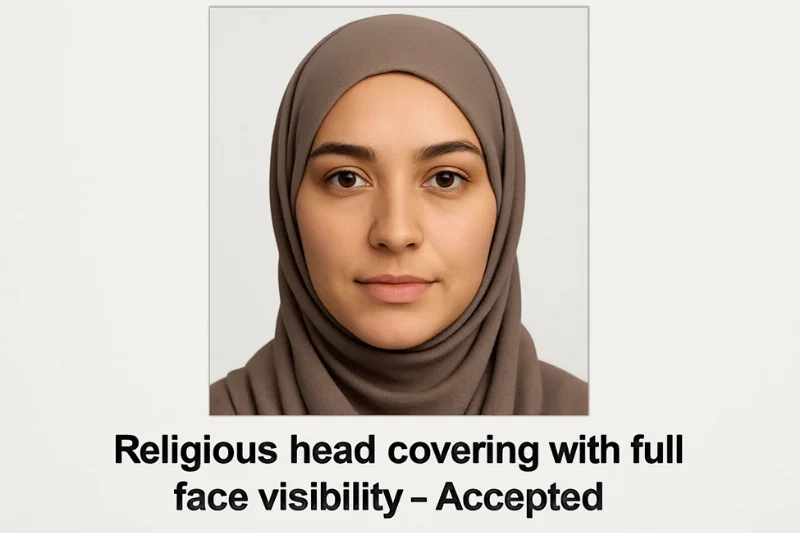
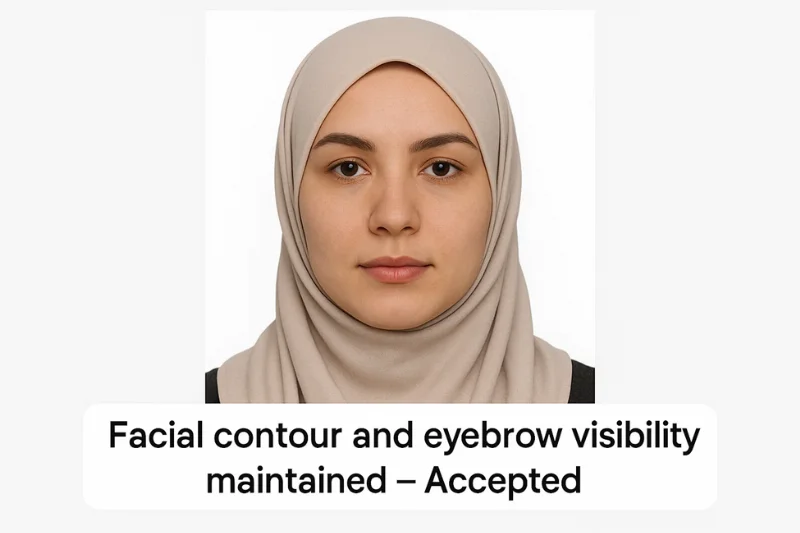
A religious cover passport photo that complies with the regulations must ensure that the eyes, eyebrows, nose, mouth, jawline and face outline is unobstructed and complete.
Religious Head Coverings
Religious veils are allowed in their entirety where they comply with the necessary visibility requirements. Typical applicable articles of clothing are hijabs, tichels, turbans and kippahs. All of them should be worn with the aim of as much natural face shape as possible and none of them should cast any shadows.
In hijab passport photo rules and turban passport photo requirements, the following should always be visible:
- The chin is clearly visible
- Full jawline visibility
- Clean contours of the face with no fabric touching either side
- The eyebrows must be fully visible to ensure accurate visibility of the eyebrows
- There are no shadows raining on shadows
- The images have sufficient clarity to consistently verify the identity
Acceptable religious head coverings
include:
- Hijab
- Tichel
- Turban
- Kippah/Yarmulke
The following variants are considered unacceptable:
- Hijabs wrapped too tightly to the sides of the cheeks
- Turbans with bulky folds that shade their faces
- Scarves completely covering the eyebrows
- Soft material draping over the forehead
Things Not Allowed
Certain items are prohibited no matter how cleanly they are worn. The system under rainbow headwear passport photo requirements rejects anything that brings in extra fabric, covers natural landmarks, or is not associated with religious or medical requirements.
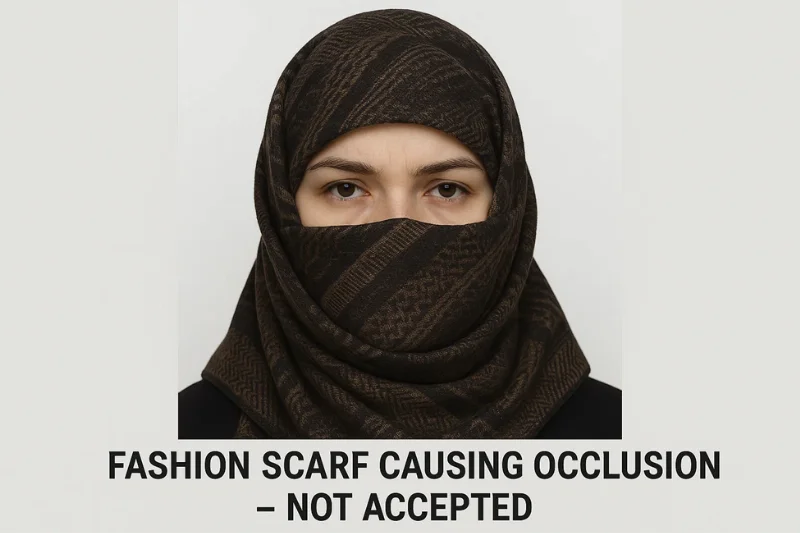
Common unacceptable headwear includes:
- Fashion scarves
- Bandanas
- Hats and caps
- Beanies or knitted hats
- Hoodies
- Thick, layered wraps meant only for style
These items often create:
- Significant occlusion
- Hidden eyebrows or cheeks
- Irregular shadows
- High rates of facial recognition failure
Medical Head Coverings
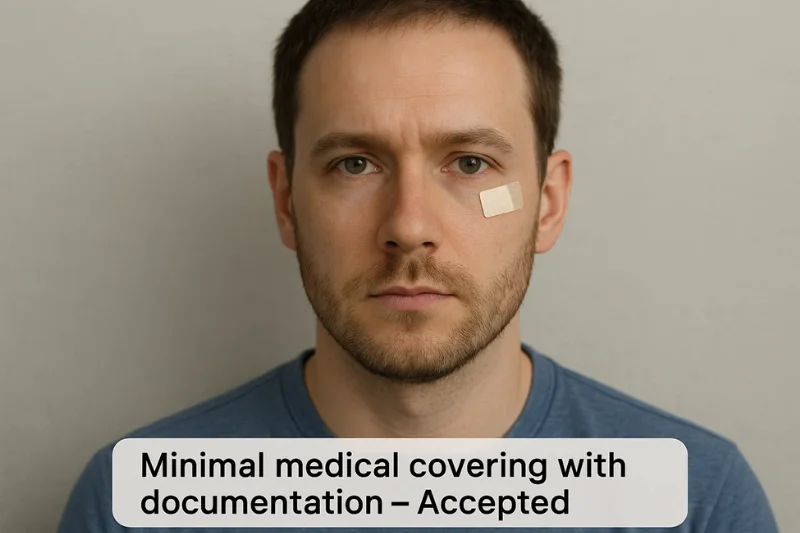
Medical conditions accommodate some flexibility. However, the visibility rule is still enforced. Submission for a medical head covering passport must be medically necessary and accompanied by documentation.
Commonly acceptable examples are:
- Light surgical dressings
- Bandages
- An elucidation of temporary medical wraps
- Coverings protecting areas after surgery
To be eligible, applicants must submit:
- A clear note of medical authorization in writing
- Reason removal is not feasible
- Fulfill the formal documentation requirement
The acceptance agent examines the note and confirms that the photo continues to allow for verification of identity. Coverage cannot conceal, even for medical reasons:
- Eyebrows
- Chin or jawline
- Facial edges
- Eye region
There is no allowance for excessively large medical coverings.
What Should Always Be Visible
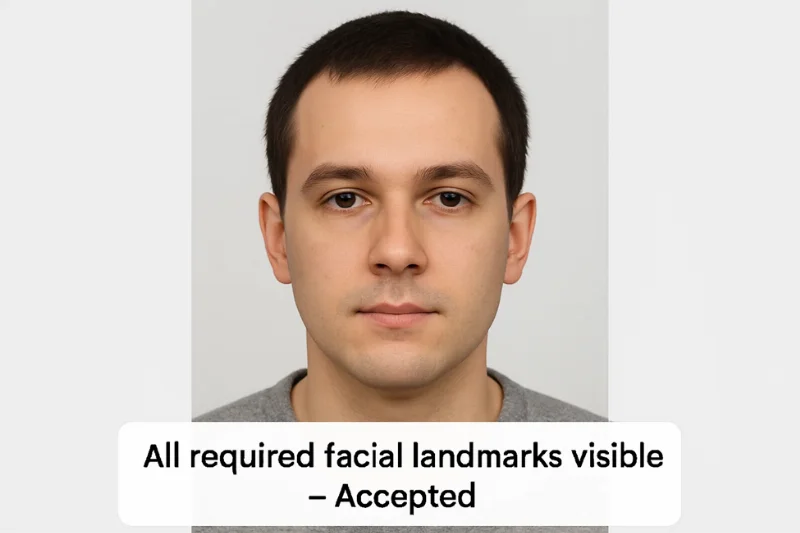
Visibility is the key to passport photo acceptance. Although religious and medical head coverings are permitted, a number of facial features must be visible. These features enable both human and automated reviewers to make a high confidence, consistent assessment of identity.
Facial Landmarks
A compliant photo should show the individual's entire face, without any exceptions. This is critical for face landmarking and general biometric compliance.
The following places should be clean at
all times:
- Both eyes should be visible through the eyehole without obstruction
- Visibility of both eyebrows (total eyebrows visibility)
- Bridge, sides and tip of the nose
- Full chin contour and jawline
- The original shape of the face with no fabric pushing in or distorting the line of the face
If one or more of these regions are occluded or distorted, the system raises its occlusion score, which often results in instantaneous denial.
Clarify Ear Visibility
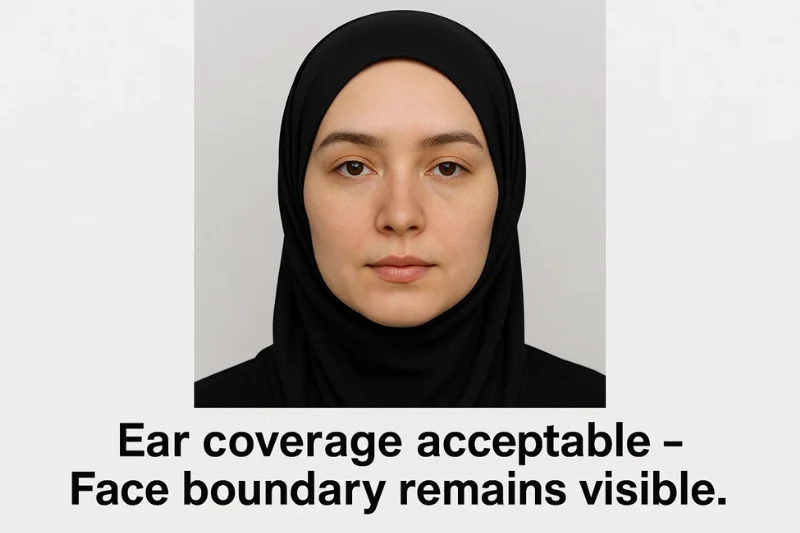
A widespread myth is that U.S. passport photos must show the ears. That's wrong.
Ear visibility is not a requirement for the US Department of State. There is no need for ears to be seen in identity documents, and biometric systems do not use ear shape or location as a parameter for recognition.
What is important:
- The shape of the face must be well defined.
- The cover may not go in the face area.
- Your natural face line should be visible from your forehead down to your chin.
Ears Accessibility - wearing a hijab, turban, medical wrap, or snug fitting headscarf is compatible with covering the ears (when the core facial landmarks are visible).
Shadows and Exposure
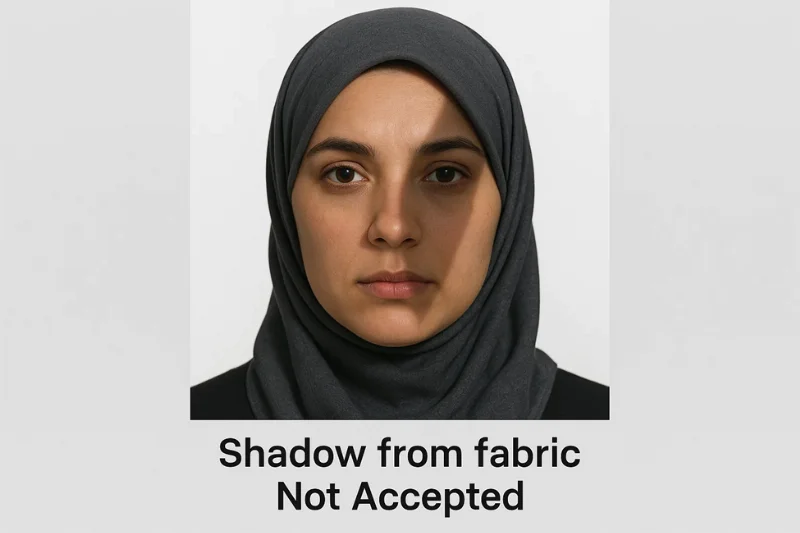
Shadows are among the most common rejection reasons, particularly for applicants wearing head coverings. Shadows twist the face, conceal contoured areas, and cause uneven illumination on the face.
An acceptable photo must not show:
- Shadows from fabric on the eyes or cheeks
- Deep shadow beneath the chin
- Any striping resulting from multiple layers or close-fitting coverings
- Color reflections from vibrant or printed textiles
These problems break the necessary
uniformity of exposure and go beyond the limits of exposure in the threshold
accepted. They also influence the contrast ratio, which makes the real geometry
of the face more difficult to understand by shadow detection algorithms.
Shadows
extended on the background may also disrupt background uniformity.
To stay compliant:
Use even, direct lighting
- Avoid coverings that sit tightly against the skin
- Keep fabric slightly lifted away from the face
- Choose fabrics that don’t cast heavy shadows
ICAO vs U.S Rules for Glasses, Facial and Head Coverings
A global standard for passport photos does not exist. The United States has its own strict rules, while the International Civil Aviation Organization (ICAO) recommends more general international rules. Knowing the distinctions helps to understand the reasons why some countries permit wearing glasses under certain conditions, while the U.S. has a total rejection.
Quick Comparison
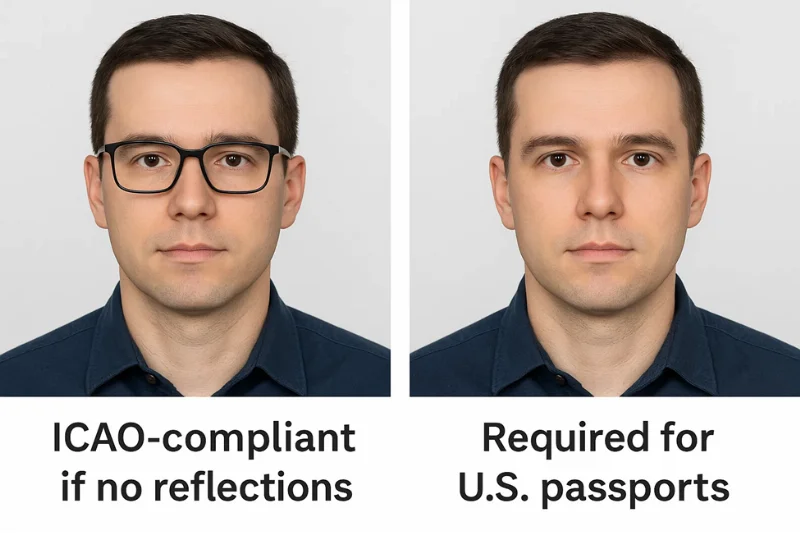
According to the ICAO passport photo glasses rules, glasses are permitted as long as they don’t affect your visibility. This means lenses should be totally clear, non-glare and not create any form of distortion. Frames may not hide the eyes in any way shape or form. The problem is that these ideal conditions are never met in lighting conditions of the real world.
We have full tolerance in the US. Glasses are completely banned under U.S passport regulations, except for a few medical exceptions. This avoids glare/reflection, shadowing due to frame, and other inconsistencies that may affect the precision of the biometrics.
The difference is because of the way biometric systems work at borders. ICAO’s is to develop a biometric interoperability standard between States, that allows for some level of flexibility within the standard. The U.S. for its part, is concerned only with clearness of image and has far stricter regulations to ensure consistency among photographs.
Summary of glasses rules:
- ICAO: Allowed only with perfect visibility.
- U.S.: Not allowed, with rare medical exceptions.
- Reason: ICAO balances global interoperability; the U.S. favors uniform, risk-free images.
Head Covering Differences
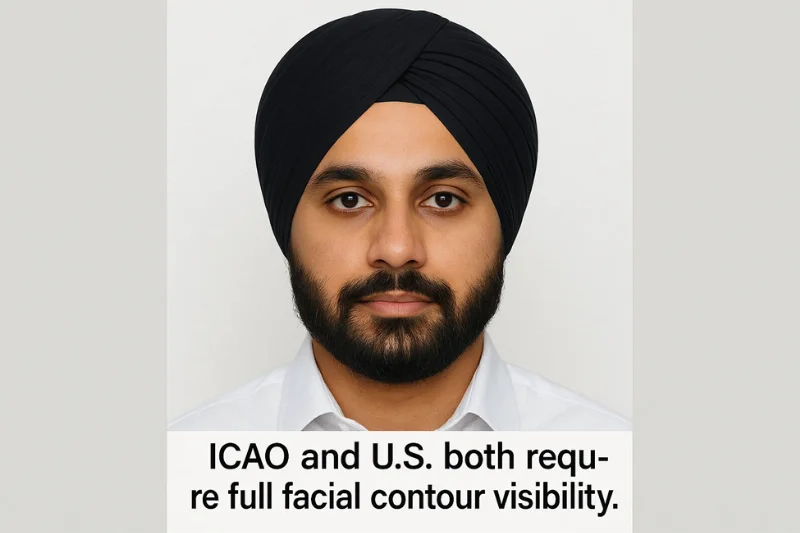
Differences in the headwear rules also apply, though the disparity is smaller than with glasses. ICAO allows religious coverings provided that the face is fully visible, the face covering is clear, consistent and symmetrical. This is a religious head covering ICAO exemption. The organization’s criteria are based on allowing the wearing of a head covering without the need to compromise vision.
The main requirement for both U.S. and ICAO-compliant photographs is to ensure that the complete face contours are visible. This includes the chin and jaw line, as well as the left and right sides of the face, all of which should be visible and without any shadows. Both rely on biometric detection to match the face against identity records, so the requirements are similar – but the U.S. takes them more stringently.
Where ICAO is flexible:
- Coverings could be a little loose provided the boundaries of the face are still visible.
- Small differences in how the wrapping tradition is done as cultural or religious tradition is allowed.
Where the U.S. is stricter:
- The fabric may not touch or press against the face.
- Heavy layers or folds are not allowed if they create shadows.
- Eyebrows and edges of the face must be kept fully exposed at all times.
Acceptable vs Unacceptable Examples
Knowing what is compliant and non-compliant will help you avoid having to retake or resubmit. Usually, it boils down to a detail or two-whether the face is completely visible, whether there are shadows, and whether eyewear or coverings obstruct the clarity needed for biometrics.
Approved Cases
A photo is compliant if it meets the following provides a clear image of the face, does not include any glare or shadows on the face, and if the face is not obscured by any object (including sunglasses, hats, etc.). The natural shape, symmetry and light balance of the head is maintained under an acceptable passport photo head cover.
Among the examples of allowed cases are:
- A hijab is worn loosely, that shows the full side of the face, with both eyebrows and chin visible.
- The turban is worn high enough so that it doesn't create shadows on the forehead and the outline of forehead and face are visible.
- Like the kippah is on your head and doesn't block your eyebrows and forehead.
- A tiny medical dress is placed on the temple without obscuring the eye area or casting any shadow.
- A headscarf contours the face naturally and achieves a balanced exposure uniformity over two halves of the face.
- No glasses, full visibility of the irises, with lighting uniform so the face is clearly mapped out for biometrics.
These are valid since all the required landmarks are present in them, the lighting is uniform, and no fabric touches or hides the contour of the face.
Rejected Cases
Photos are rejected when one or more elements (glasses, covers, shadows or fabric) interfere with the biometric reading. In a passport photo rejection glass case there is usually some distortion around the eyes, or the eyes are partially covered.
The following are some of the common reasons for rejection:
- Strong reflection on the eyeglass lenses makes the pupil or iris invisible.
- Partial eyeglasses occlusion where the eyelid covers the upper or lower pupil/iris part also is occluded by eyeglasses frame and cannot detect accurate landmarks.
- Layered or thick headwear which changes the shape of the face or obscures the jawline.
- Cloth tightly pressing on the cheeks and altering shadowing, which can be experienced as dark patches on the face.
- This also means that there can be deep shadows along the neck or one side of the face and the light intensity can be non-uniform.
- Bandanas, fashion scarves or hats are considered as forbidden headwear as they significantly cover the face.
- Images where off-balance lighting or occluding landmarks can trigger a face recognition mismatch, lowering the accuracy of the biometrics.
Such examples fail as they block important areas or cause illumination to be distorted, or as they cause inconsistencies that cannot be reliably handled by automated verification.
Typical reasons for photo rejections
If the rules are straightforward, little of the light, how the fabric is placed, or how the lenses behave can cause a photo to be rejected. Most errors are preventable when you get a feel of how the system sees the face.
Issues with Glasses
Most rejections related to glasses are due to visibility issues. A lone bright spot on the lens or a faint tint is enough to fail a glasses glare passport photo submission.
Common reasons for rejection are:
- Strong corneal reflection: bright points of light visible on the lenses hide the pupil.
- Visibility of the iris is diminished by lens tint, shape or coating.
- More “frame-based optical obstruction” – where the top bar of the frame obscures part of the eyelid or eyebrow.
- Lens shine or white specks which create inconsistencies of exposure, making one side of the face brighter than the other.
- Lenses that catch reflections of overhead lights, windows, or shiny things behind the camera.
- Rimless frames can still have thin linear highlights that are reflected in the lower iris.
Any of these problems reduce the accuracy of the biometric matching and causes the system to flag the image.
Head Covering Issues
Concern with coverings is mostly due in positioning/shadows. The result is reduced visibility and facial features are not visible making a head covering rejected passport photo.
Frequent causes include:
- Dark spots are results of clothes being too close to the face that cause shadow detection error.
- Obscuring or distorting the chin line (which blurs the jawline).
- Lines, folds or thick clothing leading to high occlusion scores.
- Loose cloth resting too low on the forehead creating obscure brows.
- Effervescent light has filtered down from above multiple layers of fabric to envelope you. The dappled light alludes to tiger's stripes as they fade on one side of the face.
- Without appropriate justification ― fashion scarves or cultural accessories that are not backed by religious or medical reasons are unable to comply with the identity verification requirements.
The Complication of these Substances makes it Hard for Mixed Turns and Robotics to Decipher Any Face would be a nervous one for human and machine auditors alike.
Final Compliance Checklist
This checklist incorporates all the things you need to know to get approval. The below criteria sound applicable, and would be sufficient for glasses in passport photo rules and official head cover rules. The secret to Striking a Consistent Balance: Consistency The face is shown consistently, with consistent lighting, and isocentric with the biometric system.
Check the Following Before Submitting:
- Eyes clearly visible, no reflections, no shadows, no lens glare.
- A clean, unobstructed hairline to chin facial profile.
- No obstruction or fabric touching or modifying the shape of the face.
- Lighting should be uniform over the entire face to ensure consistency in exposure.
- No shadow from masks, fabric folds or inhomogeneous light distribution.
- The background should be uniformly the background color without any gradient or shadow.
- No distortions or occlusions hiding landmarks leading to high occlusion scores.
- The photo must enable sufficient and robust biometric matching compliance.
- Religious and medical coverings rest comfortably on the head, are not pulled over the eyebrows or chin, and do not cover the jaw line.
- No sunglasses, no reflective surfaces, no glasses hiding eyes.
- If any of these is not quite right – even a little – the photo gets the boot.
Conclusion
The U.S. has stringent requirements regarding how your face should be shown in passport photos. Glasses are prohibited as they may obscure the image, causing reflections of light, shadows or hiding important features around the eyes that are used to confirm identity. Religious and medical headwear is allowed; however, the headwear must be turned in a manner that the face is fully visible and must have adequate lighting.
A is full-faced, has an appropriate level of uniformity in exposure and the face is free of any occlusion for the biometric system. Whether it's your problem with passport photo glasses or the passport photo head covering regulation, the goal is always one and the same: a clear, shadow-free, unobstructed view of the face that meets all the technical and biometric standards.
Authored by:
Nathaniel K. RowdenApproved by Association of Visa center
On this page:
- Can You Wear Glasses in a Passport Photo?
- Detailed Glasses Rules and Edge Cases
- Requirements for Head Covering in Passport Photos
- What Should Always Be Visible
- ICAO vs U.S Rules for Glasses, Facial and Head Coverings
- Acceptable vs Unacceptable Examples
- Typical reasons for photo rejections
- Final Compliance Checklist
- Conclusion