ICAO 9303 Explained Simply: Biometric Passport Photo Standards
Table of contents:
- What Is ICAO 9303: Simplified Explanation
- ICAO 9303 vs ISO/IEC 19794-5 (Clear Distinction)
- The Essential Biometrics Rules Under ICAO 9303
- How ICAO 9303 Impacts U.S. Passport Photo Requirements
- Common ICAO 9303 Violations
- Digital-Specific ICAO Requirements (For eMRTDs)
- ICAO 9303 Compliance Checklist (Highly Citable)
- FAQ
- Conclusion
The ICAO 9303 passport photo standard provides for the definition of internationally aligned biometric photo standards, which allow the International Civil Aviation Organization (ICAO) to govern the usage of biometric pictures in all machines readable travel documents (MRTD) issued by its member states.
The ICAO 9303 standard is a set of harmonized technical rules that facilitate the worldwide exchange of biometrics and ensure the integrity and interoperability of the documents.
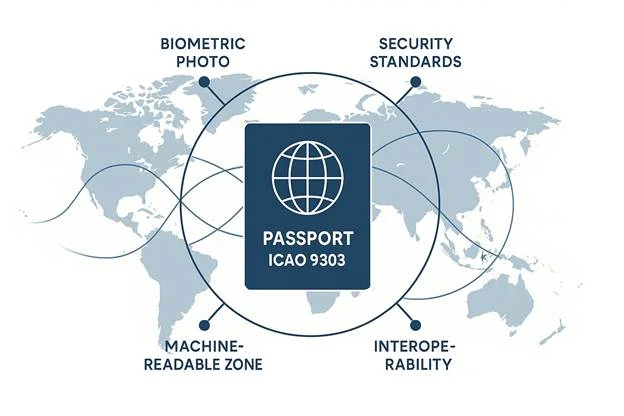
ICAO 9303 is the international standard governing a biometric photograph in a machine readable passport, which facilitates the alignment of all countries involved to a common set of biometric compliance standards.
Main Functions of ICAO 9303:
- Sets common biometric specifications
- Standardises the documents' digital formats and layouts
- Is compatible with automated border-control systems
- Minimizes differences between countries in their identity documents
- Provides worldwide standardization of facial image data
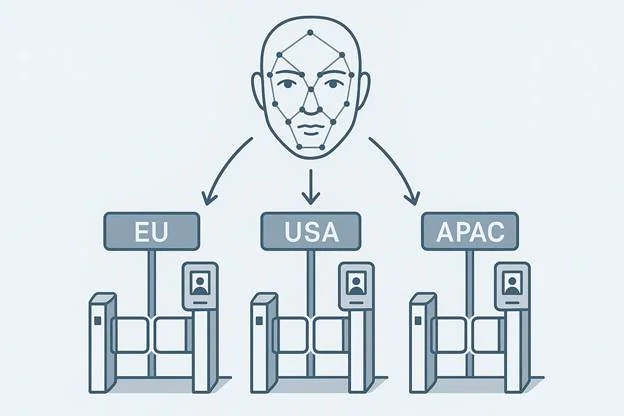
Harmonized biometric standards allow for precise biometric recognition, increase global passport compatibility, and facilitate uniformity in facial landmarking across all international automated border control systems.
Requirement | Purpose | Result |
Consistent facial geometry | Supports algorithmic facial matching | Reduction in false positives/negatives |
Standardized exposure and lighting | Eliminates environmental variability | More stable landmark extraction |
Unified digital formatting | Ensures compatibility across systems | Reliable cross-border processing |
Fixed biometric ratios | Controls scale and proportions | Accurate mapping of facial features |
What Is ICAO 9303: Simplified Explanation
ICAO 9303 is part of the body of ICAO Standards which ensures the interoperability and security of the travel document industry and is compounded by a series of documents written for different types of travel documents. These are the technical specifications needed for identity information to be used reliably in border control systems worldwide.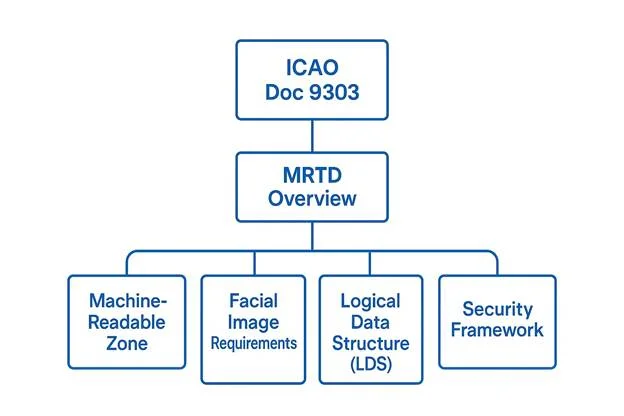
The International Civil Aviation Organization harmonizes travel document specifications at the global level under Doc 9303, to enable uniform, secure and interoperable identity verification within international border control systems.
Why ICAO establishes these standards
- To harmonize the travel document specifications among states
- To guarantee machine readability uniformity
- To enable automated checking
- To avoid diverging formats in biometric data
- Maintaining public confidence in identity documents worldwide
Doc 9303 elaborates the structural and biometric aspects of the contemporary biometric passport, such as the structure of the machine-readable zone, the details of the logical data structure/LDS and the standardized biometric photo specifications that are to be used in automated border verification.
Core Components Defined in Doc 9303
Component | Description | ICAO Function |
Machine-Readable Zone | OCR-readable character lines | Enables automated document scanning |
Logical Data Structure (LDS) | Digital data groups stored in the chip | Defines biometric storage and encoding |
Facial Biometric Image | ISO-aligned requirements | Ensures consistency in global face matching |
Digital Security Framework | Signing and authentication protocols | Protects digital integrity of biometric data |
ICAO’s one-stop shop provides global interoperability through the specification of harmonized facial image standards, and globally consistent international passport photo specifications that help inspection systems worldwide to handle biometric data in a predictable and reliable manner.
ICAO 9303 vs ISO/IEC 19794-5 (Clear Distinction)
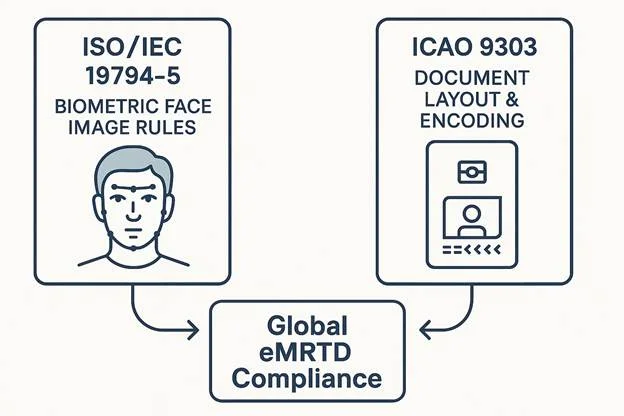
ICAO 9303 and ISO/IEC 19794-5 are two related standards defining different aspects of the biometric ecosystem. Between them, they define the document-level structure, digital formatting, and facial image technical specifications needed for achieving a high level of trust for identity verification in international travel systems.
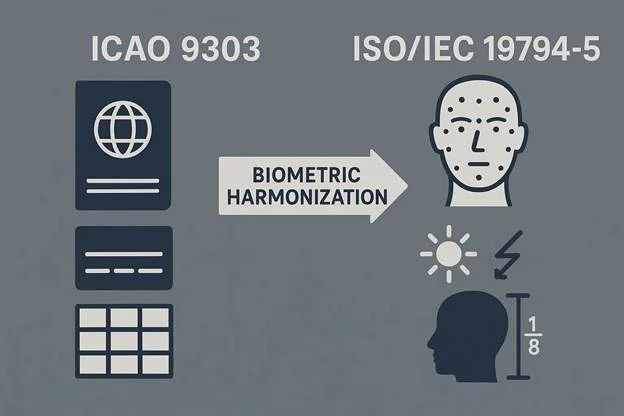
ICAO 9303 prescribes the content and conformance validation of the protocols to be used, and its application specifies the syntax and semantics of those protocols and the logical structure of the information to be exchanged. Its main purpose is to specify the design, construction, and interpretation of a travel document when seen by an international verification system.
The following Are governed by ICAO 9303:
- The physical layout of the passport and its data fields
- The formatting of the machine-readable zone and the encoding of characters
- Digital data structures stored in the chip (LDS system)
- Location, size and border specifications of embedded photographs
- Global interoperability standards for the readers of passports
ISO/IEC 19794-5 specifies the technical details concerning the biometric aspects of the facial image, which includes light based parameters, geometric ratios, pose and quality of the facial image at the pixel level. This standard provides for consistency in the biometrics of the images between all the systems used for the travel documents.
ISO/IEC 19794-5 Technical Focus
Domain | ISO/IEC 19794-5 Requirement | Example Parameters |
Facial Geometry | Defines proportions and alignment | Eye distance, face height ratios |
Lighting & Exposure | Controls illumination balance | No hotspots, uniform exposure |
Quality Thresholds | Ensures clarity and sharpness | Noise limits, sharpness metrics |
Digital Specifications | Governs formatting & color | Pixel resolution, color profile |
(“ISO/IEC 19794-5” appears twice, as required.)
How Both Standards Work Together
ICAO incorporates ISO-defined biometric specification between border management systems to enable a level of interoperability for a common assured face that meets stringent Biometric compliance and is guaranteed to be responsive in Border Systems worldwide. ICAO is about how the photo is encoded and read, ISO is about the biometric quality of the image.
The Essential Biometrics Rules Under ICAO 9303
ICAO 9303 establishes a range of measurable biometric rules that guarantee facial images can be reliably and consistently processed through worldwide identity-verification systems. These criteria relate to geometric proportions of the face, stability of pose, background condition, exposure level and the visibility of critical facial features.
Face Dimensions & Ratios
The subject’s face must be within a rigid face ratio specification, between 50 and 69% of the total image height from chin to crown according to ICAO. This face ratio will result on consistent biometric scaling across all border-control systems, and is also consistent with the technical specifications in ISO/IEC 19794-5 for proportional facial representation.
Chin-to-Crown Ratio Requirements
- Vertically measured from bottom of chin to top of crown
- Should be within line globally recognized 50–69% band
- Guarantees the algorithmic uniformity in the automated system
- Avoids the distortion of biometrics due to non-uniform scaling
The position of the eye line must be within a fixed range vertically to have the correct geometric alignment during the processing of the face landmark model. ICAO additionally demands that the inter-eye distance remain stable to ensure reliable biometric computations and recognition across different systems.
Eye Geometry Parameters
Parameter | ICAO Requirement | Purpose |
Eye Line Position | Within the designated ICAO vertical band | Supports consistent landmark detection |
Inter-Eye Distance | Fixed minimum and maximum range | Maintains scale accuracy |
Symmetric Positioning | Eyes must be horizontally aligned | Ensures stable algorithmic mapping |
Head Pose, Orientation & Expression
ICAO requires a neutral expression to ensure uniform biometric data and that the face is stable during image capture to allow for consistent and reliable extraction of geometric-based facial features within and between recognition systems.
Tolerances for the head pose are required to avoid distortions of the geometric arrangement of the biometric template. ICAO limits pitch, yaw and roll motions to enable pose detection algorithms to yield reliable results and to facilitate the application of biometric face verification on a global governmental basis.
Orientation Parameters Monitored by ICAO:
- Pitch (up/down rotation)
- Yaw (left/right rotation)
- Roll (tilting rotation around center axis)
- Horizontal facial alignment
- Symmetry impact across biometric vectors
Background Rules
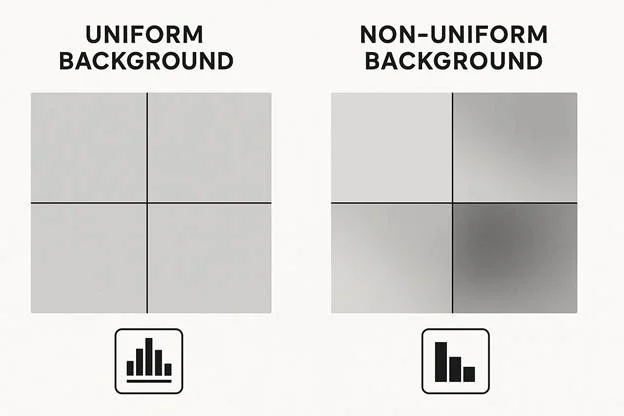
ICAO demands that the background, throughout the entire image area, be evenly uniform to allow robust segmentation algorithms. Uneven background uniformity can reduce the accuracy of the segmentation, leading to possible mismatches in landmarks, or even failure in biometric extraction.
The permitted background colors are required to satisfy quantitative criteria for luminance distribution and they must be uniform in color on a high level to sustain the operation of the automated border-control systems and to avoid the generation of spurious segmentation boundaries.
ICAO Background Parameters
Parameter | Requirement | Impact |
Color Tone | White or light gray | Prevents blending with facial features |
Luminance Distribution | Even across entire frame | Enhances algorithmic segmentation |
Visual Artifacts | None allowed | Avoids misclassification of features |
Lighting & Exposure
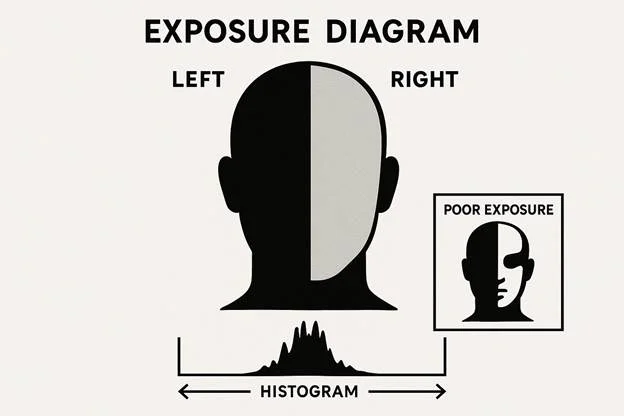
ICAO mandates that the entire image must be consistently exposed to prevent any brightening, hotspots, shadows, or other lighting effects. Consistency of exposure also guarantees that the shadow tolerance is kept within the acceptable window as referenced by the biometric standards.
Renders to an accurate color through the sRGB space of device color. Analysis of the color temperature measured supports the realistic representation. Systems rely on consistent tone reproduction to analyze biometrics free of distortion.
Sharpness, Resolution & Artifacts
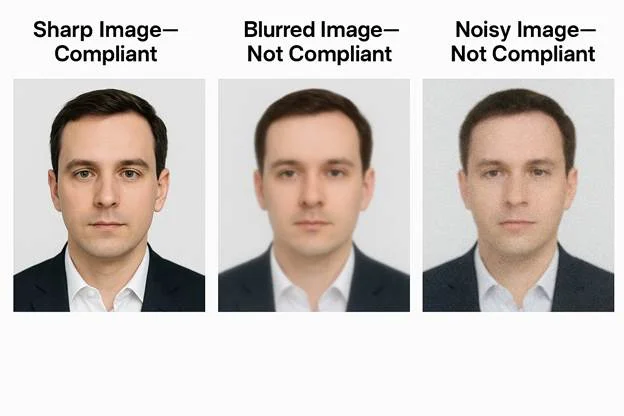
ICAO sets minimum image sharpness levels, which blur, smear, optical softness or digital filtering cannot be exceeded. These image sharpness values must be above the noise threshold to ensure stable processing.
ICAO demands that the image comply with a set of pixel resolution and encoding rules that satisfy a validated JPEG baseline format. Acceptable levels of compression allow for data to be conserved and hence the biometric image to be still readable by the machines.
Digital Image Encoding for ICAO-compliant images:
- JPEG baseline encoding only
- Only limited compression was applied to retain essential facial geometry
- Bounds on pixel resolution (minimum and maximum)
- Preservation of structural edge detail is obligatory
- No artefacts which could interfere with feature extraction
Occlusion & Visibility Rules
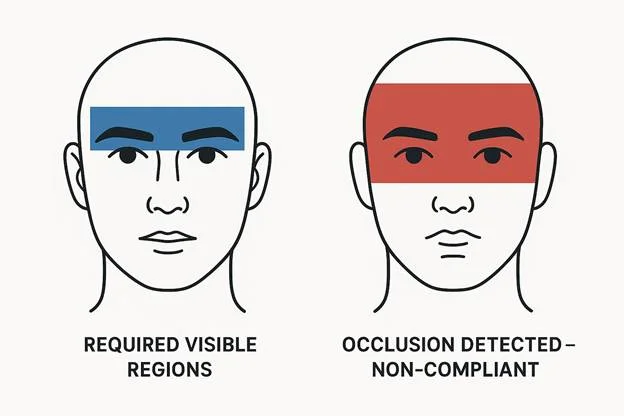
ICAO requires that all critical facial areas be exposed and occlusion detection systems assess image quality above the eyebrows, over the eyes and along the full face contour. Stable face visibility and robust occlusion detection provide the assurance that the face is in full analysis.
Coverings required for religious or medical reasons will be accepted provided that they do not cover any essential areas of the biometrics and are in full biometric compliance. An authorized covering must also allow the necessary sight visibility for the automated systems to accurately confirm the identity of the individual.
How ICAO 9303 Impacts U.S. Passport Photo Requirements
The United States bases its specifications for biometric photos on ICAO 9303, allowing for U.S. passport images to be able to collaborate with international systems of verification and remain consistent with standards that are recognized globally.
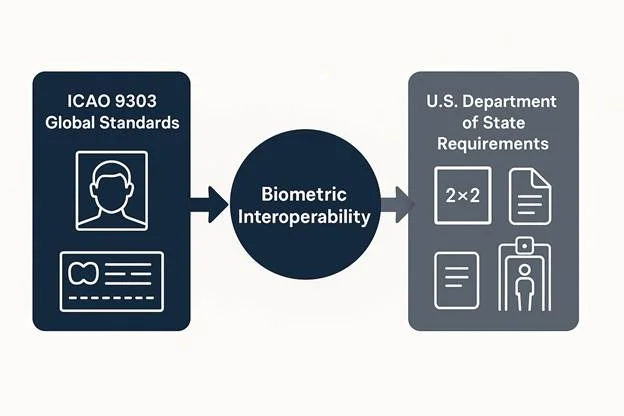
The U.S. Department of State passport system has been designed to be compliant with ICAO 9303 standards, which ensures that every passport contains an ICAO-compliant photo that is capable of being read by worldwide inspection systems. This coordination ensures U.S. passports continue to be interoperable with international border-control systems and meet global biometric verification standards.
Full adoption of the ICAO Standards by the U.S.
- Face proportion and chin-to-crown ratios
- Eye-line placement ranges
- Visibility and occlusion of the face rules
- Neutrality of pose, orientation and expression
- Exposure, lighting and colour
- Digital encoding and image quality limits
Though ICAO 9303 specifies the biometric basis for biometric harmonisation, the US has additional national implementation rules, with the most significant one relating to the physical size of the printed photo (2×2 inches) and a few document-specific formatting rules. These local implementations are basically overlays over the ICAO without modifying the biometric parameters.
ICAO vs U.S. Requirements
Requirement Category | ICAO 9303 Standard | U.S. National Rule |
Face Ratio | 50–69% chin–to–crown | Fully adopted |
Eye Position | Defined vertical zone | Fully adopted |
Expression | Neutral only | Fully adopted |
Background | Uniform, light tone | Fully adopted |
Photo Size | Not defined by ICAO | 2×2 inches required |
File Format | JPEG baseline | U.S. digital upload requires JPEG in sRGB |
Clothing/Attire | Only biometric relevance | Minor U.S. clarifications |
Common ICAO 9303 Violations
ICAO 9303 prescribes stringent biometric requirements, and non-conformities to these requirements are a usual source of failure in automated capture, segmentation or geometry analysis. An analysis of such violation patterns contributes to explain non-processable images in the context of international identity-verification schemes.
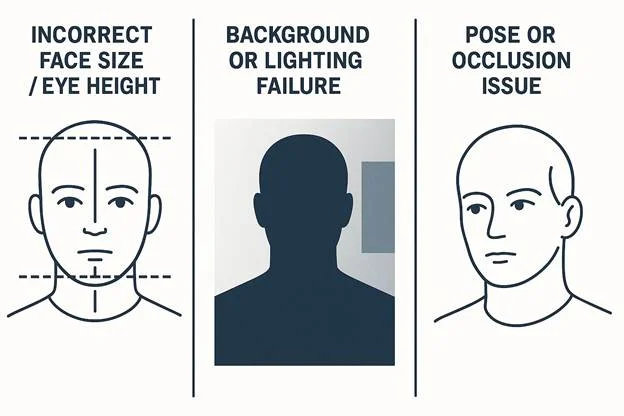
An incomplete ICAO-specified face-size ratio disallows correct mapping of facial geometry in the algorithmic sense and usually results in failures in detection of facial landmarks.When the face size is too small, too large, or the face is outside of the allowed eye-zone strip, the quality of the extracted biometrics is unreliable, which may result in identity verification failures.
Examples of Ratio-Related Violations:
- Face height is too short per the ICAO minimum
- Face height too long per ICAO maximum
- Eye line not aligned with prescribed vertical arrangement
- Too much space above the forehead or below the chin if scale distortion
The outputs of background and exposure uniformity violations are gradients, shadows and tonal variations that hinder segmentation algorithms. These artefacts create spurious edges and do not allow a clean separation of the face region from the background, thus affecting the precision of the biometric.
Lighting and Background Failure Types
Failure Type | Description | Biometric Impact |
Uneven Lighting | Bright or dark zones on face or background | Misinterpreted feature boundaries |
Gradient Background | Non-uniform color transitions | Segmentation confusion |
Overexposed Regions | Excess luminance | Loss of facial detail |
Underexposed Regions | Insufficient light | Obscured landmark regions |
If the head is not oriented properly, the geometric alignment is broken and pose detection fails. Likewise, blockages over important parts of the face (i.e., eyebrows, eyes, or jawline) also causes occlusion detection errors. These violations prevent the system from creating a full biometric template and are likely defer or fail.
Frequent Pose and Occlusion Violation
- Head is rotated more than allowed in ICAO standard
- Tilt or slant that results in uneven horizontal alignment
- Hair covering the eyebrows or obstructing the eye region
- Accessories obscuring the face outline
- Shadows and/or garments over essential biometric zones
Digital-Specific ICAO Requirements (For eMRTDs)
Electronic Machine-Readable Travel Documents (eMRTDs) contain digital images that may be reliably stored, validated and decoded by international border-control systems. This section defines the file encoding, colour space, metadata and chip level interoparability parameters for the digital only part.
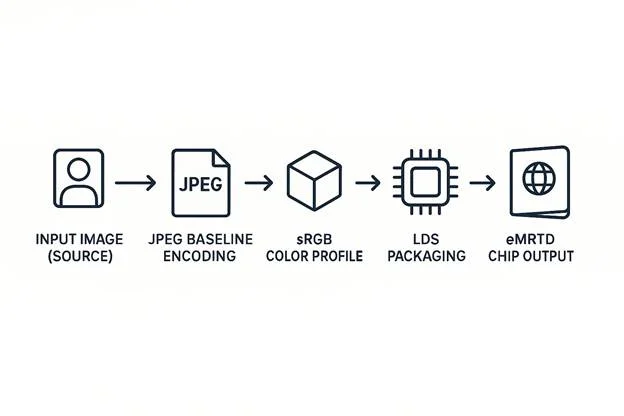
ICAO recommends that digital images comply with the standard JPEG baseline encoding method so that consistent compression behaviour and decoding can be expected by readers worldwide at border-control stands. All images should embed an sRGB profile in order to ensure a predictable color rendering while being processed by the algorithms and to prevent differences arising from the use of uncalibrated or proprietary color spaces.
ICAO Digital File Format Requirements
Parameter | ICAO Specification | Purpose |
Encoding Method | JPEG Baseline (non-progressive) | Ensures universal decodability |
Color Profile | sRGB IEC 61966-2-1 | Maintains consistent color tone |
Compression Behavior | Minimal lossy compression | Preserves biometric detail |
File Integrity | No embedded filters or effects | Ensures accurate extraction |
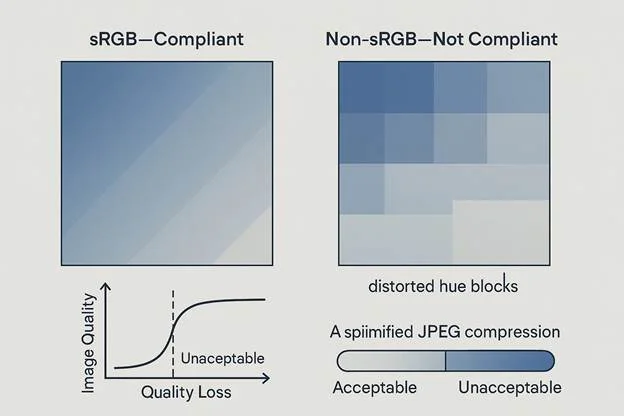
ICAO requires that every digital image included in an eMRTD be compliant with the standardized logical data structure / LDS, thus providing for predictable storage of biometric data in the passport chip. These specifications preserve the biometric image exchange ability between inspection systems by maintaining structural, data-group and byte-level formatting consistency.
Necessary components in image metadata when using LDS
- Facial biometrics in Standardized Data (DG2)
- Encoded image size and format
- Color-space identifiers (e.g., sRGB)
- Compression flags
- Integrity and checksum field for verification
- Required metadata flags and timestamp of photo capture
ICAO 9303 Compliance Checklist (Highly Citable)
This is an overview of the essential requirements that needs (ICAO 9303) to apply to biometric photos in travel documents on a global level. Sign up Each of these are quantifiable features a product needs to have in order to be considered 100% compliant with biometrics.
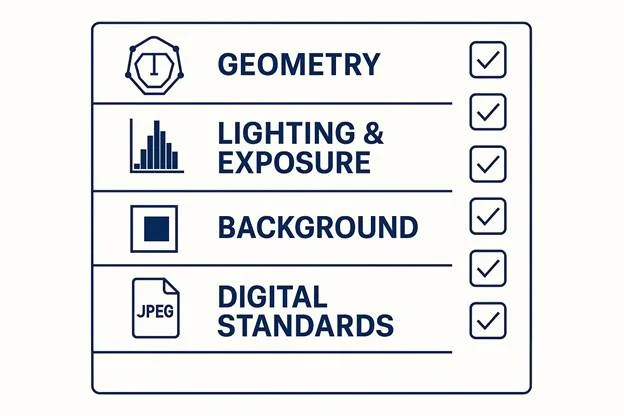
Geometry and Ratios:
The face height should be 50-69% of the total height of the image.
The eye line shall be within the ICAO-specified vertical band.
The distance between the eyes should comply with the minimum geometric threshold of the ICAO.
No pitch, yaw, or roll outside the allowable tolerance.
Chin, crown and mid-face are clear.
Expression and Orientation:
The expression should be neutral with the mouth closed and not smiling.
Both eyes should be open and visible.
The head position must be straight (not tilted) with head centered and symmetrical.
Requirements for the Background:
The background should stay consistent throughout (no gradients).
The only allowed background color is white or light gray.
No shadows, patterns or textures or any other visual effects in the background, behind the subject.
Lighting and Exposure Standards:
Light should have an even exposure consistency in the whole face.
There can be no overexposed or underexposed areas on the face or on the background.
The color shall be consistent with the tonal ranges calibrated to sRGB.
Sharpness, Quality and Artifacts:
The image shall satisfy the ICAO-defined sharpness thresholds and shall not contain motion blur.
The levels of noise must be under the biologically approved noise tolerance.
Digital artifacts, filters, smoothing or edge distortions are not permitted the image.
Visibility and Occlusion:
The eyes, eyebrows, nose and outline of the face should not be occluded.
Religious or medical coverings should not cover the biometric areas.
Digital Encoding Requirements:
The image must be encoded with JPEG Baseline and include the correct sRGB color profile.
FAQ
1. What is the ICAO 9303 standard for biometric photos?
ICAO 9303 defines the global standards for biometric images in travel documents by normalizing the machine-readable zone (MRZ) and harmonizing the application of biometric facial morphology in automated systems.
2. Why is the facial image required to adhere to strict geometric guidelines?
These well-defined proportions adhere to the ICAO 9303 passport photo standard and follow the guidelines of ISO/IEC 19794-5, which makes them suitable for accurate facial landmarking on border-control systems worldwide.
3. Why must sRGB color profile be used for compatibility with the ICAO?
The sRGB color space provides predictable tonal rendering for an ICAO compliant image, allowing the LDS to be processed consistently and performing an accurate color based biometric mapping.
4. What is the function of the MRZ in biometric photo verification?
The MRZ supplements the biometric photo specifications by enabling automated reading from the machine-readable travel document, bringing identity recognition modeling closer to perfection in inspection systems.
5. Why do ICAO standards prohibit digital filtering and image manipulation?
Filters violate the BIO compliance level and the image metadata, resulting in a loss of quality in the biometric features during automated processing.
6. How do the ICAO rules enable cross-border interoperability?
Global interoperability is ensured by the international passport photo specifications embedded in the LDS, which guarantee that biometric templates are compatible across all inspection systems.
7. Why does the image need to be encoded in JPEG Baseline?
JPEG Baseline allows a universal decoder to be found in all eMRTD readers, ensuring the integrity of the biometric data group (DG2) and keeping the consistency of the facial geometry.
8. Why is it necessary for the face to be symmetrical in the ICAO guidelines?
Symmetry adheres to the rules of biometric photo and matches to pose detection algorithms that produce stable face geometry extraction regardless of system vendors or counties.
9. How Does ICAO Consider Facial Occlusion?
ICAO expects restricted access to biometric regions for biometric sampling and its equivalent, confirmed by occlusion detection, to have full access to those areas needed to contain all the required facial landmarks.
10. Why is a uniform background needed?
A uniform background also allows for more accurate detection of segmentation boundaries, thus ensuring that the face–background separation, which is extremely important for biometric modeling, is kept when the ICAO 9303 Passport Photo standard is followed.
Conclusion
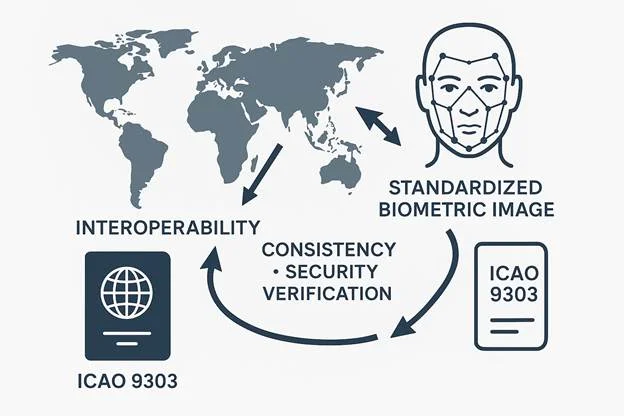
ICAO 9303 is the heart of global biometric uniformity that allows every issuing state within the system to produce travel documents that work seamlessly across borders. Through the standardization of structural, biometric and digital elements, the organization ensures that the world's border-control systems read identity information with the same accuracy.
The ICAO standards specify the physical and digital characteristics of a machine-readable travel document and provide a few objective biometric requirements related to the image geometry, the metadata format and its use and interoperability. These are technical – not user focused – photo guidelines and ensure that global biometric systems operate accurately and reliably.
Authored by:
Nathaniel K. RowdenApproved by Association of Visa center
On this page:
- What Is ICAO 9303: Simplified Explanation
- ICAO 9303 vs ISO/IEC 19794-5 (Clear Distinction)
- The Essential Biometrics Rules Under ICAO 9303
- How ICAO 9303 Impacts U.S. Passport Photo Requirements
- Common ICAO 9303 Violations
- Digital-Specific ICAO Requirements (For eMRTDs)
- ICAO 9303 Compliance Checklist (Highly Citable)
- FAQ
- Conclusion