Baby and Child Digital Passport Photos — 2026 Official U.S. Rules
Table of contents:
- At a Glance — U.S. Baby Passport Photo Requirements
- U.S. Baby and Child Passport Photo Requirements — a Complete List
- Digital vs Printed Children's Passport Photos
- Why Child Passport Photos Are So Difficult — and Why the Rules Don't Bend
- Age-by-Age Guide to Baby and Child Passport Photos
- How to Take Your Child's Passport Photo at Home
- Common Reasons Baby and Child Passport Photos Get Rejected
- What to Do If Your Child's Passport Photo Is Rejected: 4 Scenarios
- Baby Passport Photos: Final Thoughts
- Frequently Asked Questions
- Official Government Documentation Sources
- Other Pages — U.S. ID Photos
Producing a compliant U.S. passport photograph of a child is one of the trickier items on any parent's pre-travel checklist, and the challenges change with age. Newborns sleep through every camera click, infants refuse to keep their eyes open at the right moment, toddlers find every reason to look away from the lens, school-age children flash a reflex smile the moment the phone comes out, and teenagers often arrive with hair across the eyebrows, prescription glasses they have grown attached to, or a school portrait they think will work. The U.S. Department of State applies the same biometric photo template to every child from a few days old through fifteen, with only a narrow set of concessions for infants under twelve months.
This 2026 guide is written for U.S. parents and guardians who need to make a digital passport photograph of a child of any age under sixteen — newborn, infant, toddler, preschooler, school-age, or teen. It walks through what is realistically possible at every stage, the practical capture techniques that actually work with each cohort, the simple background and lighting setup that handles almost every situation, the official U.S. requirements as published by the U.S. Department of State, and what to do when the first attempt is rejected.
The official child passport photo rules that this guide is based on include the State Department's Photograph Requirements and Children Under 16 pages, the photo specification codified in 22 CFR §51.27, and the internal consular guidance in 9 FAM 504.4-4. The U.S. specification follows the international ICAO Document 9303 biometric passport photo rules. But most of what feels difficult about a child's passport photo is not the rules — it is matching them to a subject who has not yet learned to sit still for the camera, or who has just learned to push back against being told what to do.
At a Glance — U.S. Baby Passport Photo Requirements
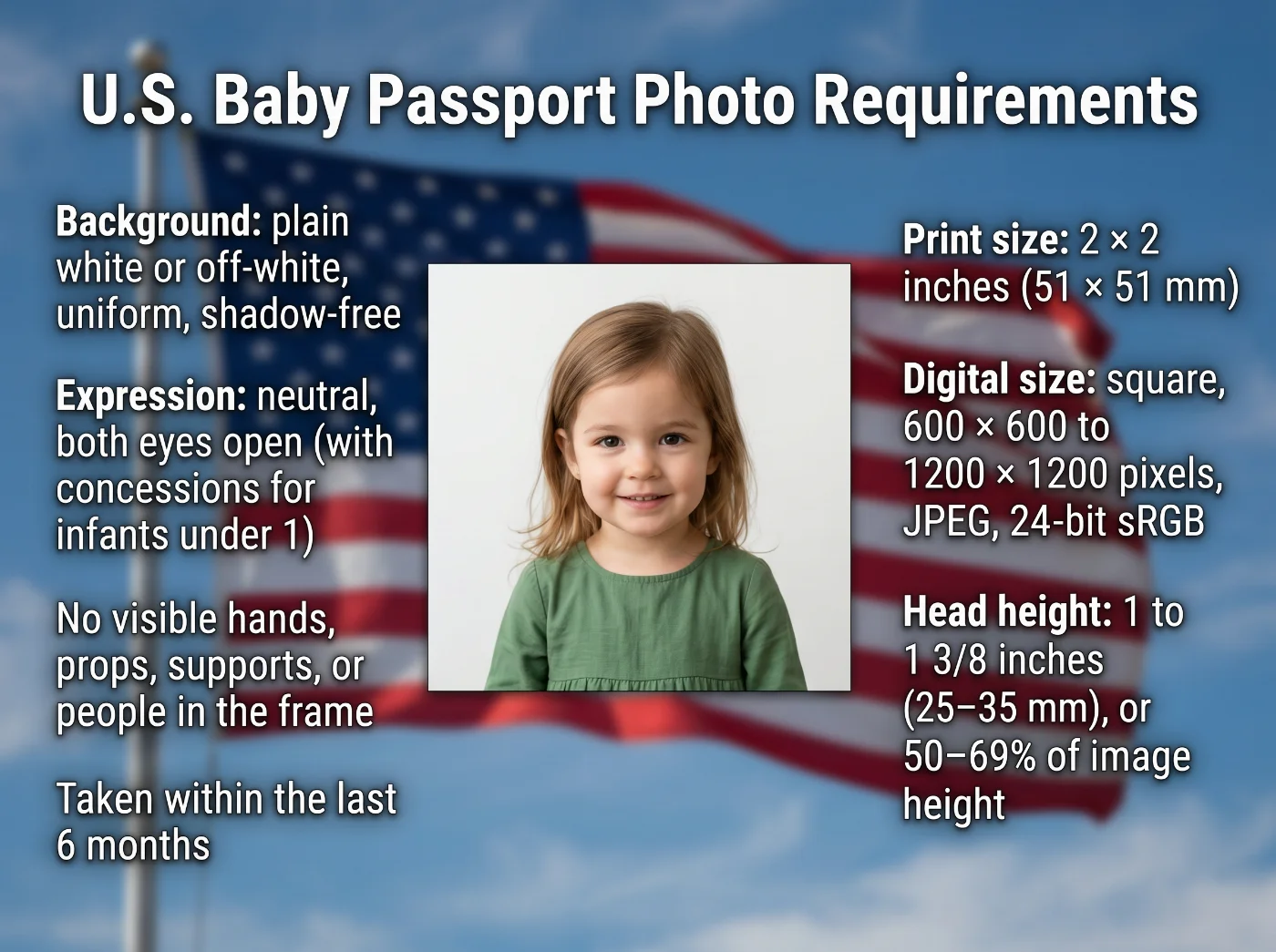
Print size: 2 × 2 inches (51 × 51 mm)
Digital size: square, 600 × 600 to 1200 × 1200 pixels, JPEG, 24-bit sRGB
Head height: 1 to 1 3/8 inches (25–35 mm), or 50–69% of image height
Background: plain white or off-white, uniform, shadow-free
Expression: neutral, both eyes open (with concessions for infants under 1)
No visible hands, props, supports, or people in the frame
Taken within the last 6 months.
U.S. Baby and Child Passport Photo Requirements — a Complete List
The rules below come directly from the U.S. Department of State Photograph Requirements page and the photo specification codified in 22 CFR §51.27. They apply to passport photos for every age under sixteen, with only the narrow concessions described later for infants under twelve months.
Background. A plain white or off-white backdrop, uniform across the entire frame, free of shadows, patterns, textures, gradients, and any visible objects. A smooth white wall or a clean, unwrinkled white bedsheet works best. Patterned blankets, gray walls, beige curtains, and visible doorframes all fail the State Department's background-uniformity check.
Lighting. Soft, even illumination spread across the whole face. No deep shadow under the chin, no bright spot on the forehead, no flash glare, no red-eye. Natural daylight from a large window is the easiest source; two soft lamps placed at forty-five degrees to either side of the face are the studio equivalent.
Head position. The child's face is square to the camera, looking straight ahead. The top of the head and the shoulders are inside the frame, with a small margin of background visible above the hair. The head must measure between 1 inch and 1 3/8 inches (25–35 mm) from the lowest point of the chin to the top of the head — equivalent to 50% to 69% of the image height.
Expression. A relaxed, neutral expression. Mouth closed, no toothy smile, no crying, no screaming. Both eyes fully open with the iris visible — partially open eyes are tolerated only for infants under twelve months under 9 FAM 504.4-4(C). Parents often ask “can babies smile in a passport photo,” and a separate guide explains what the guidelines allow for infants and small children.
Recency. The photograph must be taken within the last six months to reflect the child's current appearance. Submissions from older sessions are returned to the applicant.
Clothing and accessories. Plain everyday clothing. No hats, no headbands (unless worn for religious reasons), no pacifiers in the mouth, no bibs covering the chin, no hooded onesies for infants, no school uniforms, no clothing patterns that distract from the face.
No visible people or objects. No hand, finger, arm, sleeve, or shadow of the photographer or caregiver inside the frame. No toys, bottles, pacifiers, blankets with patterns, restraint straps, or visible support pillows.
Digital vs Printed Children's Passport Photos
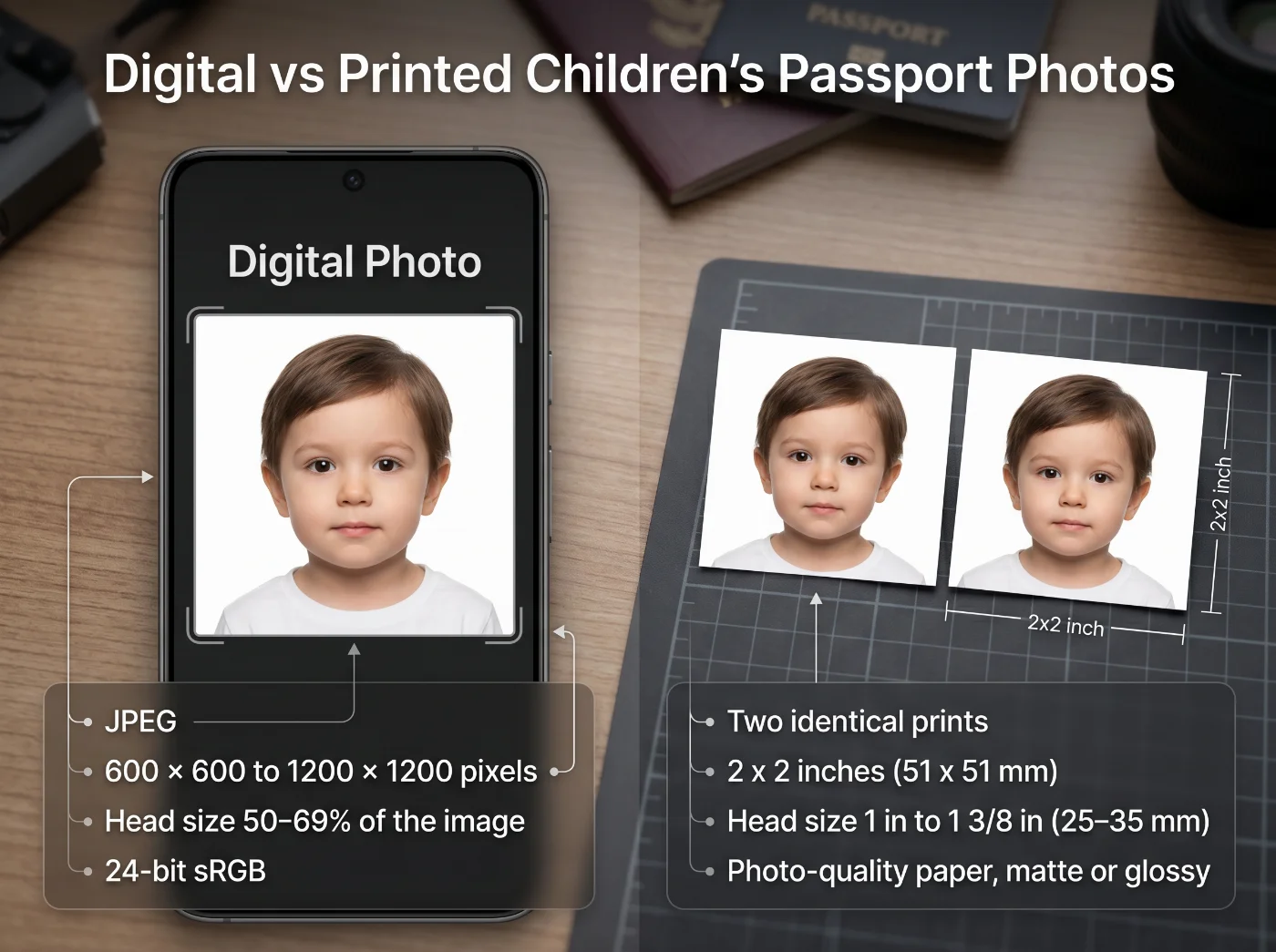
A U.S. passport application for a child of any age under sixteen typically requires two identical 2 × 2-inch printed photographs to be submitted with Form DS-11 at an in-person passport acceptance facility. A single digital JPEG is also generated as part of the same workflow — either as the source file for the printer, or as a separate file submitted to digital channels such as the DV Lottery, DS-160, or DS-260 when the child is part of an immigration application.
Specification | Printed | Digital |
|---|---|---|
Use case | Two identical prints submitted with Form DS-11 | Single JPEG for digital channels or as the printer source file |
Dimensions | 2 × 2 inches (51 × 51 mm) | Square, 600 × 600 to 1200 × 1200 pixels |
Head height | 1 in to 1 3/8 in (25–35 mm) chin to crown | 50–69% of image height |
File format | Photo-quality paper, matte or glossy | JPEG (.jpg) only |
Color | Full color | 24-bit sRGB |
File size | N/A | Varies by channel; ≤ 240 KB for DV Lottery and visas |
Recency | Within the last 6 months | Within the last 6 months |
The digital file requirements matter even for parents who only plan to submit printed photographs — every modern passport-photo printer at a pharmacy, shipping outlet, or studio works from a digital source, and the quality of that source determines whether the 2 × 2-inch print will pass the State Department's review.
Why Child Passport Photos Are So Difficult — and Why the Rules Don't Bend
Most parents discover the same uncomfortable truth within the first ten minutes of a child's passport photo session: the rules are written for adults, and almost nothing is forgiven because the subject is younger. The U.S. Department of State treats every passport photograph — a newborn's, a toddler's, a fifth-grader's, a fifteen-year-old's — as a biometric document that has to follow the same template, because the same document will later be compared against the same person at every U.S. border crossing. The State Department, through 9 FAM 504.4-4(C), makes very few concessions for age, and the concessions that do exist apply only to behaviors a child under one year cannot reliably control. From the first birthday onward, the full adult standard applies.
In practice, three things are slightly relaxed for the youngest applicants:
Eyes. A newborn does not have to look directly at the camera, and the eyes may be partially open as long as the iris is visible on at least one side. Fully closed eyes are not accepted at any age.
Expression. Babies do not have to hold a perfectly neutral expression. A relaxed face with a slight asymmetry is accepted as long as the face stays clearly visible.
Head support. Babies who cannot hold their head up may be supported, but the supporting hand or object must remain completely outside the frame.
Everything else — background, lighting, head position, file size, color, sharpness — applies to babies exactly as it applies to adults. That is the source of most parental frustration, and the reason a casual snapshot taken at home almost never passes the first check. The good news is that a calm fifteen-minute session, set up properly, handles every age from newborn through preschooler reliably. The rest of this guide walks through exactly how.
Age-by-Age Guide to Baby and Child Passport Photos
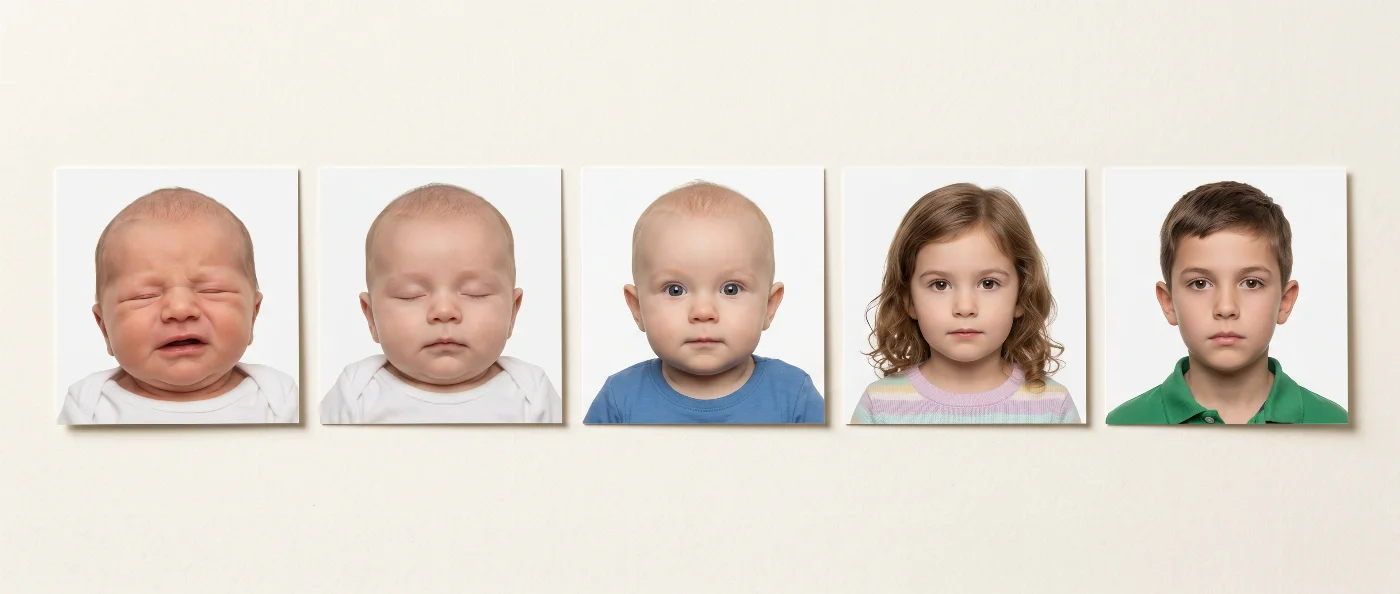
Each stage between birth and school age presents a different combination of physical and behavioral challenges. The rules do not change very much — but the practical workflow does, and so do the small concessions national authorities are willing to make.
Newborns (0 to 2 months)
Newborns sleep most of the day, cannot hold their head up, cannot focus their eyes on a camera lens, and may not stay alert long enough for a sequence of test shots. This is the age range where the international concessions matter most.
What is realistic at this stage:
Eyes may be partially open or partially closed, provided at least one iris is visible.
The face may be slightly asymmetric — a tiny head tilt is tolerated if it does not push the head outside the eye-line band.
The baby may be lying on their back rather than upright, with the camera held directly above.
What still has to be right:
The backdrop must be plain white, smooth, and shadow-free.
The face must be fully visible from hairline to chin, ear to ear.
No hand, finger, or sleeve may appear in the frame.
Lighting must be even, without harsh shadows.
Practical setup: lay the newborn on their back on a smooth, unwrinkled white bedsheet placed on a sofa or on the floor near a large window. Stand directly above with the phone or camera held with both hands. Wait for a calm moment between feedings — most newborns are most alert about thirty to sixty minutes after a feed. Take ten to fifteen frames so you can choose the best one.
Young Infants (2 to 6 months)
By two months, most babies hold their gaze on a face for several seconds at a time and start to lift their head briefly when on their stomach. The capture window is still short, and most photographs in this band are still taken from above with the baby lying on their back.
What changes from the newborn stage:
Babies may briefly meet the camera, but perfectly open eyes are still not required.
Reflex smiles are common — wait them out for the neutral expression.
The neck is stronger, so a short upright capture in a parent's arms (with the parent fully out of frame) is sometimes possible.
Practical setup: the most reliable workflow remains overhead capture on a white sheet. To get the baby to look up rather than to the side, position a single contrasting object — a black card, a dark phone case — directly behind the camera at the baby's eye line. The baby will instinctively focus on it.
Older Infants (6 to 12 months)
At six months, most babies sit with support, and many sit independently for short periods. They make eye contact more consistently and respond to sound and motion. This is the easiest infant stage to photograph for a passport.
The international concessions still apply at this age, but most older infants meet the adult standard naturally:
Both eyes are usually fully open.
Expression is more controllable, with a brief window of calm attention.
The baby can sit upright against a plain backdrop with a parent kneeling behind the camera.
Practical setup: seat the baby in a white-draped car seat or on a clean white blanket placed on a chair against a white wall, with a parent standing or kneeling out of frame to keep them stable. A second adult standing behind the camera, holding a familiar toy at lens level, draws the baby's gaze where it needs to be.
Toddlers (1 to 3 years)
Toddlers are the most challenging passport photo subjects. They are mobile, opinionated, prone to sudden movement, and rarely cooperative on command. The international concessions for under-twelve-month infants no longer apply — toddlers are held to the adult standard.
What is required at this stage:
Both eyes open and looking at the lens.
A relaxed, neutral expression with the mouth closed.
Head straight, centered, and square to the camera.
No motion blur.
Practical setup: photograph in a quiet room without other children or visible toys to compete for attention. A high chair against a plain white wall works well — it restrains the body without showing any visible restraint in the frame. Use a fast shutter speed (1/250 second or faster on most smartphones) to freeze the inevitable micro-movement. Capture a long sequence of frames — twenty to forty is not excessive at this age — and select the sharpest one. A familiar voice (not the photographer's) calling the toddler's name from directly behind the camera gives the most consistent eye contact.
Preschoolers (3 to 5 years)
Preschoolers can follow simple instructions and hold a pose for a few seconds. The capture is easier than at the toddler stage, but the standard is also stricter — at this age, there is no expectation of cooperation issues, and almost no behavioral concession is granted.
Common preschooler challenges:
Reflex smiles when the camera is pointed at them — practice a "calm face" together before the session.
Looking at the parent rather than at the camera — the parent should stand behind the photographer, not next to them.
Hair across the eyebrows — clip it back or pin it before the shot.
Practical setup: Children at this age can usually stand upright against a plain wall for a short studio-style session, which makes lighting and framing significantly easier than the seated infant workflow.
School-Age Children (5 years and older)
From about five years old, the full adult standard applies, and most children meet it without difficulty. The most common cause of rejection at this age is not the child's behavior — it is the choice of photograph. School portraits, sports photos, and casual phone snapshots almost never comply because they use colored or textured backdrops, off-axis poses, and smiling expressions. A dedicated capture against a plain white surface is required.
Age Group | Eyes | Expression | Head Support | Practical Capture |
|---|---|---|---|---|
Newborn (0–2 mo) | Partially open accepted | Mild leniency | Concealed support allowed | Overhead on a white sheet |
Young Infant (2–6 mo) | Partially open accepted | Mild leniency | Concealed support allowed | Overhead or supported upright |
Older Infant (6–12 mo) | Both eyes preferably open | Brief calm window | Concealed support allowed | Seated against a white wall |
Toddler (1–3 yr) | Both eyes fully open | Adult standard | None visible | High chair against a white wall |
Preschooler (3–5 yr) | Both eyes fully open | Adult standard | None | Standing or seated |
Child (5 yr+) | Both eyes fully open | Adult standard | None | Adult workflow |
How to Take Your Child's Passport Photo at Home
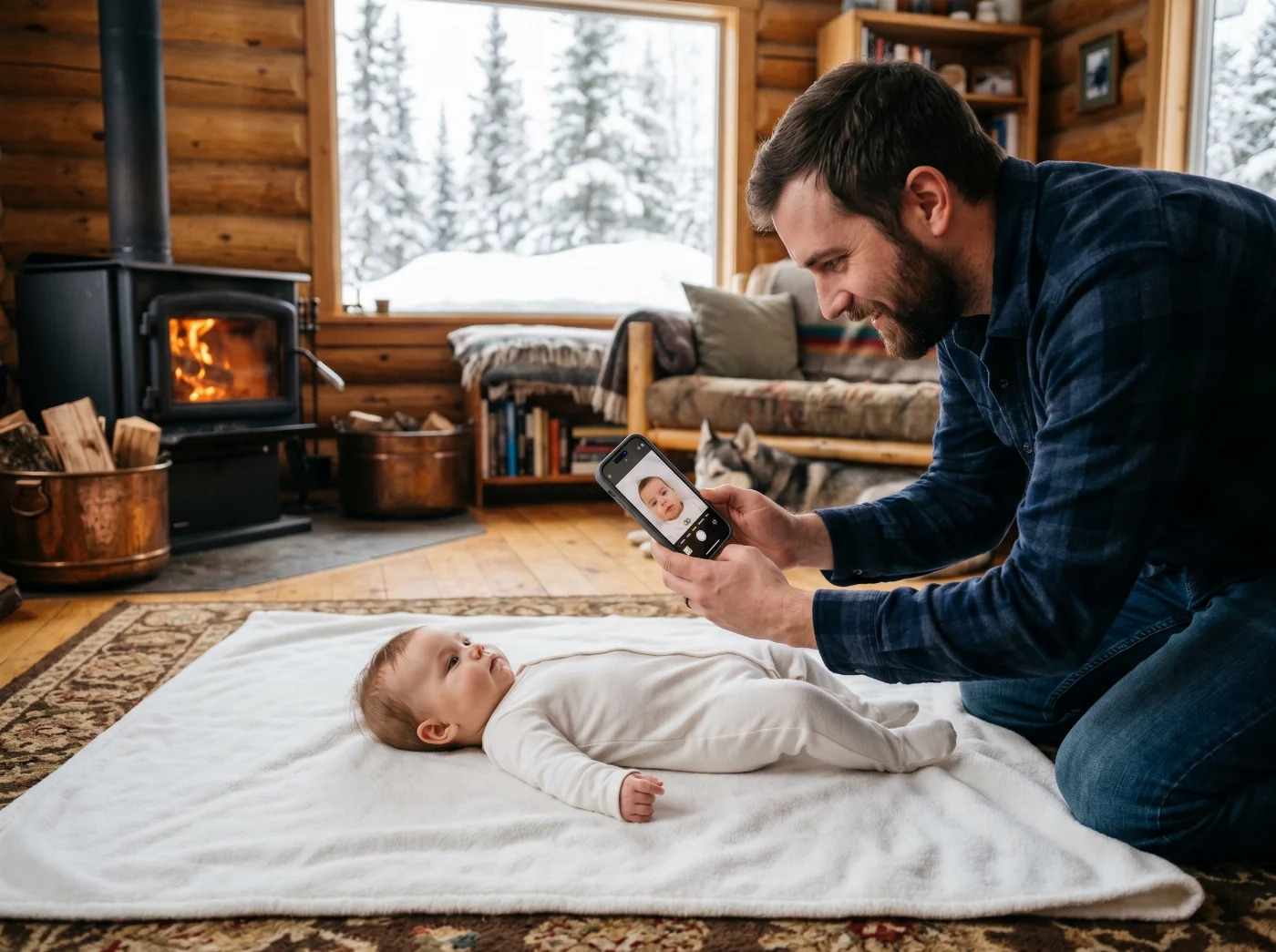
A home capture is fully acceptable to the U.S. Department of State — there is no requirement that the photograph come from a studio. The eight-step routine below scales from newborns through teenagers and produces a compliant file in roughly fifteen minutes.
1. Pick the right time of day. Mid-morning or early afternoon on an overcast day gives the softest natural light. For newborns and young infants, plan the session thirty to sixty minutes after a feed when the baby is most likely to be calm and alert.
2. Prepare the background. Stretch a smooth, freshly ironed white bedsheet against a wall, or use a freshly painted matte-white wall directly. Make sure the surface is completely free of folds, fibers, and patterns. Leave at least 50 cm of space between the baby and the surface to avoid shadows on the backdrop.
3. Choose your light source. Position the baby facing a large window with the window to one side rather than directly in front. Soft, indirect daylight produces the most reliable result. If natural light is not available, two softened lamps (lampshades or white paper diffusers help) placed at roughly forty-five degrees to either side of the baby work well.
4. Set up the camera. A modern smartphone is more than sufficient. Use the rear (main) camera, not the front-facing one. Disable Portrait mode, every "beauty" setting, HDR portrait enhancement, and any third-party camera filter. Lock focus on the baby's face if your phone allows it.
5. Position the baby. For newborns and young infants, lay them on their back on the white sheet. For older babies who can sit, use a clean white surface that hides any chair or car seat structure. For toddlers, use a high chair against the wall.
6. Get the gaze. Have a second adult stand directly behind the camera, holding the baby's favorite toy, a familiar object, or a phone playing a short video at lens level. Most babies will look at the visual stimulus rather than at the camera itself — which is exactly where you want them to look.
7. Take a sequence. Capture fifteen to forty frames in standard photo mode (not Live Photo, not Portrait). Babies and toddlers move constantly, and the difference between a usable frame and a rejected one is often a fraction of a second.
8. Crop, validate, submit. Select the sharpest frame with the eyes open and the expression relaxed. Crop to the format your national authority requires (square in most cases, often 2 × 2 inches or 35 × 45 mm). Run the file through a passport-aware tool that enforces the head-height ratio, the background uniformity, and the file-size envelope before submission.
Common Reasons Baby and Child Passport Photos Get Rejected
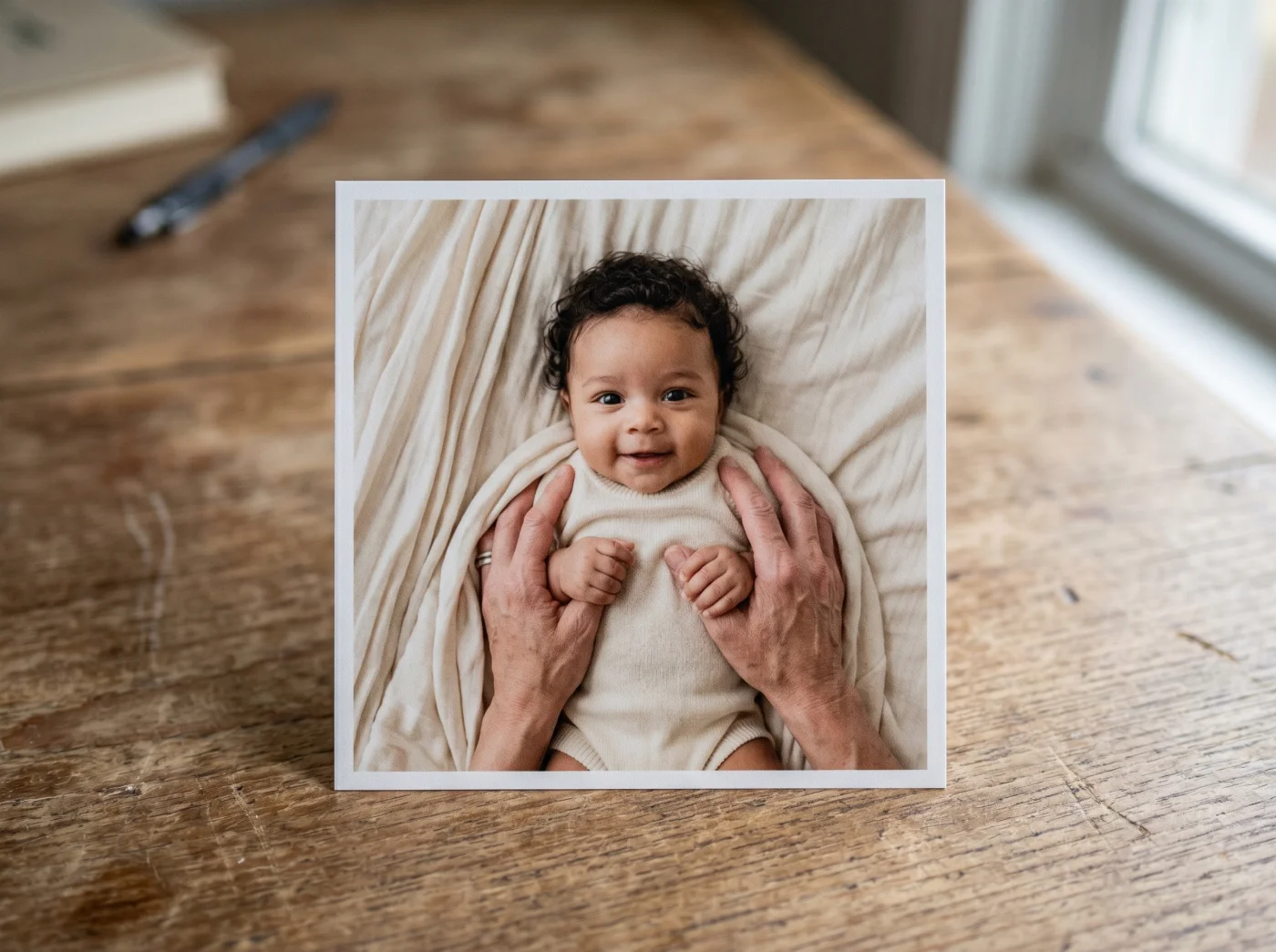
Passport photos for babies and young children get rejected more often than adult photos — not because the rules are stricter, but because infants can't hold still, parents improvise the setup, and small mistakes are easy to miss before submitting. These are the most common failure points.
Visible parent. A hand holding the baby's head, a supporting arm in the frame, a sleeve at the edge, or a shadow the photographer casts onto the background.
Textured or patterned background. A white blanket with embroidery, a sheet with visible weave, or a wall that reads as off-white or gray on camera.
Shadow behind the head. Caused by a single overhead light or by placing the baby too close to the wall.
Closed eyes. Accepted as a partial concession for infants under twelve months; never accepted for older children.
Smiling or crying. A toothy smile, a half-smile, an open mouth, or any sign of visible distress.
Hair across the face. Bangs covering the eyebrows, hair falling across the cheek, or clips that obscure the hairline.
Off-axis pose. Head tilted, face turned to the side, or chin lifted or dropped.
Motion blur. Common with toddlers, the eyes and lips lose the sharpness required for biometric processing.
Wrong file format. HEIC straight from an iPhone, PNG screenshots, BMP, TIFF, or WebP files.
Wrong aspect ratio. A rectangular crop is submitted where the authority requires a square, or the reverse.
Over-compressed image. Photos sent through WhatsApp, iMessage, or social media before submission lose quality that cannot be recovered.
Foreign objects in the frame. Pacifiers, bottles, toys, restraint straps, or the edge of a car seat.
What to Do If Your Child's Passport Photo Is Rejected: 4 Scenarios
A rejected child passport photo is almost always recoverable. The four scenarios below cover the realistic paths and the corrective action for each.
1. The passport authority returned the application by mail with a rejection notice. The notice usually identifies the failed parameter — background, expression, lighting, head size. Reshoot under the home-photo routine described above, addressing the specific cited issue. If the rejection cited a technical issue (wrong file size, wrong format), a simple re-crop and re-encode is often enough. Resubmit promptly to avoid travel-date conflicts.
2. The photo was rejected at an in-person passport appointment. Most acceptance facilities will direct you to a nearby pharmacy, shipping center, or studio for an immediate replacement. Walgreens, CVS, UPS Store, FedEx Office, and equivalent international chains typically handle infant and child sessions on a walk-in basis.
3. The photo was taken at a paid service and rejected. Most retail chains, shipping outlets, and professional studios offer a free recapture when the file fails an official check, on presentation of the rejection notice. Online passport photo makers such as PhotoGov create compliance-aligned outputs and offer free retakes or a refund if the issuing authority doesn’t accept the photo due to technical faults in it.
4. The rejection happened at a border or at a document inspection abroad. This is rare but does occur when the baby's appearance has changed significantly since the photo was taken. A fresh photograph and a renewed application are required; some embassies can process an expedited replacement within a few business days.
In every scenario, keep the original full-resolution capture on your phone or computer — a small adjustment to that original is often faster than a full reshoot.
Baby Passport Photos: Final Thoughts
A U.S. passport photo for a child of any age is a biometric document with the same underlying rules as an adult passport photo, softened only at the edges where a newborn or young infant cannot reasonably comply. The State Department's photo specification — codified in 22 CFR §51.27 and aligned with the international ICAO 9303 biometric template — accepts partial eye opening, mild expression variation, and concealed head support for infants under twelve months, and applies the full adult standard from the first birthday through age fifteen.
The practical implication for U.S. parents is that a calm home session against a plain white wall, with soft daylight from a large window, produces a compliant 2 × 2 inch photograph at every age from newborn through teenager. The single most common cause of avoidable rejection is not the child's behavior — it is the visible edge of a parent's hand on an infant photo, a textured blanket, a wall that is not actually white, a reflex smile from a school-age child, or a pair of prescription glasses a teen forgot to take off. Pay attention to the backdrop, the lighting, and the frame edges; remind older children to keep a neutral face and remove eyewear; and the rest of the rules tend to follow naturally.
Frequently Asked Questions
How Do I Take a Baby Passport Photo at Home?
Photograph the baby against a plain white wall or a smooth white bedsheet, with soft daylight from a large window to one side. For newborns and young infants, lay the baby on their back on the white sheet and shoot from directly above. For older babies and toddlers, seat or stand the child against a white wall with a parent positioned out of frame to hold their attention. Use the rear camera of any modern smartphone, disable Portrait mode and beauty filters, take fifteen to forty frames, and select the sharpest result with the eyes open and the expression relaxed. Crop to the size required by your national passport authority with a reliable online passport photo maker and validate the file before submission.
Can a Newborn Baby Have Their Eyes Closed in a U.S. Passport Photo?
Yes. Under the State Department's Children Under 16 guidance and 9 FAM 504.4-4(C), partially open eyes are tolerated for infants under twelve months as long as the face is fully visible. From the first birthday onward, both eyes must be fully open and looking at the lens.
Does My Baby Really Need a Passport?
Yes. Every U.S. citizen, including newborns, needs a valid U.S. passport to travel internationally. Babies cannot travel on a parent's passport, and the State Department requires the application to be submitted in person on Form DS-11 with both parents (or legal guardians) present at a passport acceptance facility.
Routine processing currently takes six to eight weeks; expedited processing takes two to three weeks for an additional fee of $60.
Note that mailing time to and from the passport agency can add up to two weeks on each end — plan to apply at least ten weeks before any international travel date, or opt for expedited service if your trip is sooner. Check current estimates at travel.state.gov before applying, as processing times change seasonally.
How Long Is a U.S. Baby Passport Valid?
The U.S. Department of State issues passports to applicants under sixteen for a five-year validity period, compared to ten years for adults. The shorter validity reflects how rapidly young children's appearance changes — a passport photo taken at three months is often unrecognizable by the second birthday. Children's passports cannot be renewed; when the five-year period expires, a completely new in-person Form DS-11 application is required.
What Is the Best Age to Take a Baby's Passport Photo?
There is no single best age, but the easiest practical window is between six and ten months. By six months, most babies can sit with support, hold their head up reliably, make consistent eye contact, and tolerate a short session. Before a baby is three months, capturing a photo is harder, but the U.S. Department of State concessions for infants under twelve months are most lenient. After eighteen months, toddler movement becomes the main challenge.
Can I Hold My Baby in Their Passport Photo?
You can physically support the baby during the session, but no part of you — hand, finger, arm, sleeve, hair, jewelry, shadow — may appear in the final cropped photo. The reliable workflow for newborns is to lay the baby flat on a white sheet and photograph from directly above. For older infants who need head support, position the supporting hand entirely behind the baby, crop carefully, and verify the result before submitting.
What If My Baby Cries Throughout the Photo Session?
Pause and try again later. A crying face will not pass the U.S. Department of State facial expression check if your baby is over 12 months old. Most successful baby photo sessions happen thirty to sixty minutes after a feed when the baby is fed, dry, and rested. If the baby cries for more than a few minutes, end the session, soothe them, and try again the next day. A photo session should never last more than ten to fifteen minutes.
Can I Use a Pacifier in My Baby's Passport Photo?
No. A pacifier is treated as a foreign object that obscures part of the face, and the mouth must be closed and visible (for babies over 12 months old). If your baby relies on a pacifier to stay calm, use it between shots — but remove it for each frame and capture a sequence quickly during the calm window that follows.
What Background Works Best for Baby Passport Photos?
A smooth, freshly ironed white bedsheet pinned to a wall is the easiest reliable backdrop for home capture. A freshly painted matte-white wall works just as well if the surface is clean and free of marks. Avoid eggshell paint, beige walls, blankets with visible texture or patterns, and any surface where folds or wrinkles will appear in the photo. Leave at least 50 cm of space between the baby and the backdrop so no shadow is projected onto it.
Can I Photograph My Baby in Their Car Seat?
Yes, if the car seat is white or completely covered with a plain white sheet that hides every part of the seat structure — straps, padding, head restraint, and sides. The final photo must show the baby's face against an apparent plain white background, with no visible car-seat element. The technique works well for older infants between three and eight months who can hold their head up but cannot yet sit unsupported.
How Do I Get My Baby to Look at the Camera?
Place a small object of interest — a familiar toy, a black card on a light background, a phone playing a short video — directly behind the camera at the baby's eye line. Babies follow visual stimuli more reliably than they follow sound, and most will fix their gaze on the object rather than on the camera itself. A second adult standing immediately behind the photographer holding the object works best.
My Baby Won't Stop Moving — How Do I Get a Sharp Photo?
Use a fast shutter speed (1/250 second or faster on most smartphones, faster if available) to freeze the movement. Place the baby in a setup that limits mobility without showing any visible restraint — a high chair against a white wall, a stroller seat with a white cover, a parent's lap with the parent fully out of frame. Take a long sequence of frames rather than waiting for the "perfect moment" to shoot. The difference between a sharp frame and a blurred one is often a fraction of a second.
What Should My Baby Wear for a Passport Photo?
Plain everyday clothing in solid colors that contrast with the white background. Avoid white tops (they merge into the backdrop), bright logos, busy patterns, hooded onesies (the hood can obscure the hairline), and clothing with high collars that ride up to the chin. A solid-color t-shirt, sweater, or onesie in a mid-tone color works well. No hats, hairbands, or accessories — religious head coverings are the only exception, and only when worn daily.
How Old Does a Baby Have to Be for a U.S. Passport Photo?
A baby of any age can be photographed for a U.S. passport, including a newborn just a few days old. Many parents file Form DS-11 within the first two months after birth. The U.S. Department of State routinely processes newborn applications, and the photo concessions in 9 FAM 504.4-4(C) explicitly accommodate infants under twelve months.
Can I Use My iPhone to Take My Baby's Passport Photo?
Yes. A current-generation iPhone, Google Pixel, Samsung Galaxy, and other smartphones have more than enough resolution and image quality to produce a compliant passport photo. Use the rear (main) camera rather than the front-facing one, disable Portrait mode and every beauty or HDR-portrait setting, and shoot in standard photo mode. After capture, transfer the original full-resolution file to a computer or to a passport-aware online tool by AirDrop, cable, or cloud storage — not through WhatsApp, iMessage, Telegram, or social media, all of which recompress the image and degrade quality.
Should I Edit My Baby's Passport Photo?
Editing is allowed, but only if it doesn’t alter the baby’s facial features or apply filters to the image. Mild brightness or contrast adjustment that preserves natural skin tone, white-balance correction toward neutral, and square cropping that preserves the head proportions are all acceptable. Beauty filters, skin smoothing, eye enlargement, AI background replacement, and face slimming are prohibited at every age and can result in rejection. In immigration contexts, manipulated photographs may trigger a finding of material misrepresentation under INA §212(a)(6)(C)(i). Use our dedicated Baby Passport Photo Tool to create a technically accurate passport photo of your child.
Do Twin or Sibling Babies Need Separate Photos?
Yes. Every individual on a passport application needs their own unique, recent photograph. The same photo cannot be used for two children, even if they look identical. Each twin or sibling needs a separate capture session, and each photograph is evaluated independently against the biometric template.
How Much Does a Baby Passport Photo Cost in the U.S.?
Pharmacies and retail chains typically charge $12–18 per photo set. Shipping outlets such as UPS Store and FedEx Office charge $12–15. Professional photography studios charge $25–50 and are often the most reliable option for very young infants. Online tools such as PhotoGov accept a home-shot original and produce a compliant file in under thirty seconds for $6.90 in the US — significantly less than an in-person session.
What If My Baby's Appearance Changes a Lot Before We Travel?
The U.S. Department of State and Customs and Border Protection continue to accept a valid passport even when the child's appearance has changed visibly — the document is valid until its expiration date. CBP officers occasionally request a fresh photograph at the inspection booth for an obviously unrecognizable child, but this is uncommon. If you have concerns, carry a current photograph or video on your phone that the officer can reference, and consider applying for an early replacement under Form DS-11 when the change is dramatic.
Where Can I Get a Baby Passport Photo Taken Near Me?
In the United States, most parents use one of four channels. Walgreens, CVS, Rite Aid, and Walmart operate in-store photo counters that handle infant and child sessions, typically at $15–18 per set. UPS Store and FedEx Office offer the same service on appointment at $12–15. Selected USPS branches handle passport photos by appointment, often as part of a same-visit Form DS-11 submission. Independent photography studios charge $25–50 and are usually the most reliable option for very young infants and for children with sensory needs. Another option that saves you time (and maybe a lot of stress) is an online passport photo maker that allows you to create your child’s passport photo from the comfort of your home. Check our convenient photo-making tool — the whole process takes less than a minute.
Official Government Documentation Sources
U.S. Passport Photo Requirements: The U.S. Department of State — Travel
Children Under 16 — Passport Applications: The U.S. Department of State — Travel
Form DS-11 (Application for a U.S. Passport): The U.S. Department of State
22 CFR §51.27 — Passport Photographs: Code of Federal Regulations
9 FAM 504.4-4 — Photographs: Foreign Affairs Manual, U.S. Department of State
Biometric Regulations for International ID Documents: International Civil Aviation Organization (ICAO) Document 9303
Other Pages — U.S. ID Photos
Was this helpful?
85 found this helpful
Top expert
Based on official government sources
Helpful votes: 85
Was this helpful?
85 found this helpful
Service provided by Y VISION TECHNOLOGIES LLP · Stoney Works 8 Stoney Lane, London, England, SE19 3BD · Terms · Refund policy · Contact
We value your Privacy
We use cookies to enhance your browsing experience, serve personalized ads or content. By clicking “Accept All”, you consent to our use of cookies.