New Indian Passport Photo Requirements: The Сomplete 2026 MEA & Passport Seva Guide
Table of contents:
- Goodbye 2×2: The New Indian Passport Photo 35×45 Standard
- 16 Indian Passport Photo Requirements After the 2025 ICAO Update: Full Checklist
- Acceptable Indian Passport Photo Samples
- Unacceptable Indian Passport Photo Samples
- Passport Seva Portal, PSK Appointment, and Overseas Mission: Which Photo Format Do You Need?
- India's 2025 ICAO Overhaul: 4 Rules That Changed, and What Broke for Applicants Who Missed It
- Indian Passport Photos for Minors: MEA Guidelines by Age Group
- Where to Get an ICAO-Compliant Photo for an Indian Passport: 2026 Options
- Indian Passport Photo Services: What Each Option Actually Delivers
- How to Take Your Own Indian Passport Photo
- Passport Seva Photo Rejection: 12 Causes and the Fix for Each
- Frequently Asked Questions
- Official Government Sources
- Related guides
An Indian passport photo is a biometric photograph that follows a nationwide standard for the Passport Seva and Indian missions to process your application correctly. It has to be a 35 × 45 mm colour portrait on a plain white background, taken within the last six months, with a neutral expression and no glasses of any kind. For online submissions via the Passport Seva portal or the mPassport app, your digital photo must be a JPEG exactly 630 × 810 pixels, with a file size between 10 and 250 KB, and the face filling about 80–85% of the frame, without any filters, retouching, or background edits.
Use this guide as your step‑by‑step checklist: follow each requirement once, and you’ll have a ready‑to‑upload Indian passport photo that passes both the online validator and your PSK appointment on the first try.
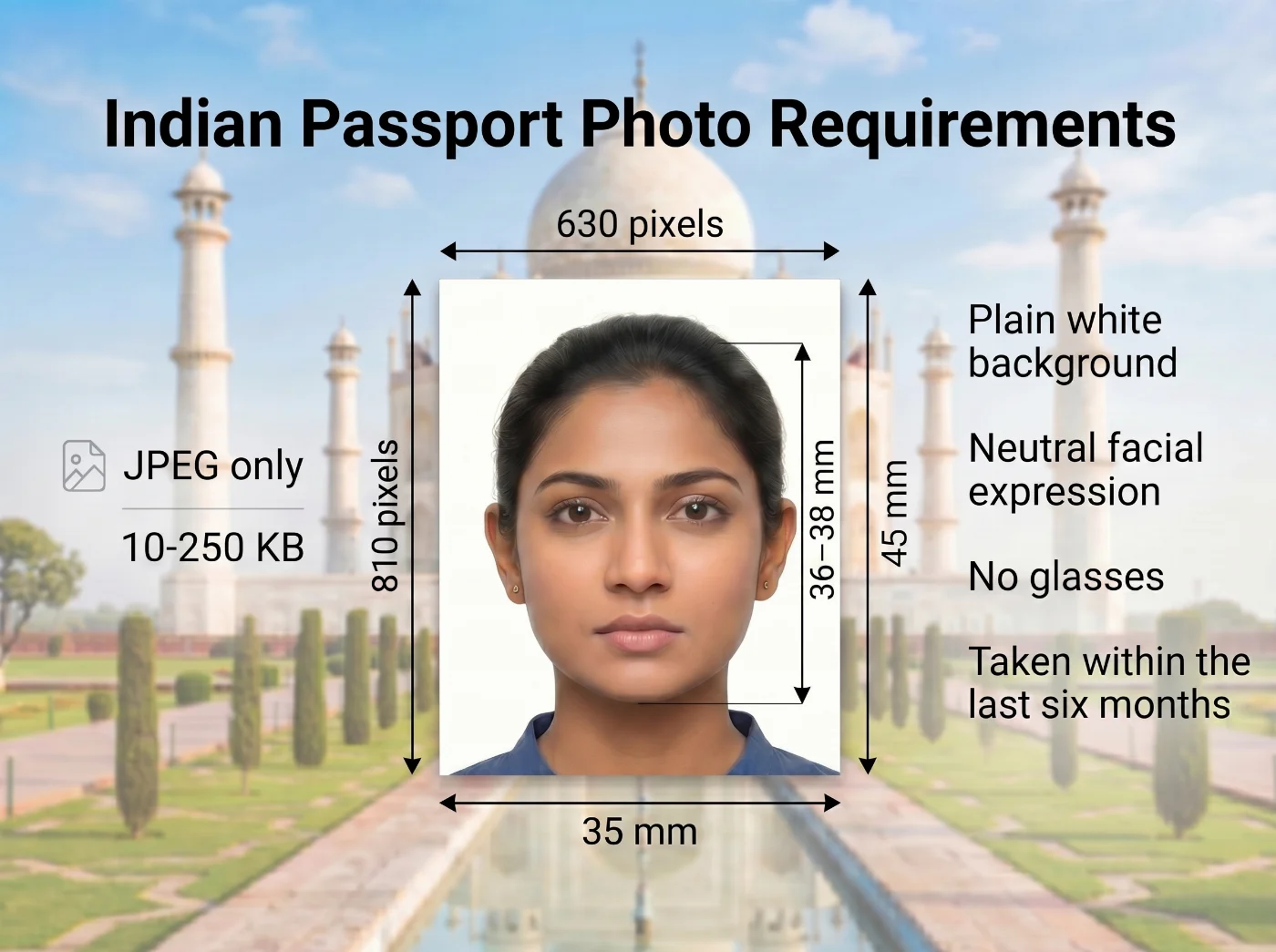 Source: Ministry of External Affairs India — Passport Seva Photo & Signature Upload Instructions
Goodbye 2×2: The New Indian Passport Photo 35×45 Standard
India overhauled its passport photo rules more fundamentally in September 2025 than any other major country has done in years. Three decades of the 2×2-inch (51×51 mm) square format ended overnight, cream and off-white backgrounds that used to be accepted started causing rejections, glasses stopped being allowed in passport photos, and a new digital standard — JPEG, exactly 630×810 pixels, 10–250 KB — began to be checked automatically by the Passport Seva portal.
The grace period that still let old-format photos through ended on February 15, 2026, so from February 16, 2026 onwards every application is assessed under the new rules taken from Ministry of External Affairs (MEA) instructions, the Passport Seva portal, and ICAO Document 9303 — which means you now need a 35×45 mm, pure-white-background, glasses-free photo that also matches the exact 630×810-pixel digital upload requirement.
16 Indian Passport Photo Requirements After the 2025 ICAO Update: Full Checklist
All specifications below are mandatory for every new and renewal Indian passport application submitted from February 16, 2026. They apply equally to Passport Seva online submissions, mPassport app uploads, and physical applications at Passport Seva Kendras (PSK), Post Office PSKs (POPSK), and Indian Missions abroad. When using the PhotoGov passport photo generator, the output meets every specification in this table automatically. Visitors to India need a different format, produced by our India visa photo maker.
Specification | Requirement | What you need to know |
1. Printed photo size | 35×45 mm | Width 35 mm, height 45 mm. India adopted this ICAO-standard rectangle in September 2025, replacing the 2×2-inch (51×51 mm) square used for over 30 years. The old square format is rejected at every submission channel from February 16, 2026. |
2. Digital upload dimensions | Exactly 630×810 pixels | Pixel-exact requirement enforced by the Passport Seva portal's automated validator. 629×810 is rejected. 631×810 is rejected. Only 630×810 passes. |
3. Digital file format | JPEG (.jpg) only | PNG, HEIC, WebP, BMP, TIFF are rejected automatically. Even a .jpeg extension (vs .jpg) may cause issues on some portal versions. |
4. Digital file size | 10 KB-250 KB | Both limits are hard. Files below 10 KB (over-compressed) and above 250 KB (too large) are rejected. A 630×810 JPEG at typical photographic quality falls within this range. |
5. Background | Plain white only | Since September 2025: strict white only. Cream, off-white, and light grey — all accepted before — are now rejected. The portal's luminance check detects any warm-toned background. |
6. Face coverage | 80–85% of the photo frame | The face must fill 80–85% of the photograph. A photo sized to US (2×2 in) or EU standards will usually have the face too small and fail this check. To avoid this, use a tool that sets the right passport picture size for each country. |
7. Face height in print | 36–38 mm crown to chin | Measured in the 35×45 mm print. At 36–38 mm face height, the head occupies the majority of the frame — more than most other countries require. |
8. Head orientation | Frontal, level, centred | Head upright, both ears at the same height, face directly facing the camera. No tilt, rotation, or side angle. |
9. Facial expression | Neutral, mouth closed | Relaxed, neutral expression with mouth firmly closed. No smiling, frowning, or raised eyebrows. |
10. Eyes | Fully open, both visible | Both eyes must be fully open and directed at the camera. Eyelashes, irises, and eyelids must all be clearly distinguishable. |
11. Glasses | Banned since September 2025 | No glasses of any kind — prescription, reading, photochromic, or anti-reflective. Frame shadows and lens reflections trigger automatic rejection. Medical exception: doctor's certificate required. |
12. Religious head coverings | Permitted for daily practice | Turbans, hijabs, and other coverings worn as part of established daily religious practice are accepted. The full face — forehead to chin, ear to ear — must be completely visible with no shadow on any facial feature. |
13. Hair | Must not cover any facial feature | Hair must not cover the eyes, eyebrows, nose, mouth, or any part of the face. |
14. Colour | Natural colour only | Black-and-white photos and photos with colour casts, filters, or tinted tones are not accepted. |
15. Digital retouching | Prohibited | Filters, beauty modes, skin-smoothing, AI enhancement, blemish removal, red-eye correction, and manual editing are all prohibited. The portal detects post-processing. |
16. Recency | Within 6 months | The photo must have been taken within 6 months of the passport application submission date. |
This article is a reference guide to Indian passport photo requirements. To generate a compliant photo from a selfie instantly, use our Indian passport photo maker. Driving licence applications are covered separately on the Indian driving licence photo 35x45 mm page, prepared for the Parivahan Sarathi portal.
Acceptable Indian Passport Photo Samples
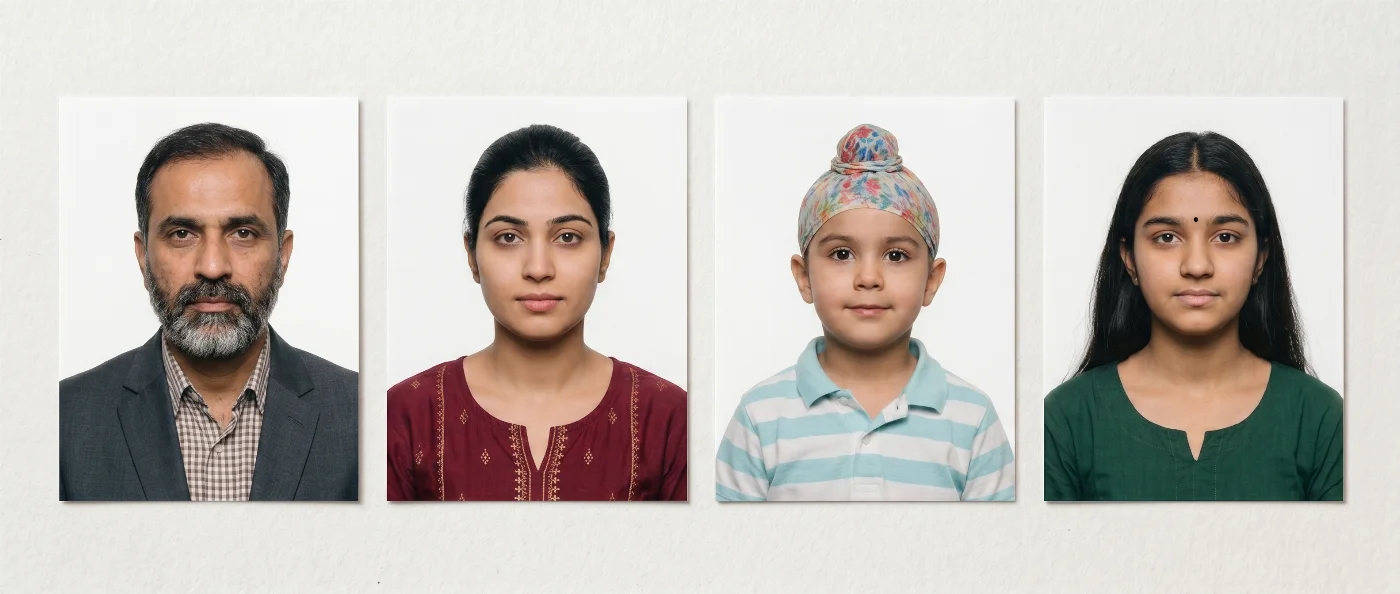 Passport Seva example: digital photo in JPEG 630 × 810 pixels (10–250 KB), with a pure white background, face centred and filling about 80–85% of the frame, both eyes open, neutral expression, no glasses, and no filters or retouching applied.
Unacceptable Indian Passport Photo Samples
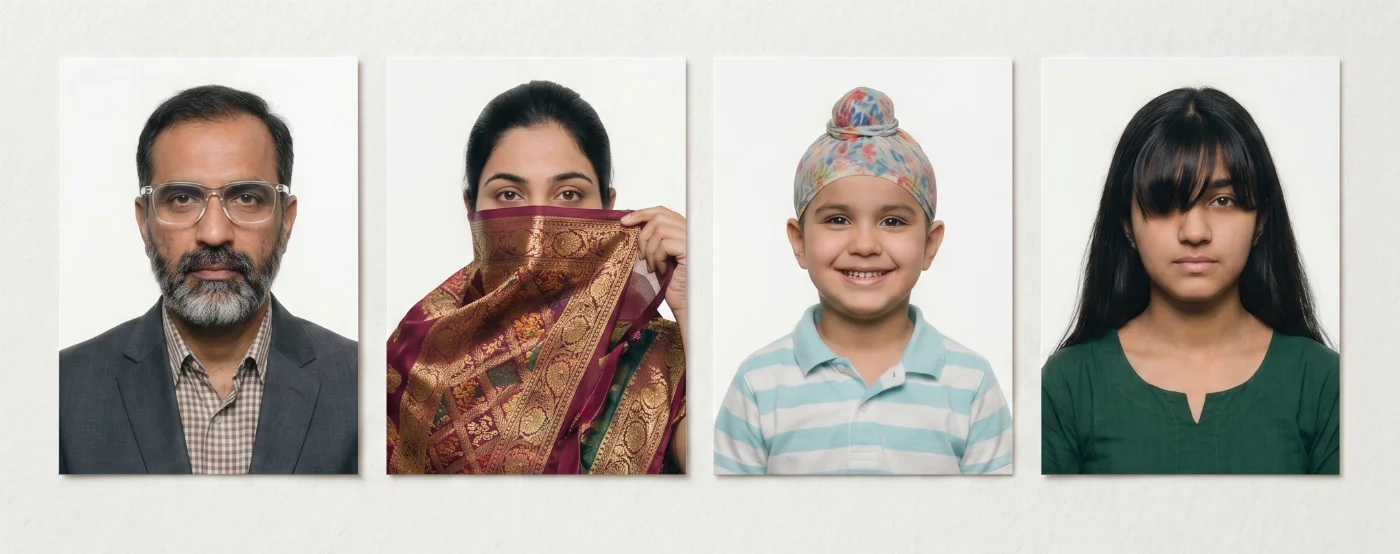 Photos are rejected if they aren’t exactly 630 × 810 pixels, don’t use JPEG format, have any background other than pure white, show glasses, have the face too small (under about 80% of the frame), show a smile or non‑neutral expression, are visibly edited or filtered, or were taken more than six months ago.
Passport Seva Portal, PSK Appointment, and Overseas Mission: Which Photo Format Do You Need?
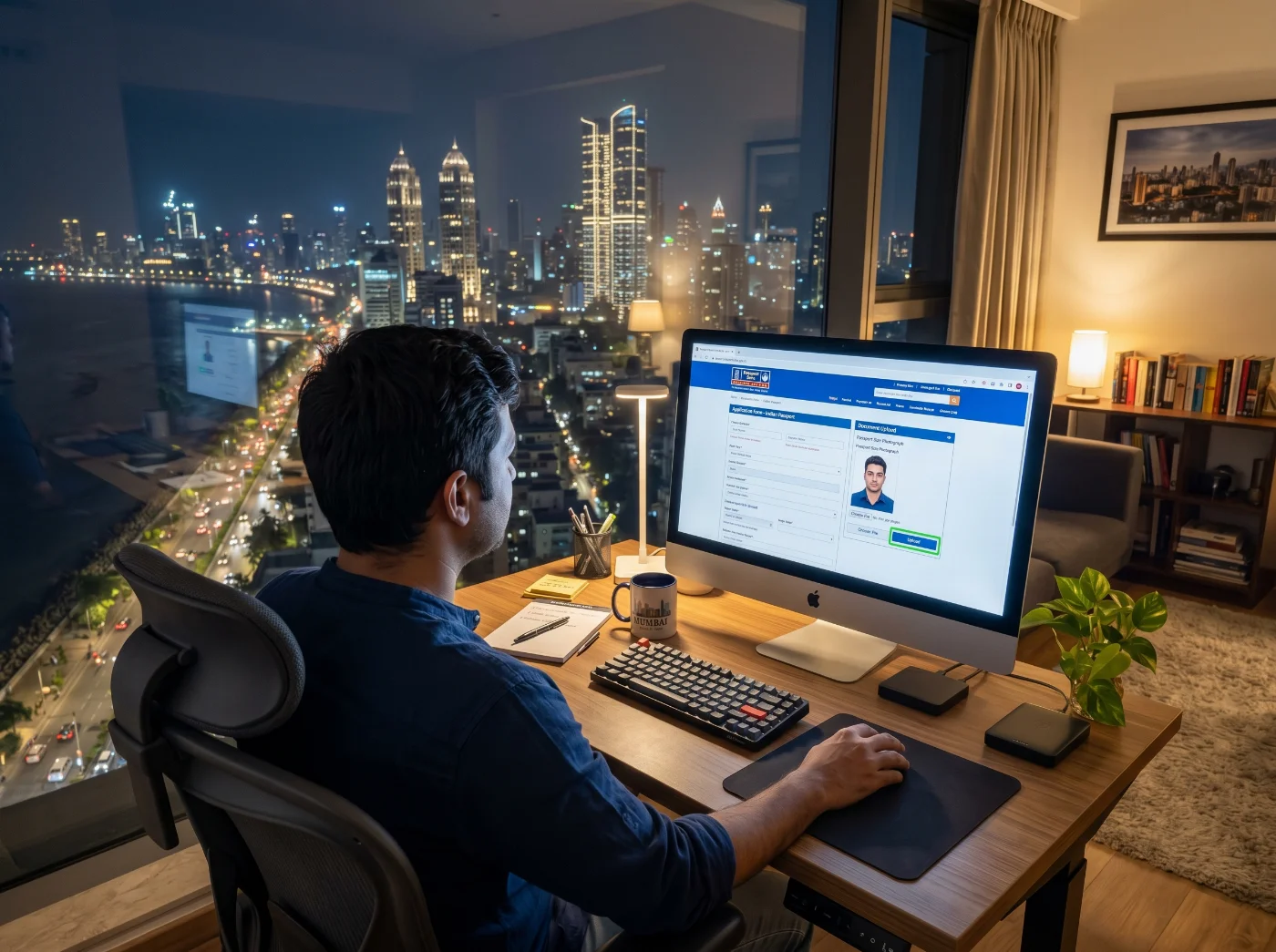
An Indian passport application often involves more than one photo submission, at more than one stage, in more than one format. Getting this wrong means delays at a step you thought you had already completed.
Step 1: The Passport Seva Portal Upload (Before Booking Your Appointment)
Before you can book a PSK appointment, you must complete an online application through the Passport Seva portal (passportindia.gov.in) or the mPassport app. Part of this process is uploading a digital passport photo. The photo must be exactly 630×810 pixels, JPEG, 10–250 KB, white background, no glasses, taken within 6 months.
The portal's ICAO validator checks the photo immediately on upload. If it fails, the portal identifies the reason and prompts you to upload a new image before you can continue. You cannot bypass this step or proceed to appointment booking without a passing upload.
Step 2: The PSK Appointment (Live Biometric Capture)
At your Passport Seva Kendra appointment, your biometric photograph is captured live by a PSK officer. This is the image stored on the passport chip. You do not need to bring a printed photo for this capture. However, check your appointment confirmation letter carefully — some PSKs ask you to bring two printed 35×45 mm photos. Bring them if requested; not all PSKs require them, but failing to bring them when asked causes unnecessary delay.
The PSK officer also compares your live appearance with the photo you uploaded to the portal. You should look the same: same hairstyle, no glasses if you uploaded without glasses, same head covering arrangement.
Step 3: Tatkal Applications — No Extra Photo Rules, But No Margin for Error
Tatkal (urgent) passports are processed within 1–3 working days for a higher fee. The photo requirements are identical to standard applications. The difference is that Tatkal leaves no room for correction: if your portal upload fails the ICAO check, or if the PSK officer identifies a compliance issue, you cannot simply rebook. Any photo submitted for a Tatkal application must be right the first time.
Overseas Indian Missions: Printed Photos Required
For applications at Indian embassies, High Commissions, and consulates abroad, two identical printed 35×45 mm colour photographs are typically required alongside the application form. Check the specific mission's current guidance. The same content rules apply: pure white background, neutral expression, no glasses, face 36–38 mm, taken within 6 months. Overseas citizens applying through the same missions can prepare an India OCI passport photo on a dedicated page.
Summary: which format is needed at which stage
Passport Seva portal / mPassport: 1 digital JPEG, exactly 630×810 px, 10–250 KB
PSK biometric capture: on-site; bring prints only if appointment confirmation requests them
Tatkal PSK: same digital upload; photo must pass first time
Overseas Indian Mission: 2 printed 35×45 mm colour photos on photo-quality paper
India's 2025 ICAO Overhaul: 4 Rules That Changed, and What Broke for Applicants Who Missed It
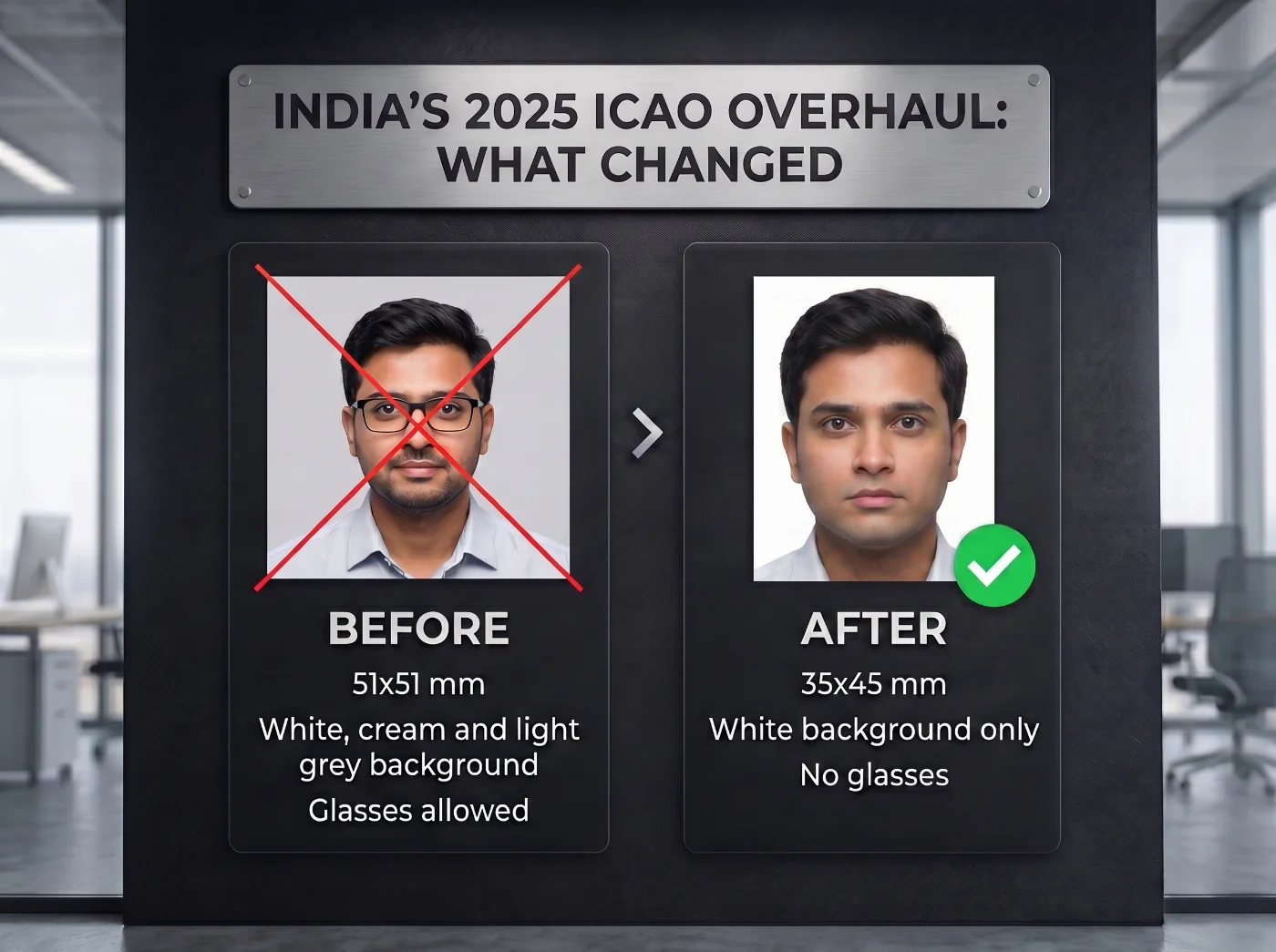
The September 2025 ICAO adoption was not an incremental tweak. It changed the format, the background standard, the eyewear rule, and the digital specification simultaneously. Many applicants — and some studios — are still submitting photos to the old standard and receiving rejections they do not understand.
1. The Format Change: 51×51 mm Square Becomes 35×45 mm Rectangle
India used the 2×2-inch (51×51 mm) square format for passport photos for decades — the same format used in the United States. ICAO Document 9303 specifies a portrait rectangle; the face-height-to-width ratio in a square format does not match ICAO biometric framing standards. India's switch to 35×45 mm aligned the country with the UK, EU, Australia, and most of the 190 ICAO member states. PAN forms use the same 35 x 45 mm space, and our India PAN card photo maker crops a portrait to it.
The practical implication: a photo taken and printed in the 51×51 mm square format is the wrong shape for a 35×45 mm application. Even if every other parameter is correct, the shape mismatch causes rejection. If you had photos prepared before September 2025, they are almost certainly the wrong size now.
2. The Background Change: Cream and Grey Become Non-Compliant
Before September 2025, Passport Seva guidelines described the background as 'white or off-white'. That language is gone. The current specification is 'plain white only'. The automated validator checks background luminance and will reject cream, warm-white, and light-grey backgrounds that were accepted under the previous rules.
This is the most common source of surprise rejections since the update. Applicants who have previously had successful applications with a cream background, and who return to the same studio or the same home setup find their new photo rejected for the first time.
3. The Glasses Ban: From Conditional to Absolute
Under the previous rules, glasses were permitted if they met certain conditions: no tinted lenses, no frames covering the eyebrows, no heavy frames obscuring the eyes. The 2025 ICAO standard eliminates conditionality. Glasses of any kind are not permitted. The automated ICAO check detects frame occlusion and lens glare independently of frame thickness or tint level.
The only exception is a genuine medical condition that physically prevents glasses removal, documented by a registered doctor's certificate submitted with the application. A general optician's prescription does not qualify.
4. The Digital Specification: From a Range to a Single Exact Number
Earlier versions of the Passport Seva portal accepted digital photos within a range of pixel dimensions. The updated specification replaced that range with a single requirement: exactly 630×810 pixels. This number is specific to the Passport Seva portal — it does not appear in standard ICAO tables, does not match the UK portal, and is not produced automatically by generic 'Indian passport size' tools that have not been updated for the 2025 change.
At 630×810 pixels, the ratio is exactly 7:9, and the image represents the 35×45 mm print at an effective 457 DPI. Any cropping or export tool that rounds to the nearest 10 pixels will produce a non-compliant file.
Indian Passport Photos for Minors: MEA Guidelines by Age Group
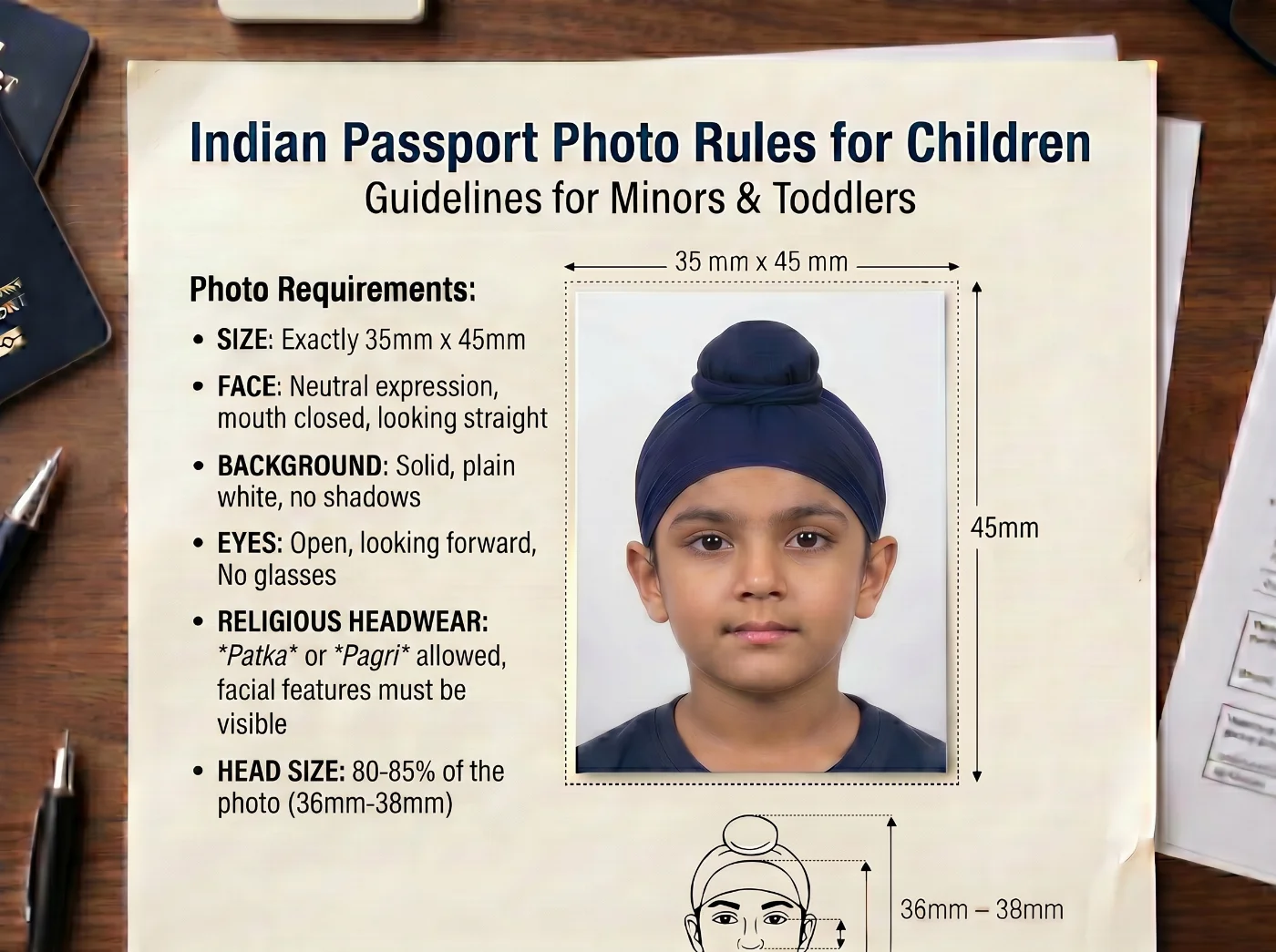
India's Ministry of External Affairs publishes specific photo guidelines for children under 4 at passportindia.gov.in. Above 4, adult rules apply in full. The PSK has specialist procedures for infant photography.
Children Under 4: PSK Capture and Overseas Photo Rules
For children under 4, the biometric photo is captured on-site at the PSK appointment using specialist equipment. No digital portal upload is required for the child's photo for this age group when applying at a domestic PSK. For overseas mission applications, the following rules apply for any pre-submitted digital or printed photo:
The infant may be photographed lying on a plain white sheet with the camera directly overhead — this eliminates background shadows entirely
A parent may hold the child upright from behind, with both hands completely out of the frame
The child's face must be centred, clearly visible, against a pure white background
Eyes need not be fully open; the mouth may be open or closed
No toys, pacifiers, rattles, or any other objects may be visible in the frame
No other person's hands, clothing, or face may appear in the image
The face takes up to 80-85% of the photo.
Parents should bring the child to the PSK appointment fed, rested, and in dark-coloured clothing. PSK staff are experienced with infant captures.
Children Aged 4 to 17: Adult ICAO Rules Apply in Full
From age 4, every specification in the requirements table above applies without modification. The child must face the camera directly with a neutral expression, mouth closed, and eyes fully open. No glasses. Religious head coverings follow the same rules as for adults: full face visible, no shadow on any facial feature. The digital upload for the portal must be exactly 630×810 pixels, JPEG, white background, taken within 6 months.
For Tatkal applications for children, the same rules apply as for adults — the urgency of Tatkal processing means any photo compliance error will cause a delay with no easy recovery option.
Where to Get an ICAO-Compliant Photo for an Indian Passport: 2026 Options
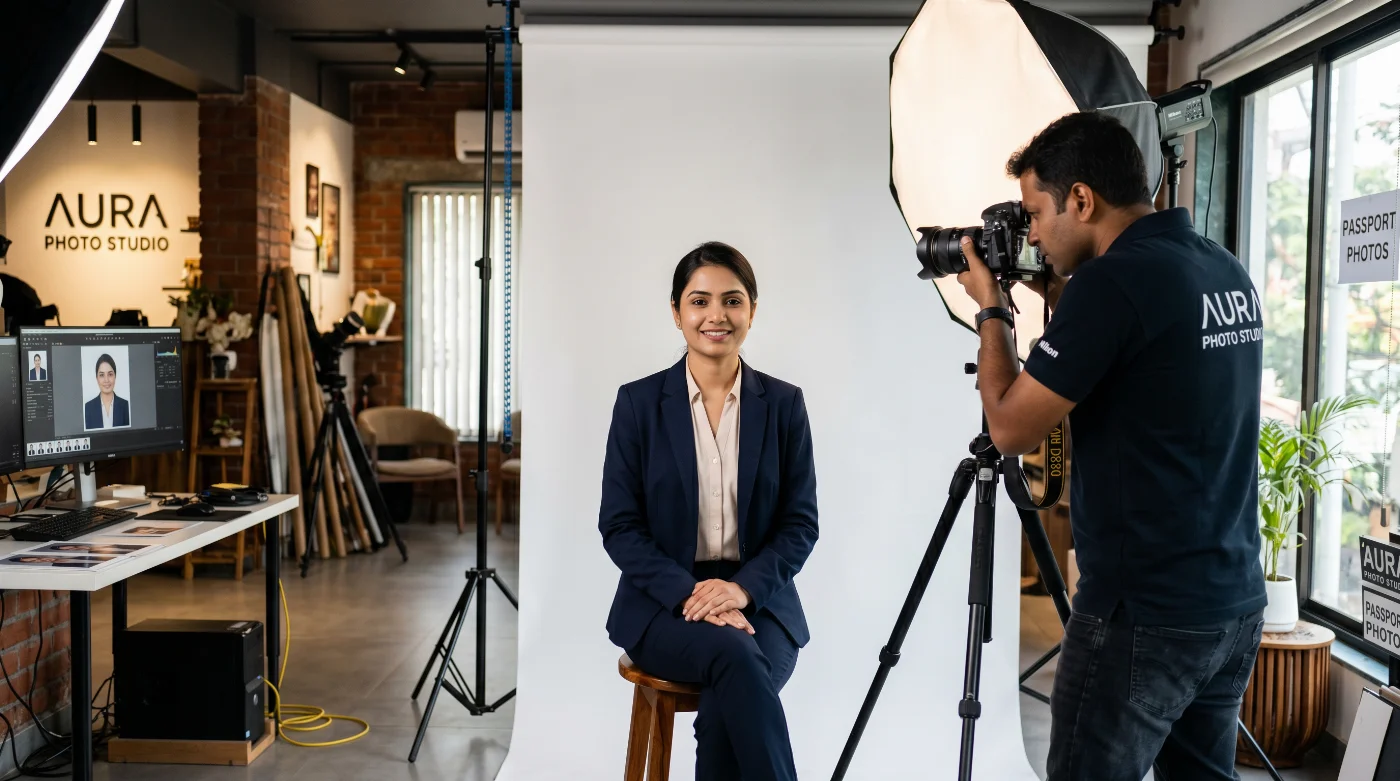
Passport Seva Kendra (PSK) and POPSK: Biometric Capture on Appointment Day
For most applicants applying through the Passport Seva portal, the biometric photo is taken on-site during the PSK appointment. PSK centres are located in all major Indian cities: New Delhi (Patel Nagar, Janakpuri), Mumbai (Andheri, Malad), Bangalore (Koramangala, Hebbal), Chennai (Teynampet, Anna Nagar), Hyderabad (Banjara Hills, Begumpet), and more. Book at passportindia.gov.in.
Professional Photography Studios: Ask Specifically for ICAO-Compliant
Since September 2025, the terms 'Passport Seva-compliant photo' and 'ICAO biometric passport photo' have become meaningful distinctions in Indian photography studios. A studio offering these specifically has updated its backdrop (to pure white), its print size (to 35×45 mm), and its digital export (to 630×810 pixels, JPEG). A studio that has not updated may still be producing 51×51 mm prints on a light-grey backdrop — useless for a 2026 application. When visiting a studio, ask explicitly for all three specifications. Studio prices: INR 50–200 across India.
Photo Booths: Check the Spec Before You Pay
Photo booths at international airports (IGI Delhi, CSIA Mumbai, Kempegowda Bangalore, RGIA Hyderabad) are more likely to have been updated for the 2025 ICAO specifications. Before inserting money, check that the booth displays '35×45 mm' and 'white background'. Most booths do not output a 630×810-pixel JPEG — if the portal upload is what you need, a booth print alone will not solve that requirement.
PhotoGov Online Tool: The Precise Print and Portal-Ready Solution
PhotoGov's passport photo maker accepts a smartphone selfie and produces a JPEG at exactly 630×810 pixels — not 'approximately 630×810', but pixel-exact — within the 10–250 KB size range, with the background set to pure white. Upload the file directly to the portal upload field. Printed 35×45 mm copies can also be ordered for delivery across India.
Indian Passport Photo Services: What Each Option Actually Delivers
Option | Approx. cost | Turnaround | Gives 630×810 px file | What it's good for |
PSK on-site capture | Included | Instant | Biometric record | Passport chip image |
PhotoGov online passport photo maker | Free | 30 seconds | Yes — pixel-exact | Portal upload + prints |
ICAO-updated studio | INR 50–200 | 5–15 min | On request | Prints + local service |
Airport photo booth | INR 60–150 | 2–3 min | Rarely | Emergency printed copies |
How to Take Your Own Indian Passport Photo
Two things kill most DIY Indian passport photos: a cream or grey background instead of white, and a digital file that is the wrong pixel dimensions. The setup below addresses both.
Find a white wall — a bright white, not warm white or magnolia. Alternatively, tape a clean white A1 sheet flat against any surface. The sheet must be perfectly smooth — even faint creases create shadow lines that the portal validator detects.
Set up even front lighting. Two lamps at 45-degree angles on either side of the camera, or a daylight window flanking the camera position, work best. No light source behind you.
Stand exactly 1 metre from the background. At this distance, your body casts no shadow onto the white surface behind you.
The camera must be placed at eye level with no angle or tilt. Your full head and the top of your shoulders must be square in the frame. Do not let the top of your head touch the top of the frame.
Remove glasses, even prescription ones. Turn off portrait mode, HDR, beauty mode, and every skin-smoothing or AI enhancement option in your camera app before taking any shots.
Look directly into the lens. Head level, both ears at the same height. Mouth closed. Eyes fully open. Expression completely neutral. Do not blink.
Take at least 8 shots. Review each at maximum zoom for sharpness — soft focus on a phone is easy to miss at thumbnail size.
Upload the sharpest, most evenly lit shot to PhotoGov. The passport photo maker crops the image to 35×45 mm, sets the background to pure white, and resizes the output file to exactly 630×810 pixels at 10-250 KB — ready to upload directly to the Passport Seva portal without any further editing.
Passport Seva Photo Rejection: 12 Causes and the Fix for Each
The Passport Seva portal's automated ICAO validator rejects photos before a human officer sees them. Here are the 12 most common, with the specific fix for each:
Wrong dimensions (not 630×810 px): Fix — use a tool configured specifically for the Passport Seva portal spec. Do not crop manually or export at 'similar' sizes.
Background not white enough: Fix — reshoot against a properly white surface under bright front lighting. Turn off warm-white or yellow household bulbs; use daylight-temperature lighting.
Glasses detected: Fix — remove all glasses before every shot. No exceptions.
Face too small (below 80% coverage): Fix — move closer to the camera, or use zoom to fill the frame. Reshooting for Indian ICAO specs requires more face than most people are accustomed to.
Non-JPEG format: Fix — on iPhones, go to Settings > Camera > Formats and select 'Most Compatible' (JPEG) before shooting.
File too large (above 250 KB): Fix — export from PhotoGov, which controls file size automatically, rather than uploading a raw camera file.
File too small (below 10 KB): Fix — do not over-compress. A 630×810 JPEG at standard quality is never below 10 KB.
Expression not neutral: Fix — reshoot. Have someone else take the photo so you are not trying to trigger the shutter yourself, which often produces a tense expression.
Post-processing detected: Fix — delete all edited versions and upload a file taken with all phone filters turned off.
Head tilt detected: Fix — check in a mirror that both ears are at the same height before every shot.
Old 51×51 mm square format: Fix — the photo needs to be completely retaken to the 35×45 mm rectangle. Cropping a square photo to a rectangle does not produce a compliant result.
Photo older than 6 months: Fix — check the file creation date in EXIF metadata. If it is older than 6 months from your application date, reshoot.
What Happens After a Portal Rejection
If the Passport Seva portal rejects your uploaded photo, it displays the specific reason on screen. Your application stays open — you are not locked out — but you cannot book a PSK appointment until a passing photo is uploaded. Address the stated issue exactly.
If the PSK officer identifies a compliance problem with your appearance on appointment day — for example, you have changed your appearance significantly since the portal upload — you may be asked to reschedule. Ensure your appearance at the PSK matches the photo you uploaded.
Frequently Asked Questions
What Are the Passport Photo Requirements in India?
Indian passport photos must follow a single nationwide standard defined by the Ministry of External Affairs (MEA), the Passport Seva system, and ICAO biometric rules. Your photo must be a 35 × 45 mm colour portrait on a plain white background, taken within the last six months, with a neutral expression and no glasses of any kind. For online submissions via the Passport Seva portal or mPassport app, the digital photo must be a JPEG exactly 630 × 810 pixels, between 10 and 250 KB, with the face filling about 80–85% of the frame and no filters, retouching, or background edits.
Key requirements:
Size (print): 35 mm wide × 45 mm high
Digital: JPEG, exactly 630 × 810 pixels, 10–250 KB
Background: Plain, pure white, evenly lit, no patterns or shadows
Pose: Full face facing the camera, head level, eyes open, mouth closed, neutral expression
Head size: Face centred, filling most of the frame (around 80–85% of the image height)
Glasses: Not allowed (no prescription, reading, or tinted glasses)
Head coverings: Allowed for daily religious or medical reasons, but the full face (forehead to chin, ear to ear) must be clearly visible with no shadows
Clothing: Everyday clothing; avoid white or near‑white tops that blend into the background and any kind of uniform or camouflage
Image quality: Sharp, in focus, natural colour, no filters, no retouching, no visible compression artifacts
Recency: Photo taken within the last 6 months and matching your current appearance
What Is the Indian Passport Photo Size?
The Indian passport photo size is 35 × 45 millimetres (3.5 × 4.5 cm).
For digital photos, the Passport Seva specification requires a JPEG exactly 630 × 810 pixels, which preserves the same 35 × 45 mm proportion and ensures the correct framing when the image is printed or processed by the system. When you create or order an Indian passport photo, specify “35 × 45 mm, 35 mm (width) × 45 mm (height)” so the file or print matches the required dimensions.
What Background Colour Is Required for an Indian Passport Photo?
For Indian passport photos, the background must be a solid, plain white colour with no shadows, patterns, textures, or gradients. Any off‑white, cream, light grey, or coloured background can cause the photo to be rejected, because the Passport Seva validator checks background luminance and expects pure white. Always use a clean, uniform white backdrop with even lighting.
How Recent Must an Indian Passport Photo Be?
An Indian passport photo must be taken within the last 6 months before the date you submit your application. The image must accurately reflect your current appearance; if you’ve had a significant change (major weight loss, facial surgery, or a very different beard/hairstyle), you should take a new photo even if the previous one is technically within the 6‑month window.
What Is the Digital Size for an Indian Passport Photo, and Where Is It Used?
For Indian passport applications, the required digital photo size is exactly 630 × 810 pixels in JPEG (.jpg) format, with a file size between 10 and 250 KB. This digital specification is used when you submit your application online through the Passport Seva portal or the mPassport app, where you must upload a compliant file before you can book a Passport Seva Kendra (PSK) appointment or finalize an overseas mission application.
Can You Smile in an Indian Passport Photo?
No. An Indian passport photo must show a neutral expression. You should look directly at the camera with both eyes open, mouth closed, and no visible smile or frown, so that biometric systems can measure your facial features accurately. Even a slight smile that changes the shape of your mouth or cheeks can lead to rejection, so keep your face relaxed and expression neutral.
Why Does the Passport Seva Portal Need Exactly 630×810 Pixels? Why Not a Range?
The 630×810-pixel requirement reflects the internal image processing pipeline of the Passport Seva portal. The portal's ICAO facial recognition module operates on a fixed input frame size — every image is compared, normalised, and stored in the same pixel matrix. A variable input range would require on-the-fly resizing, which introduces interpolation artefacts that reduce biometric matching accuracy. It is a technical infrastructure requirement specific to the Passport Seva system, not a general ICAO standard — which is why no other country uses this exact number.
I Had a Successful Application in 2024 Using a Cream Background and 51×51 mm Photos. Do I Need New Photos?
Yes. The format and background rules changed on September 1, 2025, with full enforcement from February 16, 2026. A photo taken and processed to the old specification — square format, cream background — will be rejected under the current rules regardless of whether it produced a successful application previously. You need new photos meeting the 35×45 mm, pure white background, 630×810-pixel digital specification.
Can I Wear My Prescription Glasses if I Have Worn Them in Every Previous Passport?
No. The glasses ban is absolute since September 2025 and applies regardless of previous passport photos. There is no grandfather provision. The only exception is a medical condition that physically prevents removal, documented by a registered doctor's certificate. A history of wearing glasses in past passports does not constitute medical necessity.
What Is the Difference Between a Passport Seva Photo and an Indian Visa Photo?
They use different specifications. For the Passport Seva portal, the digital photo must be exactly 630×810 pixels, JPEG, 10–250 KB, white background, 35×45 mm print. For Indian visa applications through VFS Global or BLS International, requirements vary by destination country — some still require the old 51×51 mm (2×2 in) square format, particularly for US visa applications. Do not use the same digital file for both without checking the visa-specific requirements. PhotoGov has separate configurations for Indian passport and Indian visa formats.
My Phone Camera Only Saves HEIC Format. How Do I Get a JPEG?
On an iPhone, go to Settings > Camera > Formats and select 'Most Compatible'. This switches the camera from HEIC to JPEG for all future captures. On Android, most camera apps have a file format setting in the camera menu — look for 'Picture format' or 'Image format' and switch to JPEG. Alternatively, upload any format to PhotoGov — it converts HEIC to JPEG automatically while applying all other Passport Seva specifications.
Do Both Parents Need to Attend the PSK Appointment for a Child's Passport?
Both parents do not both need to attend, but both must normally provide consent through a Declaration of Parents/Guardian (Annexure D or H, depending on the case). If one parent cannot be present, a notarised declaration or court order is required. The child's passport photo must meet all standard specifications, and the PSK officer captures the child's biometric photo on-site at the appointment.
How Do I Check Whether a Studio's Photo Will Pass the Passport Seva Validator Before Going to the PSK?
Upload the studio photo to the Passport Seva portal directly (without submitting the application) to trigger the automated check. If it passes, the portal allows you to continue to appointment booking. If it fails, the portal states the reason. You can also use PhotoGov's compliance tool to pre-check a photo against the 630×810-pixel, white background, face-coverage, and expression requirements before attempting a portal upload.
Is a Tatkal Passport Photo Any Different from a Standard One?
No. The photo requirements for Tatkal (urgent) passport applications are identical in every specification: 630×810 pixels, JPEG, 10–250 KB, white background, 35×45 mm print, 36–38 mm face height, neutral expression, no glasses, taken within 6 months. The difference with Tatkal is the timeline: the compressed processing window means there is no practical opportunity to correct a rejected photo and rebook. Every photo submitted for a Tatkal application must be compliant on the first attempt.
What Are the Specifications for Applications at Indian Missions Abroad?
For overseas applications at Indian embassies and High Commissions, two identical printed colour photographs are required:
Size: 35×45 mm (not the old 51×51 mm square)
Face height: 36–38 mm from crown to chin
Background: plain white only
Expression: neutral, mouth closed, eyes open
No glasses
Paper: photo-quality glossy or matte — not plain office paper
Condition: no creases, marks, or writing on the photo surface
Individual missions may specify additional requirements or a different number of prints — always check the specific mission's current guidance before your appointment. The digital upload to the Passport Seva portal (630×810 px JPEG) is still required as part of the online application before the overseas appointment can be booked.
Official Government Sources
Official Indian Passport Photo Requirements: Passport Seva, Ministry of External Affairs, Government of India
Passport Seva Online Portal: passportindia.gov.in
ICAO Biometric Photo Standard: ICAO Document 9303
Related guides
Was this helpful?
24 found this helpful
Top expert
Based on official government sources
Helpful votes: 24
Was this helpful?
24 found this helpful
Service provided by Y VISION TECHNOLOGIES LLP · Stoney Works 8 Stoney Lane, London, England, SE19 3BD · Terms · Refund policy · Contact
We value your Privacy
We use cookies to enhance your browsing experience, serve personalized ads or content. By clicking “Accept All”, you consent to our use of cookies.