Schengen Visa Photo Requirements: Official 2026 Guide, Expert Verified
Table of contents:
- 12 Essential 2026 Schengen Visa Photo Requirements: Checklist
- Acceptable Schengen Visa Photo Examples
- Unacceptable Schengen Visa Photo Examples
- Digital vs. Printed Schengen Visa Photos Explained
- Schengen Visa Photo Services: Overview
- How to Take a Schengen Visa Photo at Home
- Schengen Visa Photo for Children
- 10 Common Reasons for Schengen Visa Photo Rejection
- What to Do IF Your Schengen Visa Photo Gets Rejected
- Frequently Asked Questions
- Official Government Sources
A Schengen visa photo is a biometric image required by the embassies and consulates of all 29 Schengen Area member states when processing short-stay visa (type C) and long-stay national visa (type D) applications. The photo must be 35 × 45 mm, taken against a plain white, off-white, or light-coloured background, within the past six months, showing the applicant's full face with a neutral expression. These specifications apply to citizens of all nationalities applying at any Schengen embassy worldwide.
This 2026 guide covers every official Schengen photo requirement you need to follow to prevent delays or rejection of your short-stay or long-stay visa application.
12 Essential 2026 Schengen Visa Photo Requirements: Checklist
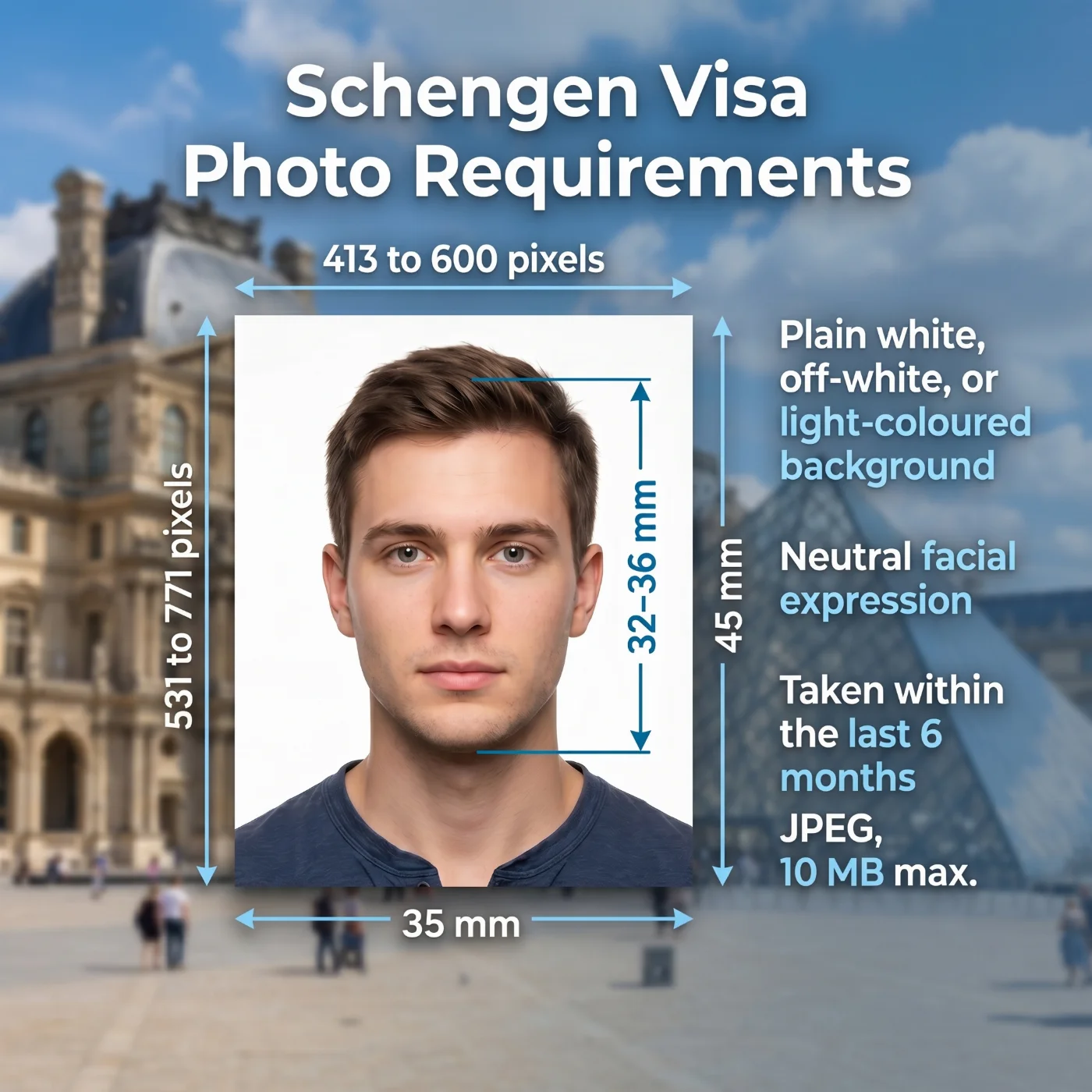 Schengen visa photo specifications are harmonized across all 29 member states. The photograph must comply with the biometric standards set by the European Union Visa Code (Regulation EC No 810/2009) and the International Civil Aviation Organization (ICAO) Document 9303, ensuring consistent automated facial recognition across all Schengen member states.
All embassies, consulates, and visa application centers process photos according to the same unified rules listed below. You don't need to verify specifications country by country — the requirements are identical whether you apply for a French, German, Italian, Spanish, or any other Schengen member-state visa.
Specification | Official Requirement |
1. Number of Photos | Two identical printed photographs are required for most paper-based Schengen visa applications. Online application portals for specific member states usually accept a single digital upload; always confirm the exact count in the instructions provided by the applying embassy or visa center. |
2. Recency | The photo must be taken within the last six months and accurately reflect your current appearance. A significant change — such as new facial hair, post-surgery changes, or weight loss — requires a fresh photo even if the previous one is still within the six-month window. |
3. Schengen Visa Photo Size | 35 × 45 mm. The face must occupy 70–80% of the image height: the head from chin to crown should measure 32–36 mm. The eye line must be positioned between 25 and 35 mm from the bottom edge of the photo. This is the standard EU/ICAO biometric portrait format. |
4. Color | Only full-color photographs are accepted. The image must reproduce natural skin tones and hair color accurately. Black-and-white, sepia, or color-filtered photos are not permitted. |
5. Background | Plain white, off-white, or very light grey background only, free of shadows, patterns, gradients, textures, or objects. Some member-state guidance specifies pure white; in practice, a uniform off-white or very pale grey (lighter than the face) is also accepted. Avoid cream, warm beige, or blue-tinted backgrounds. |
6. Lighting | Even, diffuse illumination with no harsh shadows under the nose, chin, or around the ears. No flash glare, red-eye, or bright patches on the forehead. Natural window light or soft studio lighting produces the best results. |
7. Positioning and Framing | The applicant must face the camera directly, with the head centered horizontally and vertically in the frame. No tilting, turning, or angling. Shoulders must be visible and squared to the camera. |
8. Facial Expression | A natural, neutral expression is mandatory: both eyes open and fully visible, mouth closed, no smiling, frowning, raised eyebrows, or squinting. Biometric facial recognition systems require relaxed facial muscles for accurate measurement. |
9. Attire, Head Coverings, and Accessories | Everyday clothing in solid colors is recommended. Uniforms, military camouflage, and clothing that blends with the white background are not allowed. Head coverings are permitted only for documented religious or medical reasons and must not obscure the hairline, forehead, eyebrows, or any part of the face. |
10. Glasses | Prescription glasses are accepted if the lenses don’t have glare or flash reflections and the frames don’t cover the eyes — the eyes must be fully visible. Tinted lenses, photochromic lenses, and sunglasses are never allowed. Some consulates prefer no glasses at all, so removing them is the safest option. |
11. Headphones and Electronic Devices | All earphones, earbuds, and wireless headsets must be removed before the photograph is taken. Medically necessary hearing aids that are small and do not obstruct facial features may be worn. |
12. Print and Digital Quality | Printed photos must be produced on professional photo paper (matte or glossy finish) with no borders, perforations, staple holes, or ink marks. No “pearl or silkscreen effect” is allowed, according to ICAO. Digital photos submitted online must be in JPEG format, 413 × 531 pixels (or 600 × 771 px) at 300 DPI for the standard 35×45 mm format, and a maximum of 10 MB in file size, with no visible compression artifacts, pixelation, or digital retouching. |
Expert tip: Use PhotoGov's Schengen visa photo tool to create a compliant image automatically — the platform applies all EU Visa Code specifications and ICAO 9303 biometric rules in under 30 seconds, delivering a verified digital photo ready for submission and a printable PDF sheet for in-person applications.
Acceptable Schengen Visa Photo Examples
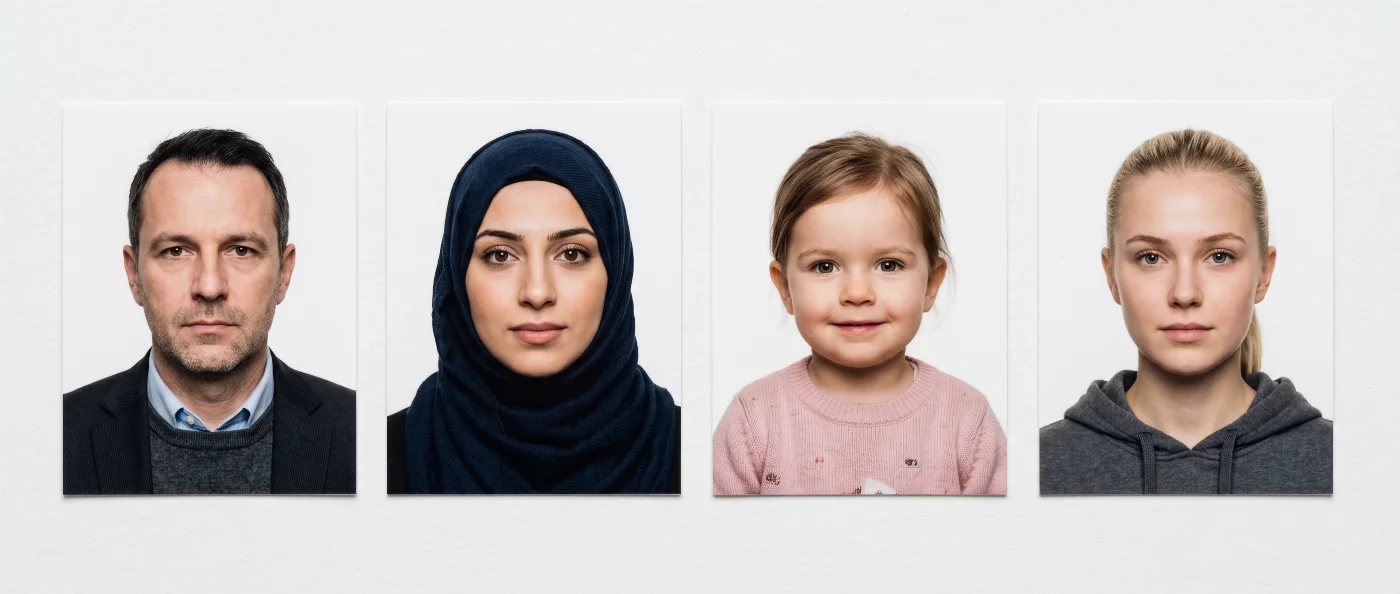 A compliant Schengen visa photo shows the applicant's full face centered against a clean white or very light background. The image is sharp and evenly lit, with no shadows on the face or the backdrop. The subject maintains a neutral expression — both eyes fully open, mouth closed, and facial muscles relaxed. The head occupies approximately 70–80% of the frame height. No glasses, hats, or non-religious accessories are present.
Unacceptable Schengen Visa Photo Examples
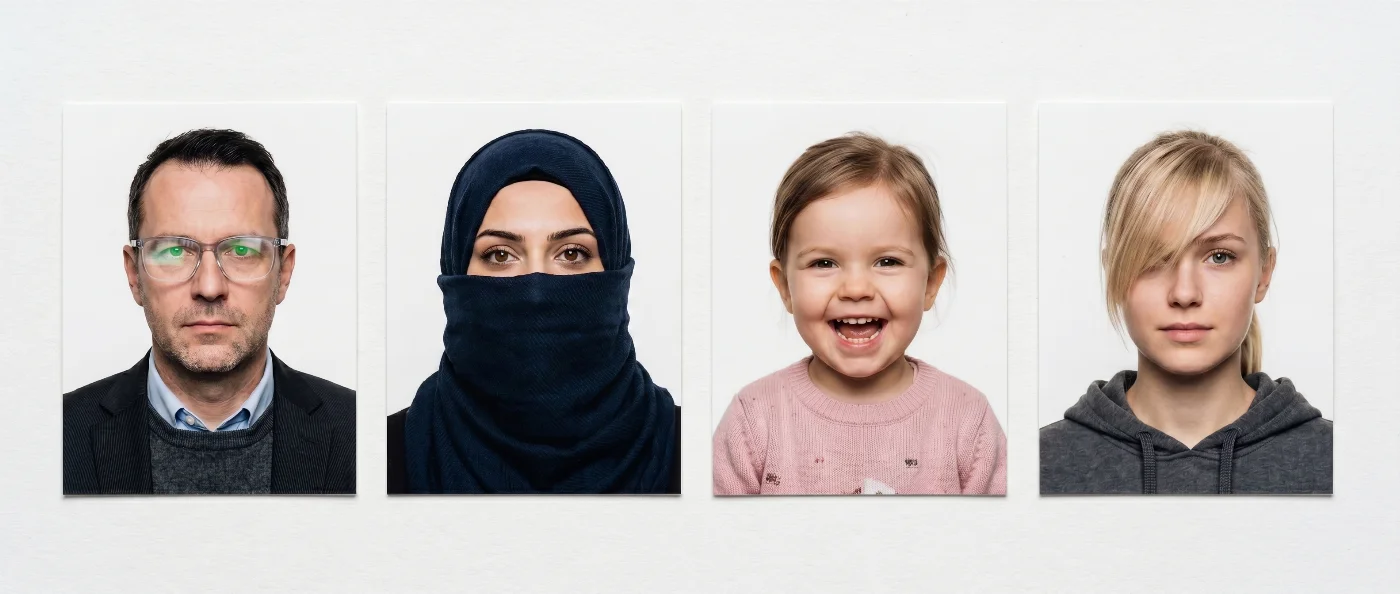 Common non-compliant photos include: images with a colored or patterned background; photos where the subject is smiling or squinting; shots with visible glasses or sunglasses; photos taken more than six months ago; images with shadow across the face or a bright flash spot on the forehead; and photos where the head occupies less than 70% of the frame.
Digital vs. Printed Schengen Visa Photos Explained
For most Schengen visa applications, two identical printed photographs must be submitted together with the application form. However, a growing number of member-state consulates and centers also accept or require a single digital photo upload for preliminary processing. The biometric specifications remain identical for both formats.
A printed Schengen visa photo must be exactly 35 × 45 mm, professionally printed on matte or glossy photo paper, with no borders or frames. A digital file prepared for upload or for use as a print source must be a JPEG at 300 DPI, with a pixel dimension of at least 413 × 531 pixels (equivalent to 35 × 45 mm at 300 DPI). File size must not exceed 10 MB.
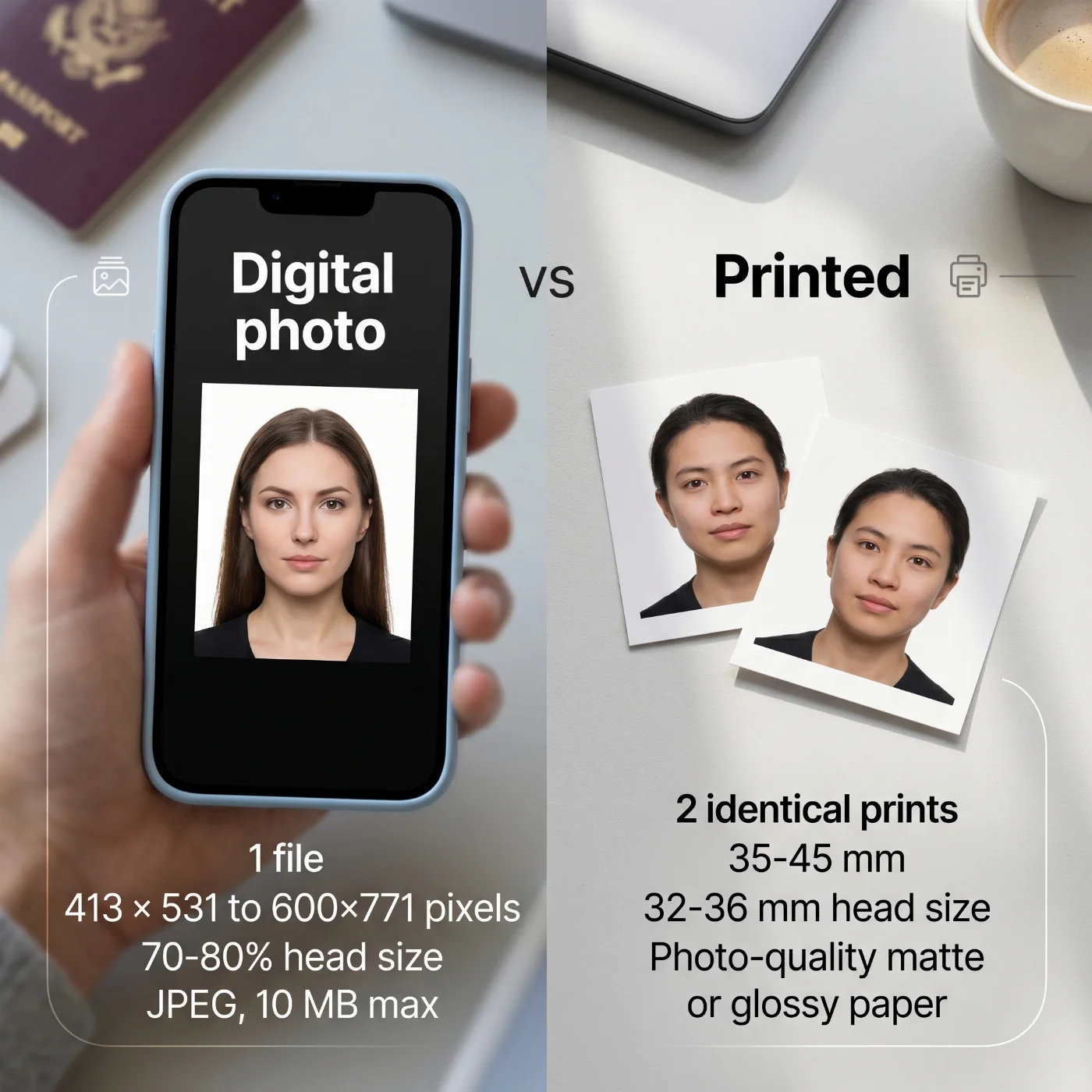
Specification | Digital Schengen Visa Photo | Printed Schengen Visa Photo |
Use case | Upload via a consulate portal or the VFS Global online system | Physical submission at an embassy, consulate, or visa application center |
Quantity | 1 file | 2 identical prints |
Dimensions | 413 × 531 to 600×771 pixels (300 DPI) | 35 × 45 mm |
Head height | 70–80% of image height | 32–36 mm from chin to crown |
Format/Specs | JPEG (.jpg), max 10 MB, 24-bit sRGB color, no artifacts | Professional photo paper, matte or glossy, no borders |
Where to Take a Schengen Visa Photo?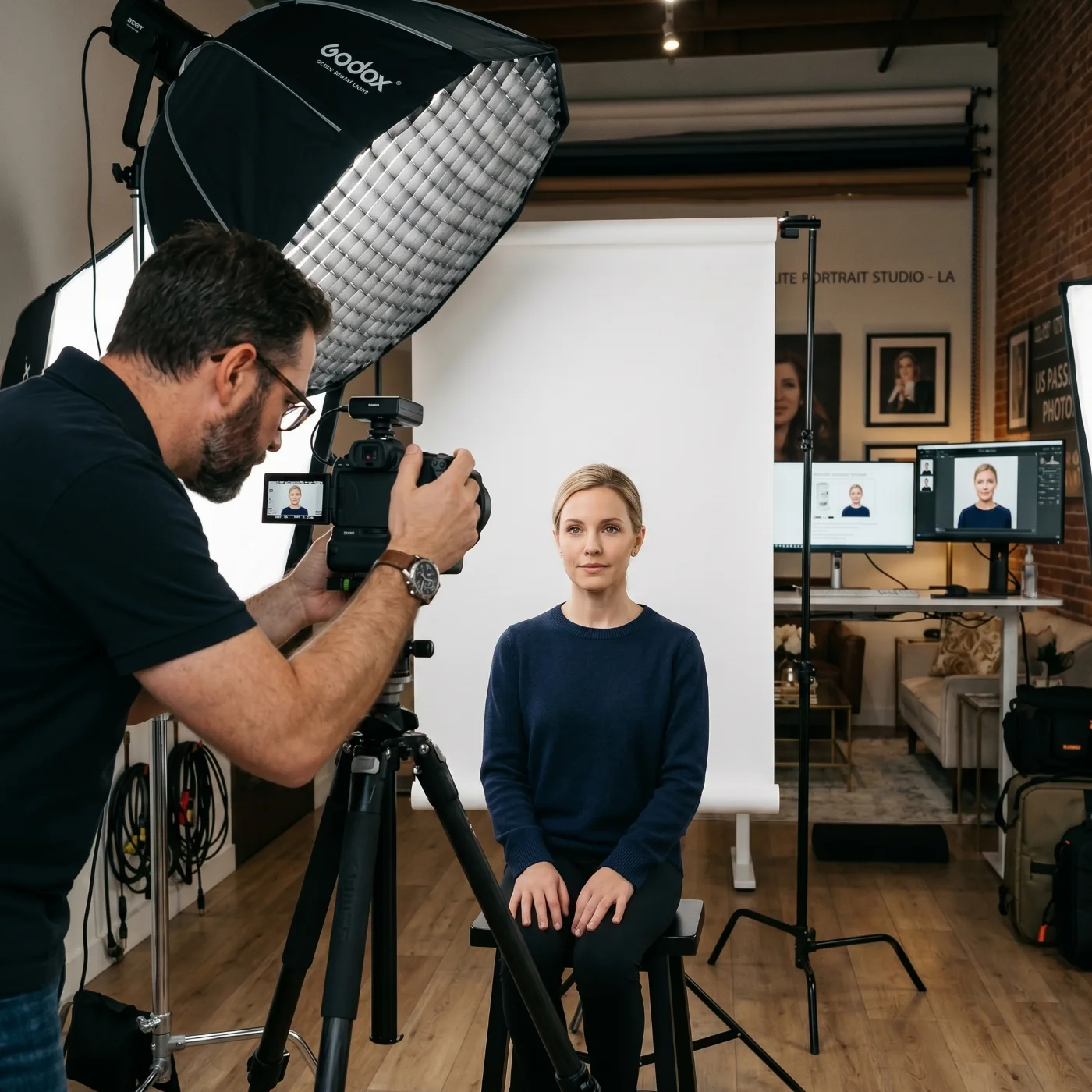 Schengen visa photos can be taken at any professional photo facility that makes a 35 × 45 mm biometric portrait on a plain white or off-white background. Below are the most commonly used options available worldwide.
Photo Booths and Kiosks
Automated photo booths in shopping centers, metro stations, and airports often support the standard European 35 × 45 mm format. While convenient, booths are a higher-risk option: uneven lighting, incorrect head positioning, and background inconsistency are frequent causes of rejection. Use a professional service if accuracy is a priority.
Post Offices and Government Photo Services
In many countries, post offices (such as La Poste in France, Deutsche Post in Germany, and Royal Mail in the UK) offer certified passport and visa photo services. Staff are generally trained to produce photos to ICAO biometric standards and can confirm Schengen-compliant dimensions and background color.
Professional Photo Studios
Commercial photography studios and specialist ID-photo providers offer the highest in-person quality assurance. Controlled lighting, calibrated equipment, and trained photographers minimize the risk of rejection. Many studios provide both printed photos and a compliant digital JPEG file on the same visit.
Pharmacy and Retail Chains
Major pharmacy and retail chains in the US, UK, and Europe (including Walgreens, CVS, Boots, and dm) often offer biometric photo services. Quality varies by branch; confirm that staff can produce the 35 × 45 mm Schengen format with a white or light-grey background before proceeding.
Online Schengen Visa Photo Tool
An online Schengen visa photo maker is the most efficient and cost-effective solution. With PhotoGov, you take a portrait with your smartphone or camera, upload it to the platform, and receive a fully compliant 35 × 45 mm image in under 30 seconds. The system automatically adjusts the crop, scales the head to 70–80% of the frame, corrects the background to plain white, and validates every parameter against the EU Visa Code and ICAO standards. You can download a digital JPEG for online submission or a printable PDF template for in-person appointments.
Schengen Visa Photo Services: Overview
Service Option | Time to Get a Photo | Approximate Cost | Acceptance Probability |
Photo Booths and Kiosks | 5–10 minutes | $5–15 | Low–Moderate |
Post Offices | 10–20 minutes | $10–20 | Moderate–High |
Pharmacy and Retail Chains | 10–20 minutes | $10–20 | Moderate |
Professional Photo Studios | 20–40 minutes | $20–60 | Very High |
Online Visa Photo Maker — PhotoGov | Under 1 minute | Free | Very High |
How to Take a Schengen Visa Photo at Home
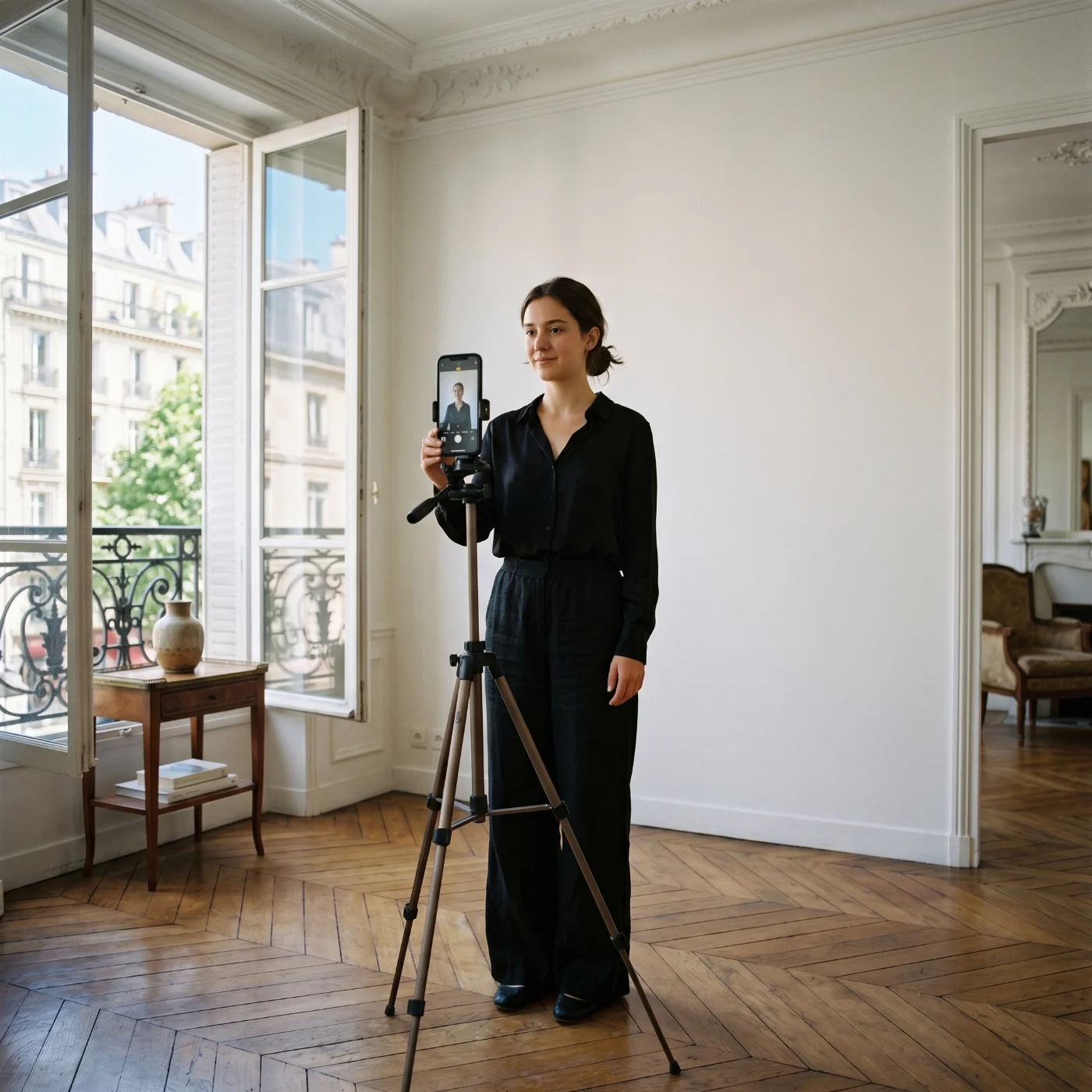
Taking your Schengen visa photo at home is straightforward with a modern smartphone and good natural light. Follow these steps, then upload your image to PhotoGov for automatic resizing, background correction, and compliance verification.
Set up the right lighting. Position yourself facing a window or other soft light source. The illumination should be even across your face — no shadows under the nose or chin, no bright patches on your forehead. Avoid using an on-camera flash directly in front of your face.
Prepare a plain background. Stand or sit in front of a plain white wall, a white door, or hang a white sheet. The background should have no visible patterns, textures, or shadows. If you cannot find a perfectly white surface, PhotoGov's background correction tool will adjust it automatically after upload.
Use a tripod or ask for assistance. Position the camera at eye level, approximately 1–1.5 meters (3–5 feet) away. If taking the photo yourself with a front camera, hold the phone at arm's length and ensure it is level with your face to avoid distortion.
Frame and position correctly. Your head and shoulders should both be visible. Look directly into the lens, keep your head level and straight, and maintain a calm, neutral expression — eyes open, mouth closed.
Take multiple shots and select the sharpest one. Do not apply any filters, beauty modes, or retouching before uploading. PhotoGov performs all necessary adjustments to meet official specifications.
Upload to PhotoGov and select "Schengen Visa." The tool will crop the image to the required 35 × 45 mm format, scale the head to 70–80% of the frame, correct the background, and validate all technical parameters. Download the compliant digital photo or a printable two-photo PDF sheet — ready for your visa application.
Schengen Visa Photo for Children
Children, including infants, must submit Schengen visa photos that meet the same biometric specifications as adult photographs: 35 × 45 mm dimensions, plain white or off-white background, neutral expression, and taken within the past six months. No exceptions are made for children over the age of approximately 12 months.
For infants under one year old, certain practical exceptions apply: the baby's eyes may be partially closed, and a slight mouth opening is generally accepted. Infants may be photographed lying on a plain white blanket, photographed from directly above, or seated in a plain white infant carrier. No other person's hands, toys, pacifiers, or support devices should appear in the frame. The background must remain uniformly white and free of patterns.
Tips for a successful children's Schengen visa photo at home:
Timing: Choose a moment when the child is awake, calm, and alert — typically after a nap or feeding.
Setup: Lay the infant on a plain white surface with soft, indirect light above; for seated older children, use the same guidance as for adults.
Expression: Encourage a calm, open-eyed neutral expression; brief vocal interactions help keep the child focused on the camera.
Background: A plain white cot sheet or a plain white wall is an ideal option.
Frame: Ensure the child's full face is visible, and no parent's hands, clothing, or accessories are in the shot.
Upload the best image to PhotoGov, and the automated tool will crop, resize, and adjust it to full Schengen compliance without any manual editing required.
10 Common Reasons for Schengen Visa Photo Rejection
Visa application centers and embassy staff reject Schengen photos more often than any other application document. Understanding the typical failure points allows you to avoid costly delays.
Incorrect dimensions: The image does not measure exactly 35 × 45 mm, or has been cropped to a non-standard aspect ratio.
Wrong background color: Background appears cream, beige, yellow-tinted, grey, or colored — only plain white or near-white is acceptable.
Shadows on face or background: Lighting from the wrong angle creates shadows under the nose, chin, or around the ears, or casts a shadow of the subject onto the background.
Non-neutral facial expression: Smiling, frowning, raised eyebrows, squinting, or parted lips violate biometric standards.
Glare on the glasses in the photo/covered eyes: Though the prescription glasses are generally accepted (double-check with your country), the glare or flash reflection on the lenses is one of the most frequent rejection reasons. If you wear glasses, your eyes must be fully visible, with no glare, no frames covering your eyes, no tinted lenses, no sunglasses.
Head too small or too large: The face occupies less than 70% or more than 80% of the image height, falling outside the 32–36 mm chin-to-crown range.
Photo older than six months: The image no longer reflects the current appearance; any significant change since the photo was taken also requires a retake.
Poor print or image quality: Visible pixelation, compression artifacts, blur, or printing on standard paper rather than professional photo stock.
Digital retouching or AI enhancements: Filters, skin-smoothing, teeth whitening, background alteration that distorts the hairline, or AI face enhancements are not permitted.
Head tilted, turned, or incorrectly positioned: The face must be centered and square to the camera. Slight head tilts are a frequent and easily missed rejection cause.
What to Do IF Your Schengen Visa Photo Gets Rejected
If your Schengen visa photo is rejected by the embassy or visa center, first carefully check the reason stated in the feedback slip or email, as staff usually indicate the exact problem (wrong size, incorrect background, shadows, expression, or glasses). Then retake the photo, making sure it strictly meets the official 35 × 45 mm format, head height of 32–36 mm (70–80% of the frame), plain white or very light grey background, neutral expression, and no eyewear or distracting accessories.
To avoid repeated refusals, use a professional biometric photo service or an online tool such as PhotoGov that applies the EU Visa Code and ICAO 9303 rules automatically and validates your image before you resubmit your application.
Frequently Asked Questions
What are the Official Schengen Visa Photo Requirements?
A compliant Schengen visa photo must meet the following official specifications, derived from the EU Visa Code (Regulation EC No 810/2009) and ICAO Document 9303:
Size: 35 mm wide × 45 mm high
Head height: 32–36 mm from chin to crown (70–80% of image height)
Background: Plain white or very light grey, no shadows or patterns
Expression: Neutral — both eyes fully open, mouth closed, no smile
Recency: Taken within the last 6 months
Color: Full-color only
Glasses: Allowed, only prescription ones, frames don’t cover the eyes, no glare or flash
Print quality: Professional photo paper, matte or glossy, no borders
Digital quality: JPEG, 413 × 531 to 600 × 771 px at 300 DPI, max 10 MB.
What is the Schengen Visa Photo Size?
The official Schengen visa photo size is 35 mm wide and 45 mm high — the standard ICAO biometric portrait format used across the European Union.
Schengen visa photo size centimeters: 3.5 × 4.5 cm
Schengen visa photo size in inches: 1.38 × 1.77 inches
Schengen visa photo size in pixels at 300 DPI: 413 × 531 pixels minimum.
What Is the Schengen Tourist Visa Photo Size?
The Schengen tourist visa photo size is 35 × 45 mm, with the head measuring 32–36 mm from chin to crown. This is the same size used for every short-stay Schengen visa.
What Is the Schengen Student Visa Photo Size?
The Schengen student visa photo size is 35 × 45 mm, with the head measuring 32–36 mm from chin to crown. The photo specification does not change between visa types — a study application uses the same photo as a tourist or business application.
What Is the Schengen Business Visa Photo Size?
The Schengen business visa photo size is 35 × 45 mm, with the head measuring 32–36 mm from chin to crown. It is identical to the size used for tourism, study, and all other short-stay Schengen visas.
How Recent Does My Schengen Visa Photo Need to Be?
Your Schengen visa photo must be taken within the six months immediately preceding your application date. The image must accurately represent your current appearance. If you have undergone a significant change in appearance — including major weight change, facial surgery, or substantial change in facial hair — a new photo is required regardless of when the original was taken.
Is the Schengen Visa Photo the Same in All 29 Member States?
Yes. The core specification — 35 × 45 mm size, a 32–36 mm head height, a light background, a neutral expression, and a photo no older than six months — comes from the Schengen Visa Code and ICAO Document 9303. Member states may add small procedural notes, so it is worth checking the page of the consulate or visa center you apply through.
Is the Schengen Visa Photo Size Different from a Passport Photo?
For most Schengen member states, the national passport photo and the Schengen visa photo share identical dimensions (35 × 45 mm) and biometric specifications under EU and ICAO standards. In practice, a photo prepared for your German, French, Italian, or Spanish passport will meet the Schengen visa photo requirements, and vice versa. Always confirm with the specific issuing authority, as minor national variations in background shade or print format occasionally apply.
What Background Color is Required for a Schengen Visa Photo?
The required background is plain white, off-white, or very light grey, uniformly lit and free of shadows, textures, gradients, or visible objects. Cream, warm beige, yellow-tinted, or mid-grey backgrounds will cause rejection. The background must be visibly lighter than the subject's face and hair to ensure adequate contrast for biometric processing.
Are Glasses Allowed in Schengen Visa Photos?
Yes, but only prescription ones, with transparent lenses that don’t have glare, flash reflection, and frames that don’t cover your eyes. The eyes must be fully visible and not enlarged by the lenses (if that is your case, it’s better to take off the glasses for the photo). Prescription glasses, tinted lenses, and sunglasses are prohibited in Schengen visa photos.
Can I Smile in a Schengen Visa Photo?
No. Even a slight smile is non-compliant if it changes the shape of your mouth or cheeks, or shows teeth. Keep a neutral expression, with the mouth closed, the eyes open, and the facial muscles relaxed, so the biometric measurements stay accurate.
Are Earphones or Headphones Allowed in a Schengen Visa Photo?
No. Earphones, earbuds, headphones, and any other visible electronic accessories must be removed before the photo is taken.
Is a Beard or a New Hairstyle a Problem for My Schengen Visa Photo?
No, as long as the photo is less than six months old and your face is fully visible. A problem arises only when facial hair or a hairstyle covers the jawline, cheeks, eyes, or eyebrows. In that case, adjust your hair or trim your beard and retake the photo.
Do I Need to Remove Facial Piercings for a Schengen Visa Photo?
There is no general ban on facial piercings, but the photo is rejected if jewelry hides facial contours, casts visible shadows, or produces strong reflections. Small, matte studs usually cause no issue, while large rings or shiny metal pieces are best removed for the photo.
Where Can I Get a Schengen Visa Photo Near Me?
Schengen visa photos are available at pharmacies, post offices, retail photo counters, self-service booths, and professional studios in most countries. Online photo tools are an alternative that works from any location at any time and lets you redo the photo immediately if it is not right.
Can I Take a Schengen Visa Photo at Home?
Yes. A smartphone or digital camera with a resolution of at least 12 megapixels is sufficient to capture a technically acceptable image, provided the setup meets official requirements: even lighting, plain white background, neutral expression, and correct framing. The most reliable approach is to take a well-lit portrait at home and then use PhotoGov to automatically crop, resize, and validate it before submission.
What is the Digital Schengen Visa Photo Format and Resolution?
For digital submission via an embassy portal, VFS Global platform, or another online system, Schengen visa photos must be submitted in JPEG (.jpg) format. The minimum recommended resolution is 413 × 531 pixels at 300 DPI (equivalent to 35 × 45 mm in print). Higher resolution — up to 600 × 771 pixels at 300 DPI — is preferred for image clarity. File size limits vary by portal but typically fall between 500 KB and 10 MB. The image must be in 24-bit sRGB color space, with no compression artifacts, filters, or digital enhancements.
How Many Photos Do I Need for a Schengen Visa Application?
Most Schengen visa applications submitted at an embassy, consulate, or in-person visa application center require two identical printed photographs (35 × 45 mm). Some VFS Global and BLS International centers additionally request a single digital file for scanning and data processing. Always refer to the application instructions from the specific embassy or processing center, as requirements vary slightly between member states and application channels.
Can Head Coverings Be Worn in Schengen Visa Photos?
Head coverings are permitted only for religious or medical reasons and only if they do not obscure the hairline, forehead, eyebrows, cheeks, or any part of the face. Religious head coverings (such as hijabs, turbans, or kippot) worn as a daily practice are accepted. Medical head coverings (worn due to illness or post-surgical care) are also accepted, but a signed medical certificate from a licensed practitioner may be required. Fashion hats, caps, beanies, and bandanas are not permitted under any circumstances.
What Clothing Should I Wear for a Schengen Visa Photo?
Wear clean, everyday clothing in solid, mid-tone, or darker colors that provide clear contrast against the white background. Avoid white, off-white, or very pale tops that blend into the background. Uniforms, military camouflage, and anything resembling official or institutional dress are prohibited. Make sure the face and neck remain clearly visible and unobstructed.
Can I Use Makeup in My Schengen Visa Photo?
Yes, natural makeup is permitted provided it does not alter your facial features, skin tone, or structure in any way that would affect biometric identification. Avoid highly reflective or glittery products that may cause unwanted glare under studio or flash lighting. Heavy contouring, theatrical makeup, or face paint that changes the apparent structure of the face is not accepted. Retouching, digital skin-smoothing, and post-processing filters are prohibited.
Are There Different Schengen Photo Requirements for Children and Infants?
The technical specifications — 35 × 45 mm, plain white background, 70–80% head proportion — apply to children of all ages, including infants. For babies under approximately 12 months, ICAO guidelines allow slight relaxation of the expression rule: eyes may be partially closed, and slight mouth opening is generally tolerated. The infant must be alone in the frame, with no visible parents' hands, toys, pacifiers, or support structures. Older children follow the same rules as adults.
What Should My Child Wear for a Schengen Visa Photo?
Dress your child in everyday clothes that contrast with the light background, such as mid-tone or darker tops without large logos or bright patterns. Avoid white tops that blend into the background, anything that looks like a uniform, and any hood, hat, or headband that covers the forehead, ears, or hairline.
What Resolution Should My Schengen Visa Photo Have for Online Submission?
For digital Schengen visa photo submission, use JPEG format at 300 DPI, with pixel dimensions of at least 413 × 531 pixels (35 × 45 mm equivalent). For sharper results and compatibility with high-resolution consulate portals, 600 × 771 pixels at 300 DPI is recommended. The maximum file size is typically 10 MB, though individual portals may set lower thresholds (some VFS Global country portals specify a maximum of 1–5 MB). Color depth must be 24-bit sRGB. Do not apply any compression settings that introduce visible artifacts.
How Do I Check If My Schengen Visa Photo Is Compliant Before Submitting?
Use the PhotoGov Schengen visa photo checker. Upload your image, and the automated compliance engine verifies: exact dimensions and aspect ratio, head-to-frame proportion (70–80%), background color uniformity, presence of shadows, facial expression neutrality, eye openness, and technical file quality (resolution, format, color depth). The system returns instant results indicating whether your photo meets all EU Visa Code and ICAO 9303 standards. Photos created with PhotoGov carry a compliance guarantee: if your image is rejected at the visa center due to a verifiable technical issue, customer support will provide a free retake or full refund.
What Are the Most Common Schengen Visa Photo Rejection Reasons and How Can I Avoid Them?
The most frequent reasons for Schengen visa photo rejection include:
Photo dimensions outside the 35 × 45 mm standard
Background that is not plain white or very light grey
Shadows across the face, neck, or background
Wearing glasses of any kind
Non-neutral expression (smiling, squinting, raised eyebrows)
Head positioned outside the 70–80% frame proportion
Photo older than six months
Visible pixelation, blur, or poor print quality
Digital filters, retouching, or AI skin enhancement
Head tilted or turned away from the camera
To prevent rejection, create your photo with PhotoGov: the platform validates every criterion automatically and flags any non-compliance before you download the final file.
Can I Use My Schengen Visa Photo for Another Application?
Yes, within reason. Because the Schengen visa photo uses the standard 35 × 45 mm biometric format, the same photo can usually be used for a European passport, an ID card, or another Schengen visa — as long as it is still within the six-month recency window and reflects your current appearance.
Can I Use a Digital Photo for a Schengen Visa?
Yes. When you apply through an online appointment portal, you upload a digital photo with the application. The file must meet the 35 × 45 mm proportions, be saved as a JPEG, and stay within the portal's file-size and resolution limits.
What Are the Schengen Visa Photo Specifications for Digital Uploads?
For an online Schengen visa application, the digital photo is usually a JPEG, at least 300 DPI, between 120 KB and 10 MB in file size, and up to about 1000 × 1200 pixels. The head should occupy 70–80% of the image. File limits differ between portals, so always confirm the exact figures with the consulate or visa center you are applying through.
Can I Use a Black-and-White Photo for a Schengen Visa?
No. Schengen visa photos must be in color to show natural skin tones and clear detail. Black-and-white and monochrome photos are not accepted.
How Do I Print a Schengen Visa Photo?
Print the photo on high-quality matte or glossy photo paper, with your printer set to maximum resolution. You can print at a photo lab, a post office, a pharmacy photo counter, or at home. A resolution below 300 DPI produces a poor-quality print that is likely to be refused.
Can I Use a Selfie for a Schengen Visa Photo?
Yes, if it is taken correctly. The best results come from placing the phone on a tripod or stand at eye level, using the timer or the rear camera, and producing a straight, undistorted, evenly lit portrait against a plain light background.
Can I Edit the Background of My Schengen Visa Photo?
Yes. You may clean and standardize the background to a plain light tone using an online photo tool, as long as the outline of your head and face is not changed, and no visible artifacts appear around your hair. Editing that smooths skin, reshapes features, or otherwise changes your natural appearance is not allowed.
Can Two People Use the Same Schengen Visa Photo?
No. Every applicant, including each child in a family application, needs their own unique, recent photo. A shared photo, or the wrong photo attached to the wrong applicant, invalidates the application.
Official Government Sources
EU Visa Code: Regulation (EC) No 810/2009 of the European Parliament and of the Council — EUR-Lex
Schengen Visa Photo Specifications: EU Common Consular Instructions — Annex 7, Photo Standards
ICAO Biometric Standards: International Civil Aviation Organization, Document 9303, Part 3 — Specifications for Machine Readable Travel Documents
VFS Global Schengen Photo Guidelines: VFS Global Application Centers
FAQs on Schengen Visas: European Commission
Was this helpful?
96 found this helpful
Top expert
Based on official government sources
Helpful votes: 96
Was this helpful?
96 found this helpful
Service provided by Y VISION TECHNOLOGIES LLP · Stoney Works 8 Stoney Lane, London, England, SE19 3BD · Terms · Refund policy · Contact
We value your Privacy
We use cookies to enhance your browsing experience, serve personalized ads or content. By clicking “Accept All”, you consent to our use of cookies.