Glasses and Head Covering Rules for Passport Photos: 2026 Guide
Passport photo rejections are more common than most people expect, and glasses and head coverings are two of the leading causes. Understanding the glasses and head covering rules for passport photos is not just about memorizing a list — it is about knowing why these rules exist and how to apply them before you submit your application. This guide covers every relevant scenario: prescription eyewear, cosmetic lenses, medical exemptions, regular and religious coverings across four major passport-issuing countries.
Why These Rules Exist: The ICAO Biometric Requirements
Modern passports are not just travel documents. They are biometric identity instruments. Every photo submitted to a passport authority is processed against the International Civil Aviation Organization (ICAO) Document 9303 standard — the international technical specification that governs machine-readable travel documents.
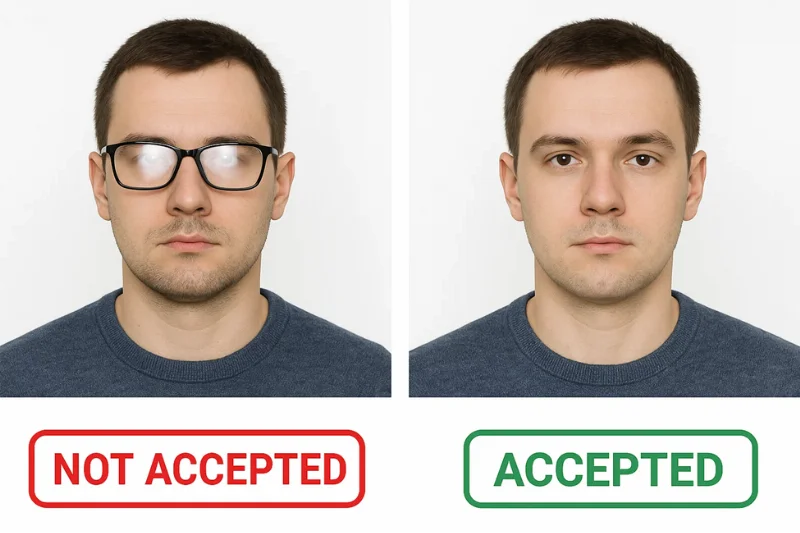
At the core of this standard is automated facial recognition. Biometric systems map specific landmarks on the human face: the distance between the pupils, the curve of the brow ridge, the geometry of the nose and jawline, and the depth of the eye sockets. Any object that partially obscures, distorts, or casts shadows over these landmarks reduces the system's ability to produce a reliable biometric template.
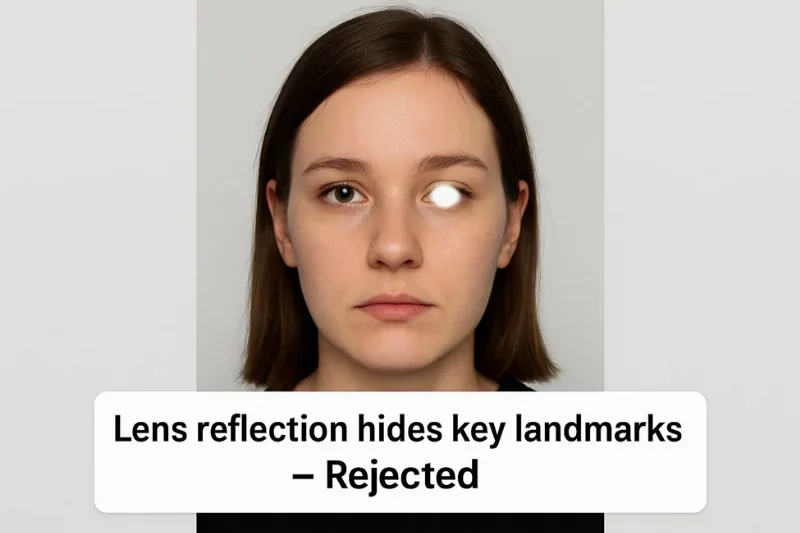
Glasses are a particular problem. Lens glare, frame shadows, refraction distortion through curved lenses, and frame edges that clip into the eye socket region all degrade landmark detection accuracy. Head coverings — when they cast shadows across the forehead or cheekbones, or create asymmetry in the face outline — produce similar interference.
This is why these rules are not arbitrary. They are engineering requirements baked into the identity verification infrastructure used at every border crossing, e-gate, and immigration checkpoint. See our detailed guide for biometric photos.
Glasses in Passport Photos: Country-by-Country Rules
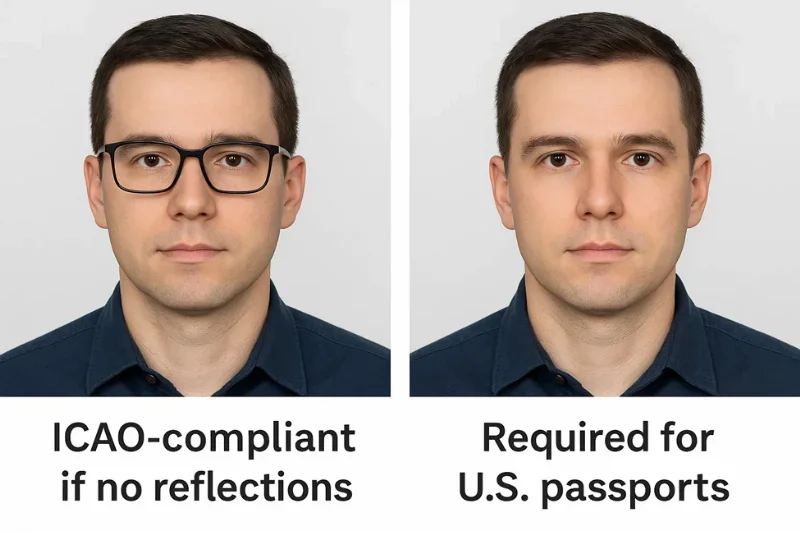
The policies governing eyewear have diverged significantly across English-speaking countries over the past decade. Canada remains the most permissive. The USA, UK, and Australia have each moved to near-total bans, with narrow medical exceptions.
Country | Glasses Allowed? | Medical Exemption | Required Documentation |
USA | No (banned since Nov 2016) | Yes | Signed statement from licensed physician |
UK | No | Yes | Signed medical statement from doctor or optometrist |
Canada | Yes, with conditions | N/A (generally permitted) | None required if lenses are clear and glare-free |
Australia | No (banned since July 2018) | Yes | Signed medical certificate; may require B11 Form |
USA — Strict Ban Since 2016
The U.S. Department of State implemented a complete ban on eyeglasses in passport photos in November 2016. The policy applies to all applicants regardless of age or vision status. Prescription glasses, reading glasses, fashion frames worn without lenses, and anti-reflective glasses are all prohibited. The only exception is a documented medical condition that makes removal physically impossible — not merely uncomfortable or inconvenient. If you qualify, your physician must provide a signed statement on letterhead confirming the medical necessity. Even with an exemption, the photo must show no glare, no shadows from frames, and fully unobstructed eyes.
Review the full US passport photo requirement list before submitting your application.
UK — No Glasses Without Medical Need
The UK government's official guidance on GOV.UK states that glasses must not appear in passport photos. The reasoning mirrors the biometric argument: lenses can create glare or reflections, cast shadows across the face, and cause distortions that interfere with automated processing. Even optically clear lenses with anti-reflective coating are prohibited under standard rules. A medical exemption is possible, requiring a signed statement from a doctor or optometrist. If granted, the photo must still meet all other requirements: no glare, no shadows, eyes fully open and visible, frames not clipping into the eye area.
Canada — Glasses Allowed With Conditions
Canada stands apart from the other three countries. Canada.ca permits prescription eyeglasses in passport photos, provided the eyes are clearly visible, there is no reflection or glare on the lenses, and the glasses are not tinted. Sunglasses are not acceptable under any circumstances. Since May 2015, tinted eyeglasses — including lightly tinted prescription lenses — have been explicitly disqualified. If your glasses create any visible glare in the photo, the application will be rejected even though glasses are technically permitted.
Australia — Similar to the USA
The Australian Department of Foreign Affairs and Trade (DFAT) banned glasses from passport photos starting July 1, 2018. The rule applies to all standard applicants. A medical exemption exists for conditions such as recent eye surgery or a permanent inability to remove eyewear, but the applicant must submit a signed medical certificate alongside the application. In some cases, a B11 Form (Medical Certificate for Passport Photo) is required. Even under a medical exemption, lenses must be untinted, frames must not obscure the eyes, and no reflections are permitted in the image.
Medical Exemptions for Glasses
A medical exemption for glasses is granted in narrow circumstances. Vision impairment alone — meaning you need glasses to see — does not qualify in the USA, UK, or Australia. The exemption is reserved for situations where removal of the glasses is physically impossible due to a medical condition: for example, post-surgical fixation, severe photophobia requiring tinted lenses for medical protection, or a structural condition where the glasses cannot be safely removed.
To apply for an exemption:
Obtain a signed statement on official letterhead from a licensed medical doctor, ophthalmologist, or optometrist.
The letter must state the specific medical reason removal is impossible — not merely that you prefer to wear them.
Submit the letter with your passport application at the time of photo submission.
Even with an exemption, the photo must meet all biometric requirements: no glare, no shadows, eyes fully visible and unobstructed by frames.
If the photo fails the technical requirements despite the exemption, you will be asked to retake it. The exemption permits you to wear glasses — it does not exempt you from the image quality standards.
Contact Lenses and Tinted Lenses
Contact lenses occupy a separate category from eyeglasses, and the rules are consistent across all four countries.
Clear, non-tinted contact lenses are permitted in all countries without restriction. Because they do not introduce glare, shadows, or frame distortion, they pose no biometric interference. You do not need to disclose that you are wearing clear contacts.
Colored or cosmetic contact lenses that change the natural color of your eye are not permitted. The prohibition exists because eye color is recorded in passport data and used as an identification marker at some border control points. A photo that misrepresents your eye color creates a permanent discrepancy in your biometric record.
Transition lenses (photochromic lenses that darken in response to UV light) are banned in passport photos in all four countries. Even if the lenses appear clear indoors, they are classified as tinted lenses under passport photo rules. If you wear transitions as your only pair of glasses, remove them for the photo.
Theatrical or special-effects contact lenses — including lenses with patterns, unusual pupil shapes, or any non-standard appearance — are prohibited for the same reason as colored cosmetic lenses.
Head Covering Rules in Passport Photos
Head coverings are evaluated differently from glasses. While glasses are prohibited by default (except in Canada), head coverings are permitted by default — provided they are worn for a genuine religious or medical reason and the covering does not interfere with the visibility of the face.
Country | Religious Coverings | Medical Coverings | Key Visibility Requirement |
USA | Allowed with a signed statement of daily wear | Allowed | Eyes, brows, nose, mouth, jawline fully visible |
UK | Allowed if face is fully visible | Allowed | The full face from forehead to chin must be visible |
Canada | Allowed | Allowed | Full face visible; no shadows on face |
Australia | Allowed; plain material only, no patterns | Allowed | Full face chin to forehead, including outer eye corners; no shadows |
Religious Head Coverings
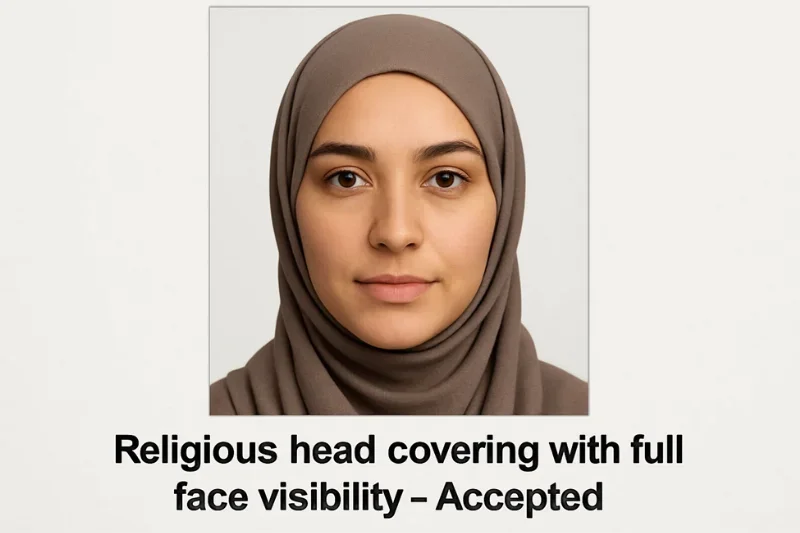
Religious head coverings are permitted across all four countries. Accepted types include:
Hijab — worn by Muslim women; must be a plain, solid-colored fabric. The face from chin to hairline must be fully visible. No fabric may cross the forehead or cast a shadow over the nose bridge.
Turban — worn by Sikh men and women; the covering must be neat, symmetrical, and not create any shadow across the face.
Kippah (yarmulke) — typically small and positioned at the back of the head; generally does not interfere with visibility requirements.
Tichel or mitpachot — a Jewish head wrap; must be plain and not extend across the forehead.
Niqab or face veil — these are not permitted in any country for standard passport photos, as they cover the lower face and obstruct the landmarks required for biometric processing.
In the USA, the U.S. Department of State requires applicants wearing religious head coverings to submit a signed statement confirming the item is worn daily for religious reasons. Australia requires that the material be plain — no decorative patterns, embroidery, or textures — and that no shadows fall anywhere on the face.
Medical Head Coverings
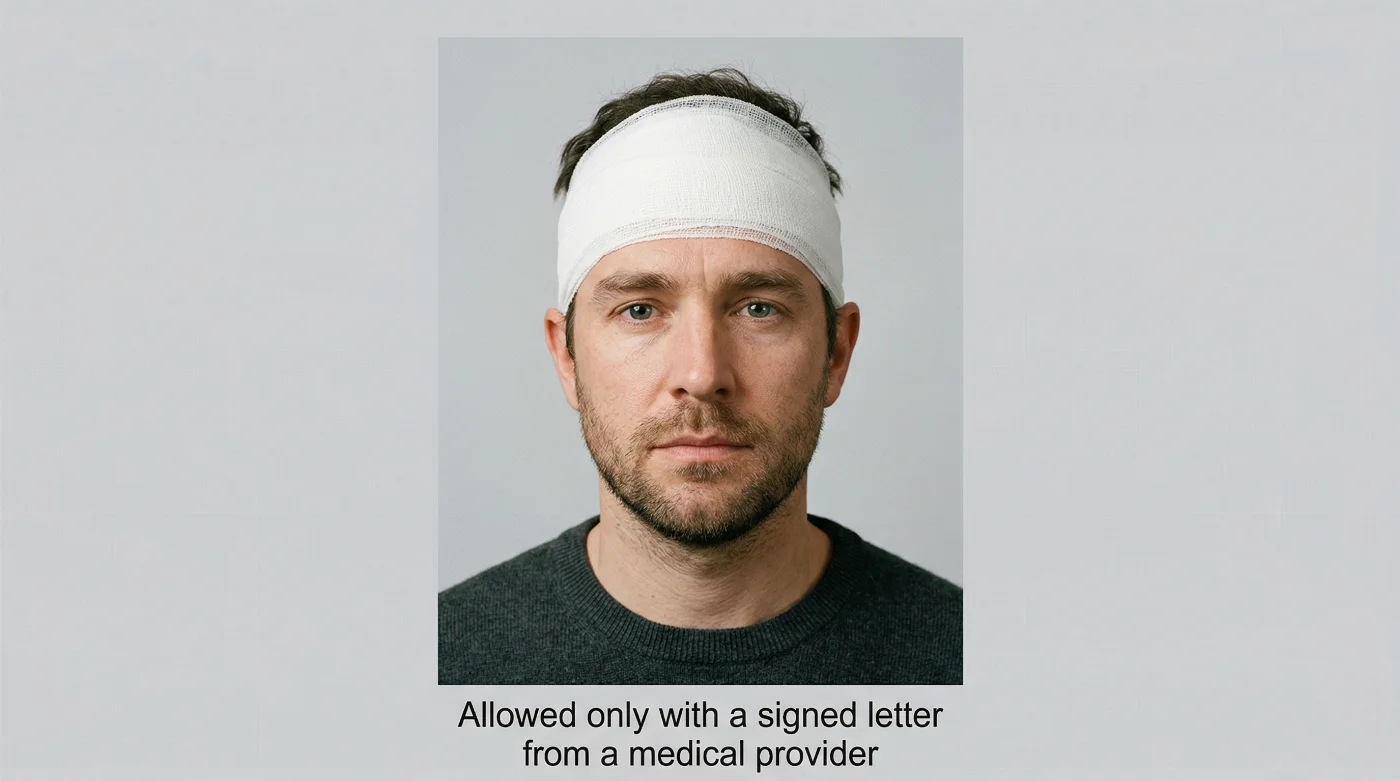 Medical head coverings are permitted for documented conditions such as chemotherapy-related hair loss, alopecia, scalp conditions requiring protective covering, or recovery from head surgery. As with religious coverings, the full face must remain visible. Coverings worn for cosmetic reasons without a medical basis are not eligible for this exemption.
If the condition is temporary — such as post-operative wound coverage — it is worth waiting until the covering can be removed, if the timeline allows. A photo with a head covering on file may create verification difficulties later if the covering is no longer present when you travel.
What Is Never Allowed
The following are not permitted under any circumstances:
Fashion hats of any style (baseball caps, beanies, fedoras, wide-brim hats)
Bandanas or non-religious fabric wraps
Hair accessories that significantly alter the outline of the head
Coverings that obscure the hairline, forehead, or temples without a religious or medical basis
Any covering that casts a shadow on the face
Coverings with decorative patterns (prohibited specifically in Australia).
If the condition is temporary — such as post-operative wound coverage — it is worth waiting until the covering can be removed, if the timeline allows. A photo with a head covering on file may create verification difficulties later if the covering is no longer present when you travel.
Visibility Requirements That Apply to Everyone
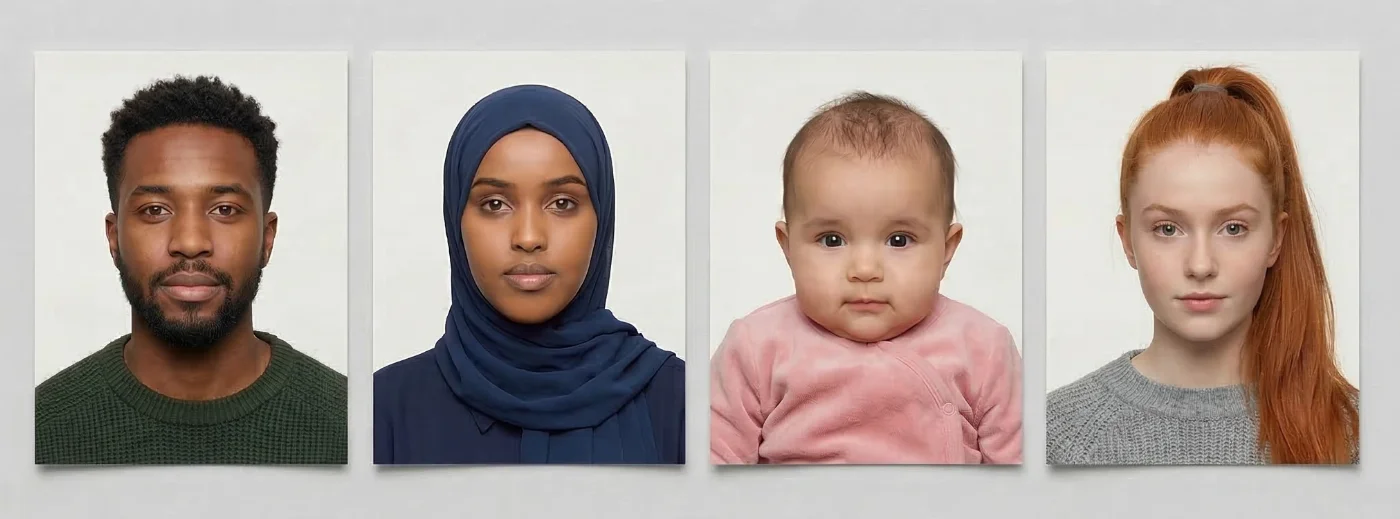 Regardless of whether you wear glasses, a head covering, or neither, the following facial features must be fully visible in every passport photo:
Both eyes — fully open, clearly visible, looking directly into the camera
Both eyebrows — completely unobscured by hair, frames, or fabric
The nose — full bridge and tip must be visible
The mouth — closed, with lips visible
The jawline — complete contour from ear to chin on both sides
The face outline — from the chin to the point where the covering or hairline begins
Ears are not required to be visible. This is a common myth. Neither the U.S. Department of State nor the ICAO standard requires ears to appear in a passport photo. Hair over the ears, head coverings that conceal the ears, and earrings that draw attention to the ear area are all acceptable, provided they do not interfere with the jawline or face outline.
Shadows: The Hidden Rejection Risk
Shadows are one of the single most common reasons passport photos are rejected — and they are almost entirely preventable with proper lighting setup.
For glasses wearers (primarily relevant in Canada, where glasses remain permitted), shadows cast by the frame — particularly from the bottom of thick frames falling across the upper cheek — will trigger rejection even if the photo meets all other requirements.
For head coverings, shadows present a more complex problem. A hijab or turban that sits close to the face can create a shadow along the jawline, across the forehead, or into the inner corners of the eyes. This occurs most often when the light source is overhead or off to one side.
How to eliminate shadows:
Use diffuse, even front-facing lighting. Avoid single overhead bulbs or sunlight from a window casting strong shadows.
Position yourself at least 50 cm from the background surface to prevent your head from casting a shadow behind you.
If taking the photo at home, use two light sources at equal angles from both sides of your face to neutralize shadows.
After taking the photo, zoom in on the eye corners and jawline area specifically to check for shadows.
If using a hijab or turban, shoot a test frame and review it before the final submission.
Pre-Submission Checklist
Before submitting your passport photo, confirm each of the following:
No glasses are present in the photo (unless you are in Canada with clear, glare-free lenses, or you hold a valid medical exemption with supporting documentation).
No tinted lenses of any kind appear in the photo — including transition lenses, lightly tinted prescription lenses, or cosmetic contacts.
If you wear a religious head covering, you have a signed daily-wear statement ready (required in the USA; confirm requirements for your country).
If you wear a medical head covering, supporting documentation from your physician is attached to your application.
The covering is plain material with no decorative patterns (required in Australia; best practice everywhere).
Your eyes, eyebrows, nose, mouth, and jawline are all fully visible and unobscured.
There are no shadows on your face — check the jaw line, forehead, and inner eye corners specifically.
There is no shadow behind your head on the background.
Your expression is neutral: eyes open, mouth closed, looking directly into the camera.
The photo was taken within the past six months and accurately reflects your current appearance.
Clear, non-tinted contact lenses are acceptable — confirm they are not cosmetically colored.
You have reviewed the specific requirements for your country's passport office before final submission.
Frequently Asked Questions
Can I Wear my Prescription Glasses in a US Passport Photo?
No. The U.S. Department of State has banned all eyeglasses from passport photos since November 2016. The ban applies to all applicants, including those who wear prescription glasses every day. The only exception is a documented medical condition that makes removal physically impossible, supported by a signed physician's statement. Vision correction needs alone do not qualify.
Is a Hijab Allowed in a Passport Photo?
Yes. A hijab is permitted in passport photos in the USA, UK, Canada, and Australia, provided it is worn for genuine religious reasons and the full face — from chin to the lower edge of the forehead — is clearly visible. In the USA, you must submit a signed statement confirming that you wear the hijab daily for religious reasons. In Australia, the material must be plain with no patterns and must not cast any shadow on the face.
Are Clear Contact Lenses Allowed in Passport Photos?
Yes. Clear, non-tinted contact lenses are permitted in all countries without restriction. They do not introduce glare, distortion, or biometric interference. Colored or cosmetic lenses that change your natural eye color are not permitted, as eye color is used as an identification reference in passport records.
Why are Transition Lenses Not Allowed Even if They Appear Clear Indoors?
Transition lenses are classified as tinted lenses under passport photo regulations, regardless of their appearance at the time the photo is taken. Because they can darken under UV exposure, the photo would not consistently represent your appearance across different lighting conditions. All four countries — the USA, the UK, Canada, and Australia — prohibit transition lenses.
Do My Ears Need to be Visible in a Passport Photo?
No. This is a widespread misconception. The U.S. Department of State does not require ears to be visible, and neither does the ICAO 9303 standard. Hair over the ears, head coverings that conceal the ears, and earrings are all acceptable, as long as the jawline and face outline remain fully visible.
What Happens if I Submit a Passport Photo With Glasses and My Application is Rejected?
Your application will be delayed, and you will need to submit a new, compliant photo before processing can continue. In some countries, any fees associated with the rejected application phase may not be refunded. If you are on a time-sensitive travel schedule, this delay can be significant. It is far more efficient to retake the photo before submission than to deal with a rejection after the fact.
Note: if your DV Lottery entry is rejected because of the glasses issue, you can only resubmit your entry the next year, with no exceptions.
Can I Wear a Kippah in My Passport Photo?
Yes. A kippah (yarmulke) is recognized as a religious head covering and is permitted in passport photos in all four countries. Because a kippah typically sits at the back or top of the head without covering the forehead, it rarely interferes with the required facial visibility. Confirm that it is not casting any shadows across the crown or forehead area.
Was this helpful?
15 found this helpful
Authored by:
Nathaniel K. Rowden (Compliance consultant)Approved author
Verified by Photogov experts
ICAO 9309 compliant
Based on official government sources
Helpful votes: 15
Was this helpful?
15 found this helpful