How to Upload a Digital Photo: 4 U.S. Scenarios (Renewal, Visa & DV Lottery)
Table of contents:
- Find Your Scenario — Jump to the Right Section:
- Scenario 1: Uploading a Digital Photo for Online Passport Renewals
- Scenario 2. Uploading a Photo for a Nonimmigrant U.S. Visa Application
- Scenario 3. Photo for an Immigrant Visa (DS-260)
- Scenario 4. Uploading a Photo for the DV Lottery
- Digital Passport Photo Upload: All Scenarios at a Glance
- When You Cannot Upload a Digital Photo
- Frequently Asked Questions
- Official Government Sources
- Related pages
Uploading a digital photo for your U.S. passport or visa seems simple — until your application gets rejected because of biometric mistakes or the wrong file format. This guide walks you through every requirement, every common mistake, and every step of the upload process, based directly on the U.S. Department of State guidelines and prepared for the four U.S. photo scenarios: online passport renewal, nonimmigrant visa (DS-160), immigrant visa (DS-260) and the DV Lottery entry.
Find Your Scenario — Jump to the Right Section:
Use case | Section of this Guide |
|---|---|
1. Renewing a U.S. passport online (age 25+) | Scenario 1 section below |
2. Applying for a non-immigrant U.S. visa (tourist, student, work) | Scenario 2 section below |
3. Applying for an immigrant visa (green card via consular processing) | Scenario 3 section below |
4. Entering the Diversity Visa (DV) Lottery | Scenario 4 section below |
Scenario 1: Uploading a Digital Photo for Online Passport Renewals
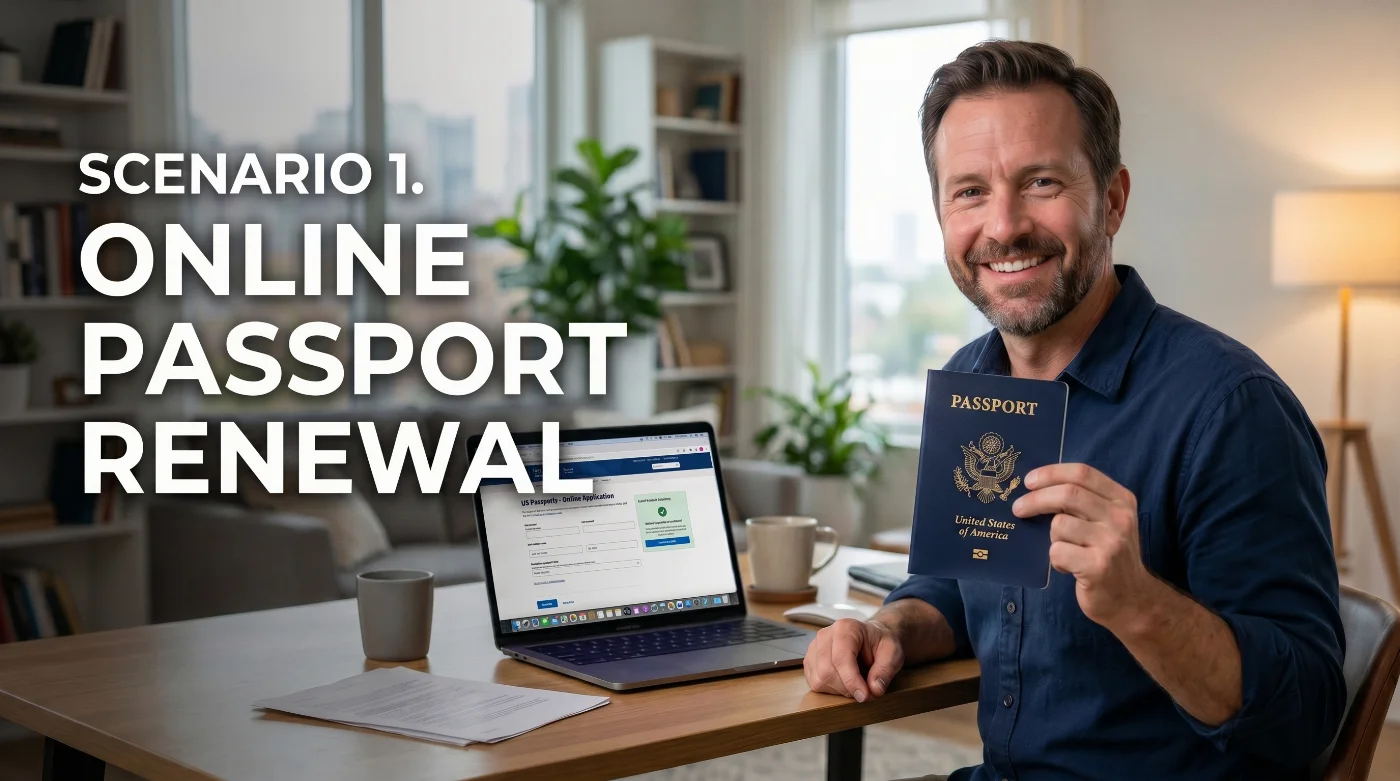
The U.S. passport renewal photo is submitted at a designated portal as part of an online renewal application. For a complete step-by-step walkthrough, including photo setup, the automated validator sequence, and all rejection error codes, see our detailed Online passport renewal guide.
Eligibility check (all must apply): age 25+; 10-year adult passport expiring within 1 year or expired less than 5 years ago; no name, sex, or other personal data changes; passport in your possession and undamaged; not traveling for at least 6 weeks from submission; located in a U.S. state or territory.
File specs: JPG, JPEG, PNG, HEIC, or HEIF — 54 KB to 10 MB. The U.S. Department of State does not set a pixel size or color profile for online renewal; PhotoGov delivers a JPEG of 600 × 600 pixels.
Key pitfalls:
Color profile. No color profile is required for online renewal — upload the PhotoGov file as is; sRGB matters only for visa photos (DS-160). The iPhone guide walks through a passport photo taken with an iPhone end to end, including the camera settings that matter.
Non-white background. Take your photo against a plain, light wall in even lighting — PhotoGov replaces it with the plain white background the U.S. Department of State requires. If your source image has shadows, glare, or any artifacts, retake the photo instead of editing it. Stand several feet from the wall and use diffuse, even lighting.
Reduced image quality. Upload the file you downloaded from PhotoGov as is: a copy sent by text message, re-saved by a messaging app, or captured as a screenshot loses quality.
Filters, AI edits, or beauty mode. Any software that alters facial geometry or skin texture causes biometric landmark mapping failure. Upload the PhotoGov file without filters or further edits.
Digital Renewals of Сhildren Passports
Children 16 and older follow the same process as adults and are eligible for online renewal if they otherwise meet the eligibility requirements. All standard U.S. Department of State photo requirements apply — white or off-white background, neutral expression, both eyes open, no glasses, no hats, taken within the last 6 months.
Children under 16 cannot renew a passport online and are not eligible for the digital upload process. They must apply in person using Form DS-11 at a passport acceptance facility and submit a printed 2×2-inch photo on matte or glossy photo paper.
Uploading a Photo for Passport Renewal Online vs. In-Person Application
There are two ways to renew a U.S. passport, and each requires a different photo format — even though the underlying photo requirements (white background, neutral expression, no glasses, etc.) are identical. Where the rules differ for digital or printed passport photos, our comparison page sets both formats out side by side.
Online renewal — available atopr.travel.state.gov — requires a digital photo file uploaded directly through the application. No printing, no mailing a photo separately. The file must be a JPG, JPEG, PNG, HEIC, or HEIF between 54 KB and 10 MB. The U.S. Department of State does not set a pixel size for online renewal; PhotoGov delivers a JPEG of 600 × 600 pixels.
In-person or mail-in renewal requires a printed 2×2 inch (51×51 mm) photo on matte or glossy photo paper, physically attached to your DS-82 form. The photo must be printed — not a screenshot, not a phone image shown on screen.
A few things that trip people up when switching between the two methods:
Do not scan a printed photo for online upload. Scanning degrades sharpness and introduces compression artifacts — the system will likely reject it for low quality. If you have a printed passport photo, you need a separate digital version, not a scan of the print.
Do not print a digital photo at home on regular paper for in-person applications. It must be printed on actual photo-quality matte or glossy paper. Most pharmacies (CVS, Walgreens) and passport acceptance facilities print photos to the 2 × 2 inch size.
Online renewal is not available to everyone. You must be 25 or older, renewing a 10-year passport, not changing personal information, and not traveling for at least 6 weeks. If you don't qualify, you must apply in person or by mail — and submit a printed photo accordingly.
If you prepare your photo with PhotoGov, you get both: a digital file ready for online upload and a print-ready version if you need to go the paper route instead.
Scenario 2. Uploading a Photo for a Nonimmigrant U.S. Visa Application
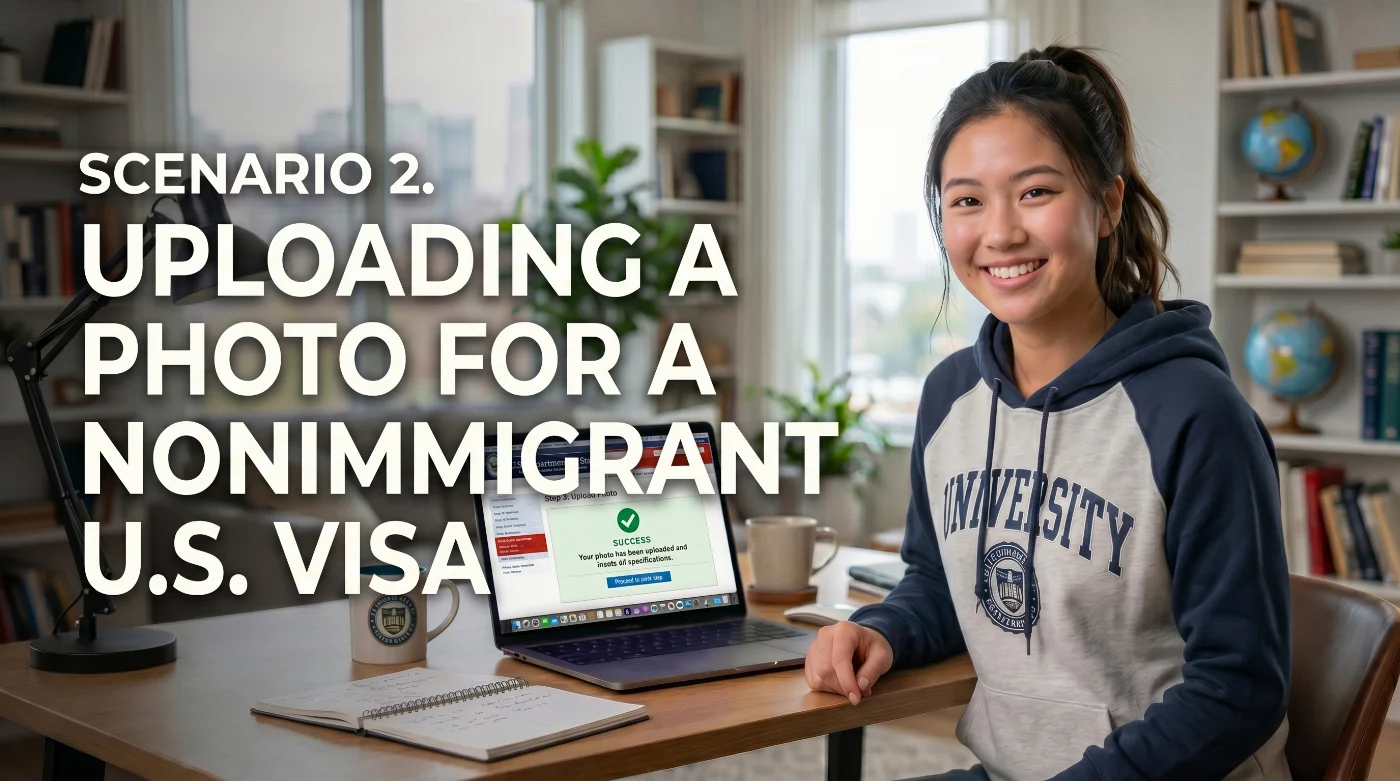
Applications for non-immigrant U.S. visas are submitted through dedicated portals, and the photos must meet a different set of requirements.
Where to submit visa photos:
DS-160 — for nonimmigrant visas (tourist, student, work, etc.) at ceac.state.gov/genniv. If a digital photo upload fails, you may need to bring one printed photo to the embassy/consulate interview. Check the official requirements before submitting.
DS-260 — for immigrant visas (green card through consular processing): bring two identical printed photos to your immigrant visa interview (see Scenario 3).
How visa photo requirements differ from passport photos:
The core rules for U.S. visa photos are the same — white background, neutral expression, no glasses, taken within 6 months — but the technical specs diverge:
Visa digital photos must be in JPEG format only (HEIF is not accepted)
240 KB max; always check the current portal instructions before submitting.
Visa photos must be square, between 600×600 and 1200×1200 pixels.
Check the U.S. Department of State's requirements for non-immigrant visa photos.
Important: A photo approved for your passport application is not automatically valid for a visa application, and vice versa — the portals run independent automated checks. If you use PhotoGov, select the correct document type (passport vs. visa) to get a file formatted to the right specs for each.
Scenario 3. Photo for an Immigrant Visa (DS-260)
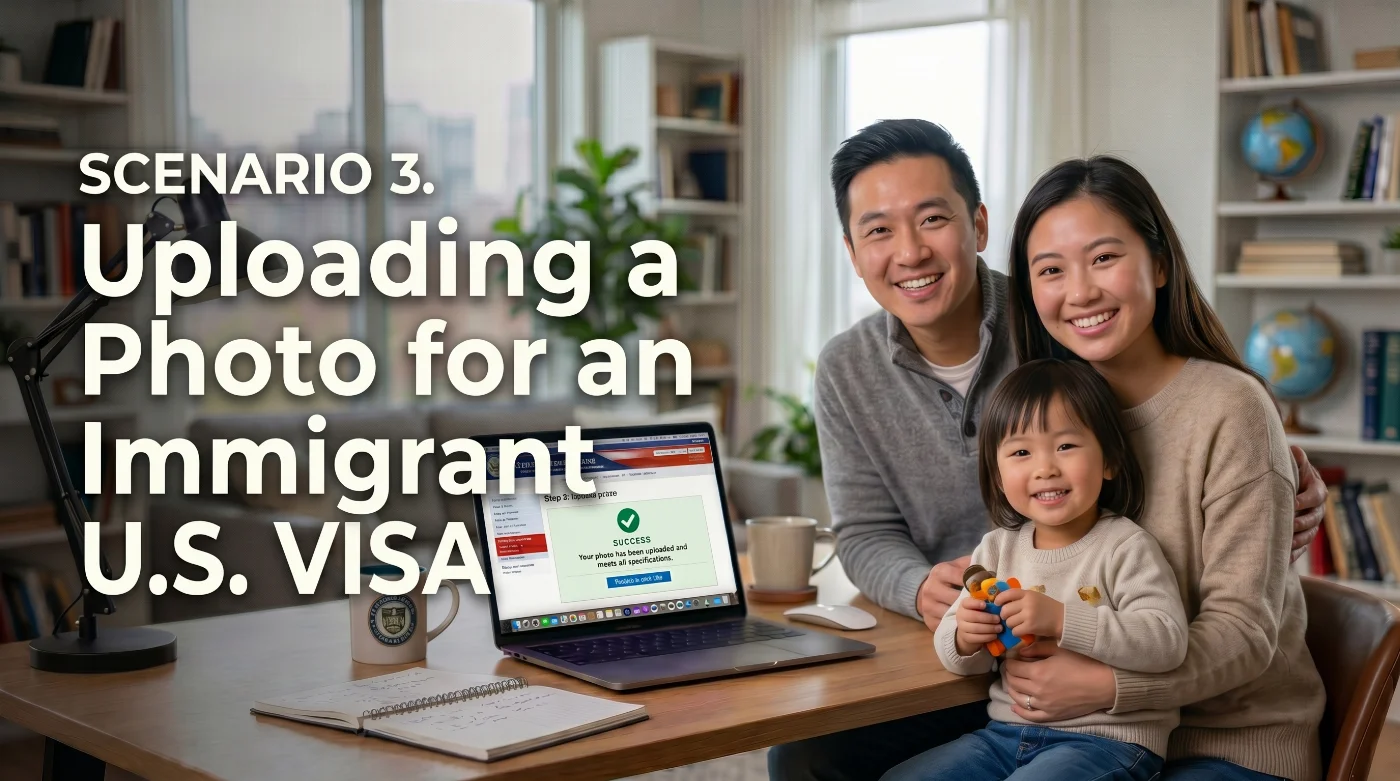
DS-260 is the Online Immigrant Visa Application, used for a green card through consular processing. For an immigrant visa (Form DS-260), bring two identical 2 × 2-inch photos printed on photo-quality paper to your interview. Follow the instructions for your case. Check the official requirements before submitting.
DS-260 vs DS-160: Note that the DS-260 is a dedicated form for immigrant visas, and the DS-160 — for nonimmigrant visas. DS-160 takes a digital photo inside the form. If you are applying for an immigrant visa using Form DS-260, you must provide two identical printed photos, 2 × 2 inches (51 × 51 mm), at your immigrant visa interview.
Scenario 4. Uploading a Photo for the DV Lottery
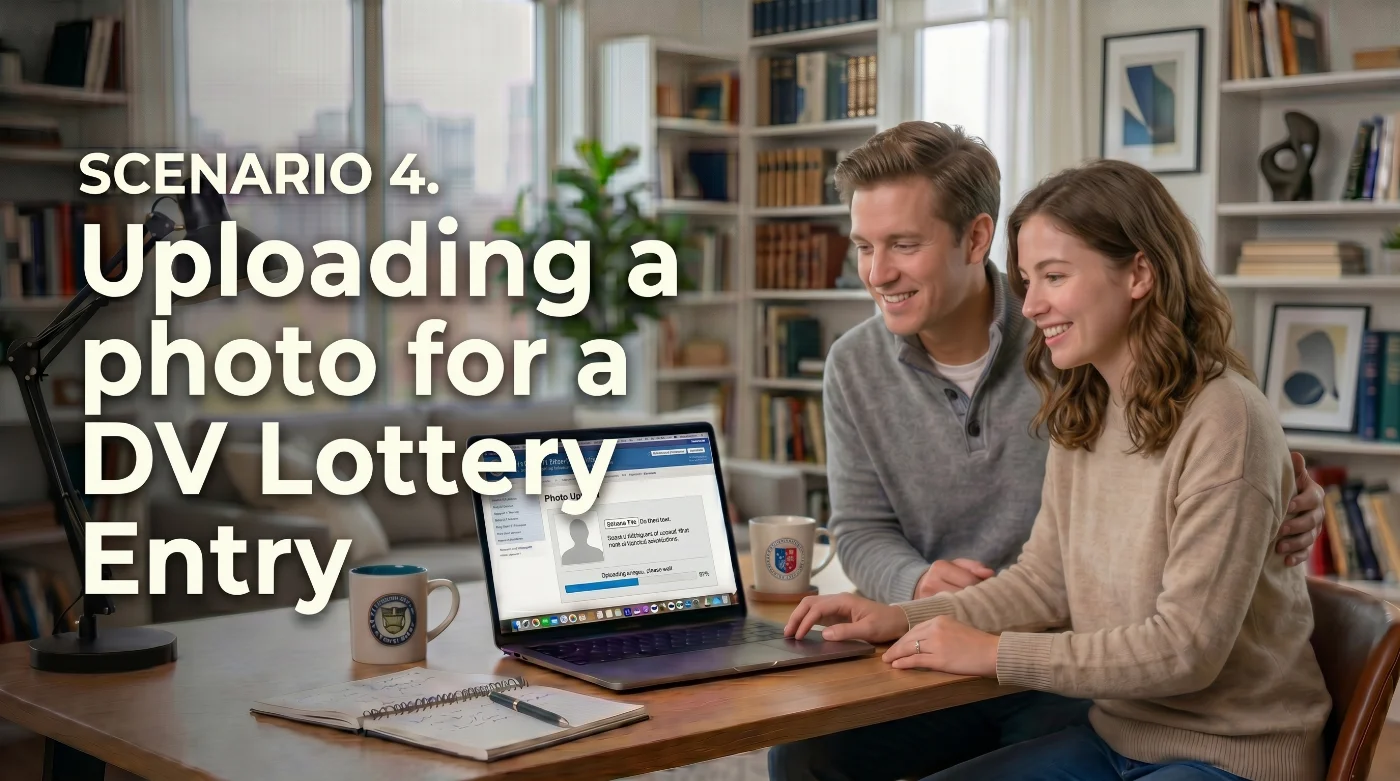
The Diversity Visa (DV) Lottery — also called the Green Card Lottery — uses a dedicated portal for its entries. The photo is uploaded as part of the entry form during the annual registration window (typically October–November, yet to be defined for the 2027 entries). The biometric requirements (white background, neutral expression, no glasses, etc.) are the same as for a passport photo — see our detailed photo requirements guide for the full checklist. The critical difference is the file size: the DV Lottery portal enforces a strict 240 KB maximum, far lower than the 10 MB limit for passport renewal.
Key pitfall: A standard passport photo file (JPEG, up to 10 MB) will be rejected. You need a JPEG of 240 KB or less, exactly 600×600 pixels. If you use PhotoGov, use the DV Lottery Tool as the document type to get a file optimized to these file specs automatically. A photo approved for DV Lottery is not valid for a passport or visa application — each portal runs an independent check. Our checklist for fixing a rejected photo goes through the errors the portals report, one cause at a time.
Digital Passport Photo Upload: All Scenarios at a Glance
Use this table to confirm which portal, format, and file specs apply to your specific situation.
Scenario | Portal | Format | File size | Key notes |
|---|---|---|---|---|
Passport renewal (online) | JPEG, PNG, HEIC, HEIF | 54 KB – 10 MB | age 25+ only | |
Nonimmigrant visa (DS-160) | ceac.state.gov/genniv | JPEG only | 240 KB max | Photo submitted inside the DS-160 form; no separate upload step |
Immigrant visa (DS-260) | ceac.state.gov/iv | Two identical printed photos, brought to the interview | Check portal instructions | Photos brought to the immigrant visa interview |
DV Lottery | JPEG only | 240 KB max | Annual entry window (Oct–Nov); strict size cap |
When You Cannot Upload a Digital Photo
Digital photo upload applies only to the upload scenarios above. In all other cases, you must submit a printed 2×2-inch photo on matte or glossy photo paper. You cannot upload digitally if:
First-time applicant (DS-11). No online portal exists for first-time passport applications. Apply in person at a passport acceptance facility with a printed photo attached to your DS-11 form.
Under age 25. Online renewal requires age 25+. Younger applicants must renew in person or by mail (DS-82) with a printed photo.
Children under 16. Must apply in person with DS-11 and a printed photo. See the “Digital Renewals of Children’s Passports” section above.
Damaged, lost, or stolen passport. Not eligible for online renewal regardless of age. Apply in person with a printed photo.
Name, sex, or personal data changes. Changes to your passport data require an in-person application. Submit DS-5504 or DS-11 with a printed photo.
Passport card only (no book). The U.S. passport card cannot be renewed through the online portal. Apply by mail with DS-82 and a printed photo. The photo specs (2×2”, white background) are identical to a passport book photo.
If you prepare your photo with PhotoGov and then discover you don’t qualify for online renewal, you can still use the same image — just request the print-ready version to submit with your paper application.
Frequently Asked Questions
Where Do I Upload a Digital Passport Photo?
It depends on what you're applying for. Online renewal, DS-160, and the DV Lottery use three separate portals — submitting to the wrong one means starting over. For DS-260, you bring two identical printed photos to your immigrant visa interview.
Passport renewal (online) — upload at opr.travel.state.gov as part of the renewal application. There is no standalone photo tool; the photo is submitted inside the form. Requires a Login.gov account to access.
Eligibility: age 25+, 10-year passport expiring within 1 year or expired less than 5 years ago, no name/sex/data changes, passport in your possession and undamaged, not traveling for at least 6 weeks, located in a U.S. state or territory. If you don't qualify, you must renew by mail or in person — see "When You Cannot Upload a Digital Photo."
Note: Sessions expire after 20 minutes of inactivity — have your photo, passport, SSN, and credit card ready before you start.
Nonimmigrant visa (DS-160) — tourist, student, work, exchange — upload inside the DS-160 form at ceac.state.gov/genniv. The photo is embedded in the application; there is no separate upload step.
Immigrant visa (DS-260) — green card through consular processing — bring two identical printed photos to your immigrant visa interview.
DV Lottery — upload at dvlottery.state.gov during the annual entry window (typically October–November). The photo is part of the entry form. File size is capped at 240 KB — significantly lower than any of the other portals.
A photo approved on one portal is not automatically valid for another. Each system runs its own automated check with its own format and size requirements.
How do I Correctly Upload a Digital Passport Photo for a Renewal?
Upload the file you downloaded from PhotoGov at opr.travel.state.gov using the file selector or drag-and-drop; the application accepts JPG, JPEG, PNG, HEIC, and HEIF files between 54 KB and 10 MB. The application includes a crop tool to adjust framing after upload.
Can I Use a Photo Taken On My Phone?
Yes. Smartphone photos work well for digital passport uploads. Use the rear camera (better quality than the front-facing camera), set it to the highest quality, have someone else take the shot, and do not apply any filters or use portrait mode beauty enhancements.
How Do I Resize a Passport Photo for Online Upload?
You don’t need to crop or resize the image manually. Upload the original photo from your camera roll to PhotoGov, select the document you’re applying for, and the tool will generate a square JPEG sized for that document — 600 × 600 pixels for online passport renewal. PhotoGov applies the biometric crop (head size 50–69% of the image height) automatically, so you only need to check that the processed image looks sharp and correctly framed before submitting.
What Happens If My Photo is Rejected During the Upload?
The portal's automated tool will display an error explaining the specific problem. If the upload system rejects your photo, correct the issue indicated in the error message and upload it again. Once the photo passes the upload check, you can submit your application. The Department of State reviews the photo after submission and may request a replacement if necessary.
How Do I Upload a Photo If the Background Isn’t White?
You don’t need to edit the background yourself — focus on taking a clean shot. Stand in front of the plainest light-colored surface you have, keep the lighting even, and leave some space around your head and shoulders in the frame. When you upload this source photo to an online passport photo maker and choose your document type, the tool replaces the background with a plain white one and applies the biometric crop. For the best result, take the photo in soft daylight, without shadows or glare on your face.
Can I Use the Same Photo for My Passport Renewal and Visa Application?
No. Each portal runs an independent automated check. Passport renewal (opr.travel.state.gov) accepts JPEG, PNG, HEIC, and HEIF; DS-160 accepts JPEG only, and for DS-260 you bring two identical printed photos to the interview; and the DV Lottery enforces a strict 240 KB file size cap. A photo that passes one portal may be rejected by another due to format, color profile, or file size differences. Prepare a separate file for each submission, or use PhotoGov and select the correct document type to get a spec-matched output for each.
What is the Difference Between DS-160 and DS-260, and Which Photo Rules Apply to Each?
The photo rules differ. For DS-160, you upload a digital photo inside the form: a square JPEG from 600 × 600 to 1,200 × 1,200 pixels, up to 240 KB. For DS-260, you bring two identical printed 2 × 2-inch photos to your immigrant visa interview.
I Don’t Qualify for Online Passport Renewal. What Are My Options?
If you are under 25, applying for the first time, changing personal data, or have a damaged/lost/stolen passport, you must apply in person (DS-11) or by mail (DS-82) and submit a printed 2×2-inch photo on matte or glossy photo paper. The photo content requirements (white background, neutral expression, no glasses, taken within 6 months) are identical to the digital version. If you prepared a digital photo with PhotoGov, you can request the print-ready version from the same file — no need to reshoot.
How Do I Prepare a Photo for the DV Lottery?
Upload at dvlottery.state.gov during the annual registration window (typically October–November). Your entry photo must be square, exactly 600×600 pixels, saved as JPEG at 240 KB or less, with a plain white or off-white background. The key constraint is file size: the portal enforces a strict 240 KB maximum. A typical passport photo file is 1–3 MB and will be rejected. Use a tool like PhotoGov and select “DV Lottery” to get a properly compressed file that stays under 240 KB without losing the required resolution.
Official Government Sources
Photo requirements for paper applications: U.S. Department of State
Official digital photo upload guide for online passport renewal: U.S. Department of State
The official U.S. online passport renewal portal: U.S. Department of State — Bureau of Consular Affairs
DS-160 nonimmigrant visa application (tourist, student, work): U.S. Department of State — Consular Electronic Application Center
DS-260 immigrant visa application (green card via consular processing): U.S. Department of State — Consular Electronic Application Center
Digital image requirements for U.S. visas (DS-160 and DS-260): U.S. Department of State — Travel
DV Lottery entry portal: U.S. Department of State — Diversity Visa Program
Related pages
On this page:
- Find Your Scenario — Jump to the Right Section:
- Scenario 1: Uploading a Digital Photo for Online Passport Renewals
- Scenario 2. Uploading a Photo for a Nonimmigrant U.S. Visa Application
- Scenario 3. Photo for an Immigrant Visa (DS-260)
- Scenario 4. Uploading a Photo for the DV Lottery
- Digital Passport Photo Upload: All Scenarios at a Glance
- When You Cannot Upload a Digital Photo
- Frequently Asked Questions
- Official Government Sources
- Related pages
Service provided by Y VISION TECHNOLOGIES LLP · Stoney Works 8 Stoney Lane, London, England, SE19 3BD · Terms · Refund policy · Contact
We value your Privacy
We use cookies to enhance your browsing experience, serve personalized ads or content. By clicking “Accept All”, you consent to our use of cookies.