Can You Smile in a U.S. Passport Photo? 2026 Rules Explained
Table of contents:
- Official U.S. Passport Photo Facial Expression Rules in 2026
- So, Can You or Can You Not Smile in a Passport Photo? The Closed-Mouth Exception
- Smiling in the U.S. Passport Photos: What Is Allowed vs. What Is Recommended
- Why Passport Photos Require a Neutral Expression
- Common Smile and Expression Errors in U.S. Passport Photos
- How to Get the Right Expression for your U.S. Passport Photo
- Can Babies and Children Smile in a Passport Photo?
- What to Do If Your Passport Photo Is Rejected for Smiling
- Pre-Submission Checklist: Expression and Pose
- Frequently Asked Questions
- Official Government Sources
Quick answer: Smiles are discouraged in passport photos: keep your expression neutral, with both eyes open and mouth closed. This is the safest way to capture your US passport photo, as your features will be easily detectable during biometric verification. The US Department of State allows a slight, closed-mouth (aka Mona Lisa) smile. However, we recommend keeping a natural expression to avoid passport application delays and rejections.
This guide explains the official U.S. rule for smiling in passport photos, the biometric reasons behind it, and, most importantly — how to avoid smile-related rejections.
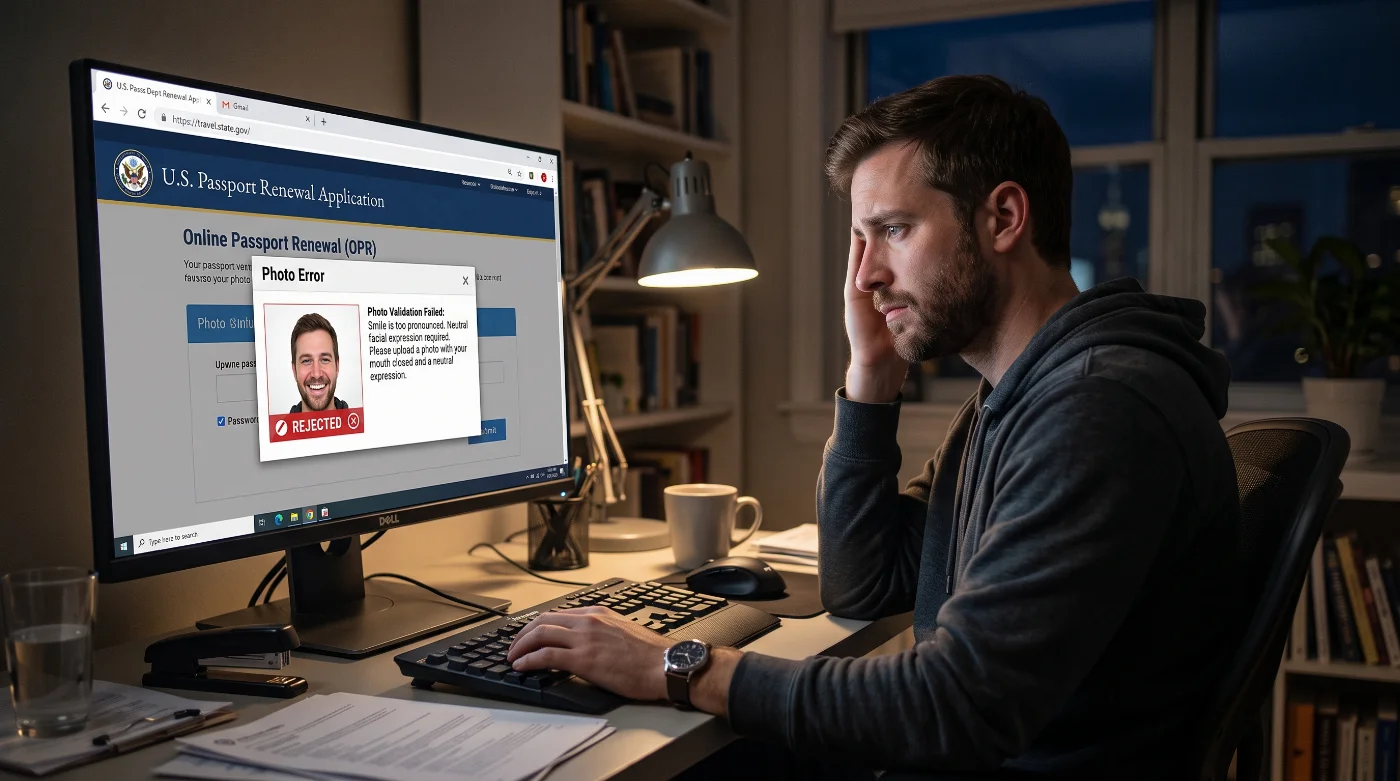
Official U.S. Passport Photo Facial Expression Rules in 2026
Your passport photo is a biometric identity image. To support reliable visual and automated verification, create a photo that follows all the specs from the table below, including a natural expression, clearly visible features, and square positioning in the shot. The facial expression specifications in this guide are based on the official U.S. Department of State rules that follow international machine-readable document requirements set by the International Civil Aviation Organization (ICAO) Document 9303.
Aspect | Requirement |
|---|---|
Facial expression | Neutral is recommended; a slight smile is allowed only if the mouth remains closed and the expression is not exaggerated |
Eyes | Both eyes open and clearly visible; hair must not cover them |
Mouth | Fully closed; no teeth visible |
Head position | Facing the camera directly; no head/shoulders tilt or turn |
Applies to | Printed photos and digital images used for online passport renewal |
The facial expression rule is the same for printed applications and digital photos uploaded for online renewal. Size, background, lighting, and file-format rules still apply separately; review the complete U.S. Department of State photo guidelines before submitting.
So, Can You or Can You Not Smile in a Passport Photo? The Closed-Mouth Exception
“You can smile in your photo. Just make sure your eyes are open, and your mouth is closed.”
As we see from the official guidance, a smile is acceptable only when all three conditions are met: both eyes are open, the lips are closed, and the expression is natural and not exaggerated. Visible teeth or a gap between the lips makes the photo non-compliant.
But keep in mind that even a compliant smile changes your facial proportions — the cheeks and mouth corners are slightly raised, and this may interfere with both automated biometric and human identification. A neutral expression therefore is the best practical choice!
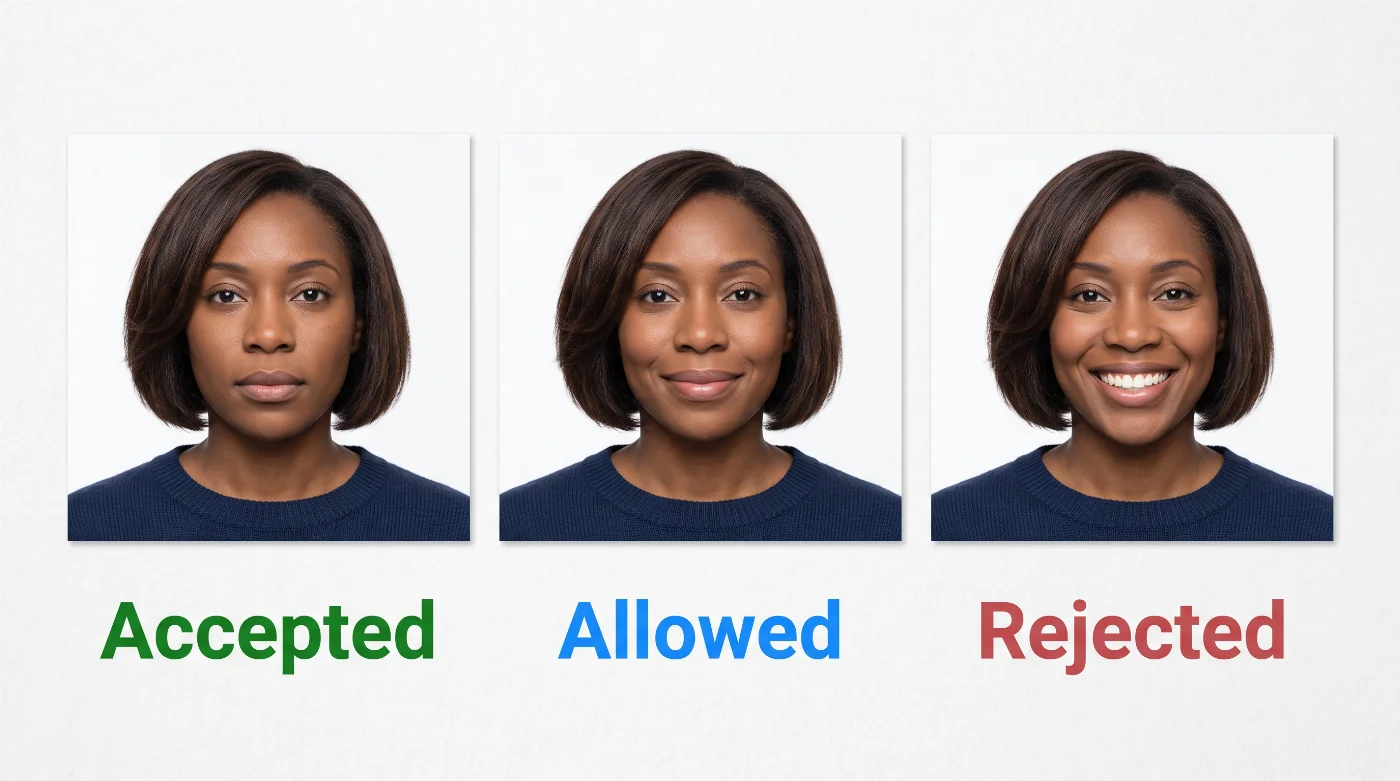
The Department of State’s passport photo unacceptable examples include an open-mouth smile. When you’re applying for a new passport, always choose a photo with relaxed lips, a closed mouth, and no visible teeth.
Smiling in the U.S. Passport Photos: What Is Allowed vs. What Is Recommended
The official rules may be misinterpreted, and even a slight mistake can be the reason for your photo rejection. We recommend referring to the “Best practice” in the table below when choosing a photo.
Aspect | Officially Acceptable | Best Practice |
|---|---|---|
Expression | A slight, closed-mouth smile if the eyes remain open and the expression is not exaggerated | A neutral, relaxed expression — no smiling, the lips are closed, the teeth aren’t visible |
Margin for interpretation | A reviewer decides whether the smile is “exaggerated” | A neutral expression removes that judgment call |
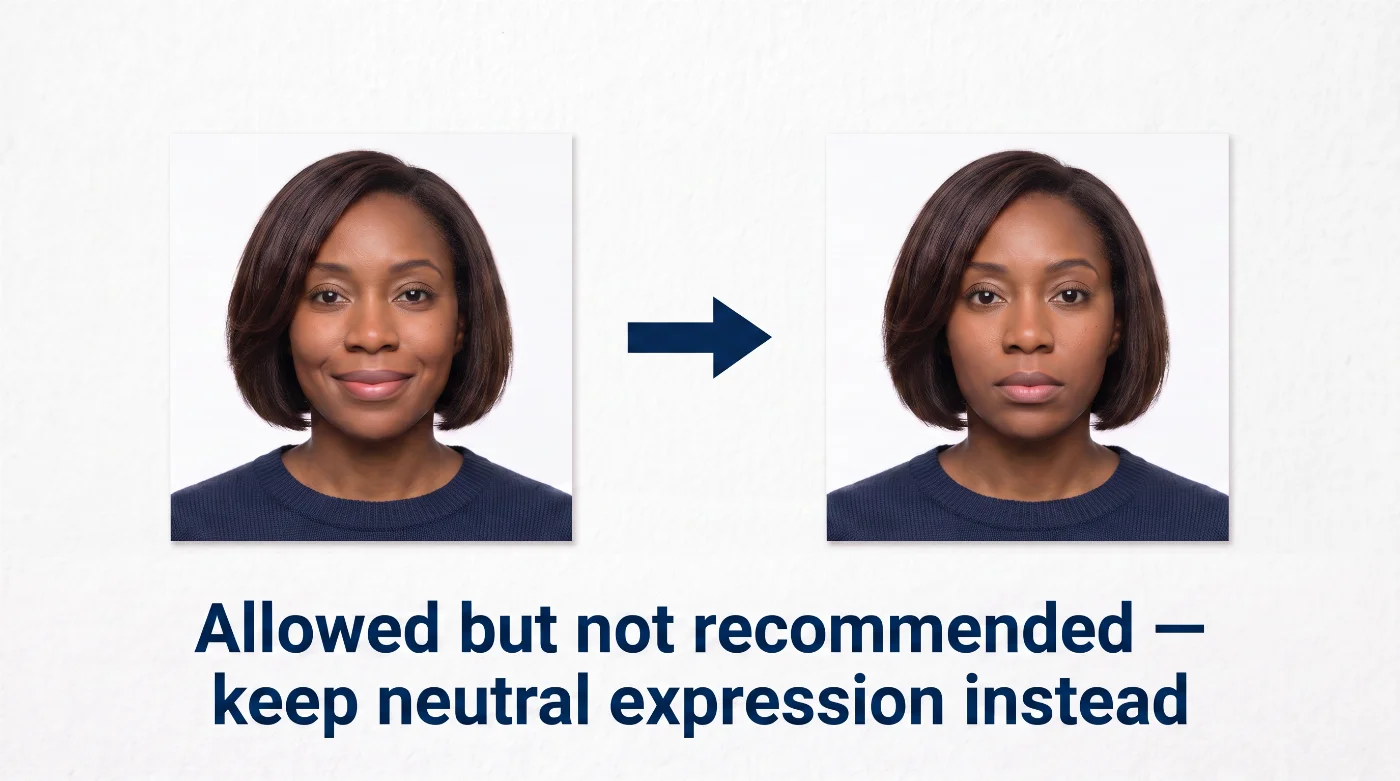
Please keep in mind that the Department of State’s accepted sample photos always show applicants with a neutral expression — never with a smile. Refer to the photo samples in this article or on the official State Department’s website to increase photo acceptance chances.
Why Passport Photos Require a Neutral Expression
Biometric photos in modern machine-readable passports are designed for reliable identity comparison over many years. ICAO Document 9303, which sets the international standard for these documents, requires a front-facing portrait with a neutral expression — a relaxed, natural-looking face keeps the eyes, cheeks, and mouth in a consistent position. A broad smile, open mouth, raised eyebrows, or squinting changes those reference points and can reduce the quality of a biometric or visual match.
Common Smile and Expression Errors in U.S. Passport Photos
The table below lists the most common expression failures in U.S. passport photos. Never try to correct them with digital tools — always retake the photo if one or a few errors appear in the photo that you’re about to submit.
Error | The reason for rejection |
|---|---|
Open mouth | Alters natural facial biometric proportions. Explicitly shown as unacceptable in the Department of State examples |
Visible teeth | Alters natural facial biometric proportions. The official source specifically sets the closed-mouth rule for passport photos |
Exaggerated expression (children) | Alters natural facial biometric proportions. A neutral facial expression is required for older children — newborns may have their eyes partially closed. |
Eyes closed or obstructed | Alters natural facial biometric proportions. Both eyes must be open and clearly visible to allow automatic and manual biometric identification. |
Head tilted | Interferes with the biometric identification — applicants of all ages must look into the camera directly, with the head and shoulders square in the shot. |
How to Get the Right Expression for your U.S. Passport Photo
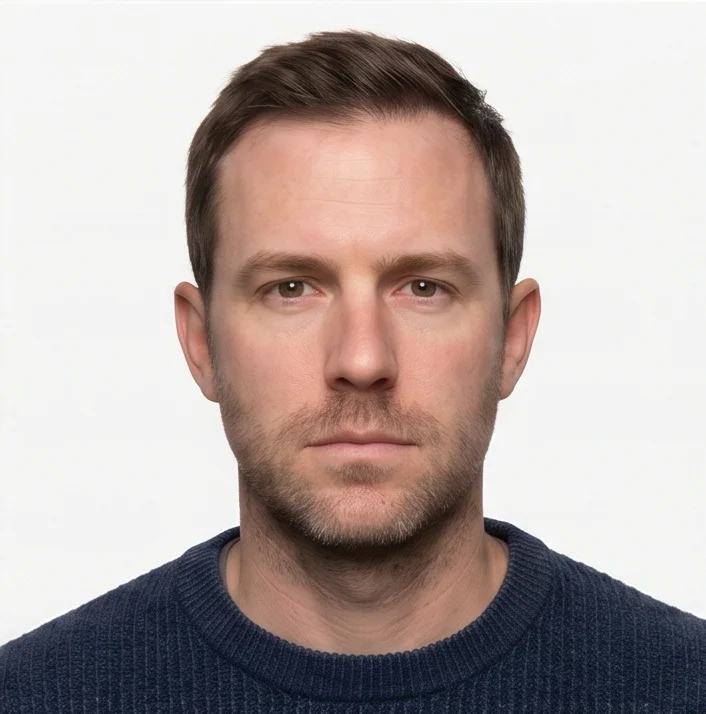
Take a Natural-Looking, Closed-Mouth Photo
Relax your jaw and lips before taking the photos. Position yourself square in the shot, keep your head level, and look into the lens rather than at the screen preview. Take several shots and choose the one with the most neutral expression — open eyes, relaxed lips, and no visible teeth.
If You Smile Automatically
Exhale slowly just before the photo is taken; holding your breath can help relax the features and keep your mouth closed. Use burst mode or ask the photographer to take several shots. Review each frame at full size and ditch images with parted lips, closed eyes, squinting, or a tilted head.
Can Babies and Children Smile in a Passport Photo?
Smiling isn’t recommended in passport photos for children either. The authorities are aware that it is very hard to make a child of any age keep an absolutely neutral expression — and the photo samples on the official page prove that. However, the key adult rules apply to children of all ages:
The child must face the camera directly, with the head and shoulders square in the shot
The face must be fully and clearly visible
A tilted head or an overall tilted positioning isn’t allowed
No parent, hand, toy, or other person may appear in the frame
The only exemption is partially closed eyes for newborns and very young children (age isn’t specified). This usually refers to children under one year old who are yet unable to control their expression: partially closed eyes are allowed in their passport photos.
But still try to take the best shot of your baby. Take the photo when the child is calm, use burst mode, and select a frame where the face is at rest. For babies, place the child on a plain white or off-white sheet and keep all support outside the frame. Use baby passport photo maker for a reliable result.
What to Do If Your Passport Photo Is Rejected for Smiling
If a reviewer rejects your photo with a smile or an exaggerated expression, submit a new photo with a neutral expression, eyes fully open, and mouth closed. Do not digitally edit the rejected image! Online applicants should upload the replacement through the requested channel; paper applicants should provide a new print in person, as instructed.
Pre-Submission Checklist: Expression and Pose
Expression. Neutral and relaxed; if smiling, keep it slight and closed-mouth.
Eyes. Both open, visible, and not obscured by hair.
Mouth. Lips together; no gap and no visible teeth.
Head. Facing the camera directly; no tilt or turn.
Final check. Compare the photo with the official accepted examples and retake it if any requirement is borderline.
Frequently Asked Questions
Is it Better to Keep a Neutral Expression or a Slight Smile in a U.S. Passport Photo?
Definitely a neutral expression. Though a slight "Mona Lisa" smile is officially allowed in the US passport photos, it can trigger an automatic biometric verification failure — as even a slight smile changes your natural facial proportions essential for biometric identification. A neutral facial expression is the safest choice for passport photos.
Can You Slightly Smile With Your Mouth Closed in a U.S. Passport Photo?
Yes. A slight closed-mouth smile is allowed if your eyes remain open and the expression is not exaggerated. A neutral facial expression without a smile is still a much safer choice that increases acceptance chances.
Can You Laugh or Grin in a Passport Photo?
No. Laughter and broad grins alter your natural features, making biometric identification hard, especially if your teeth are exposed, the mouth is open, and the eyes are partially or fully closed.
Can You Show Teeth in a Passport Photo?
No. If the mouth is open and the teeth are visible in your passport photo, it does not meet the U.S. Department of State requirements and will be automatically rejected.
Does a Slight Smile Increase the Chance of Rejection?
It can. It may interfere with automatic verification, or be rejected by a human reviewer if he decides that the expression is exaggerated and unsuitable for the document. A neutral expression is much safer. Don’t smile in your passport photo.
Can Babies and Children Smile in a Passport Photo?
A neutral facial expression is required for children. Official child guidance requires a neutral expression, although infants’ eyes do not have to be fully open.
Is the Smile Rule the Same for U.S. Visa and Passport Photos?
No. U.S. visa photo instructions require a neutral expression and do not state the passport photo’s closed-mouth smile exception.
How Can I Check If My Passport Photo Has a Correct Expression Before Submitting It?
Compare the image with the Department of State’s accepted example or use a dedicated U.S. passport photo checker such as PhotoGov to review expression, head position, framing, background, and technical specifications before submission.
Official Government Sources
Passport Photo Requirements Official Site: The US Department of State — Travel
US Passport Online Photo Requirements (Digital Photos for Passport Renewals): The US Department of State — Travel
US Visa Photo Requirements: The US Department of State — Travel
Federal Regulation on Passport Photographs (22 CFR §51.27): Electronic Code of Federal Regulations
Biometric Regulations for International ID Documents: International Civil Aviation Organization (ICAO) Document 9303
Was this helpful?
29 found this helpful
Top expert
Based on official government sources
Helpful votes: 29
Was this helpful?
29 found this helpful
Service provided by Y VISION TECHNOLOGIES LLP · Stoney Works 8 Stoney Lane, London, England, SE19 3BD · Terms · Refund policy · Contact
We value your Privacy
We use cookies to enhance your browsing experience, serve personalized ads or content. By clicking “Accept All”, you consent to our use of cookies.