Bangladesh Passport Photo Requirements: All You Need to Know in 2026
Table of contents:
- 12 Key Bangladesh Passport Photo Requirements: a Checklist
- Clothing, Head Coverings, and Glasses in Bangladesh Passport Photos
- Acceptable Bangladesh Passport Photo ExamplesUnacceptable Bangladesh Passport Photo Examples
- What Type of Photo Do I Need for My Bangladesh Passport?
- Preparing a Printed Photo for Children Under Six or MRP Applications
- 10 Common Reasons for Bangladesh Passport Photo Rejection
- What to Do if a Bangladesh Passport Photo Is Rejected
- Frequently Asked Questions
- Official Sources
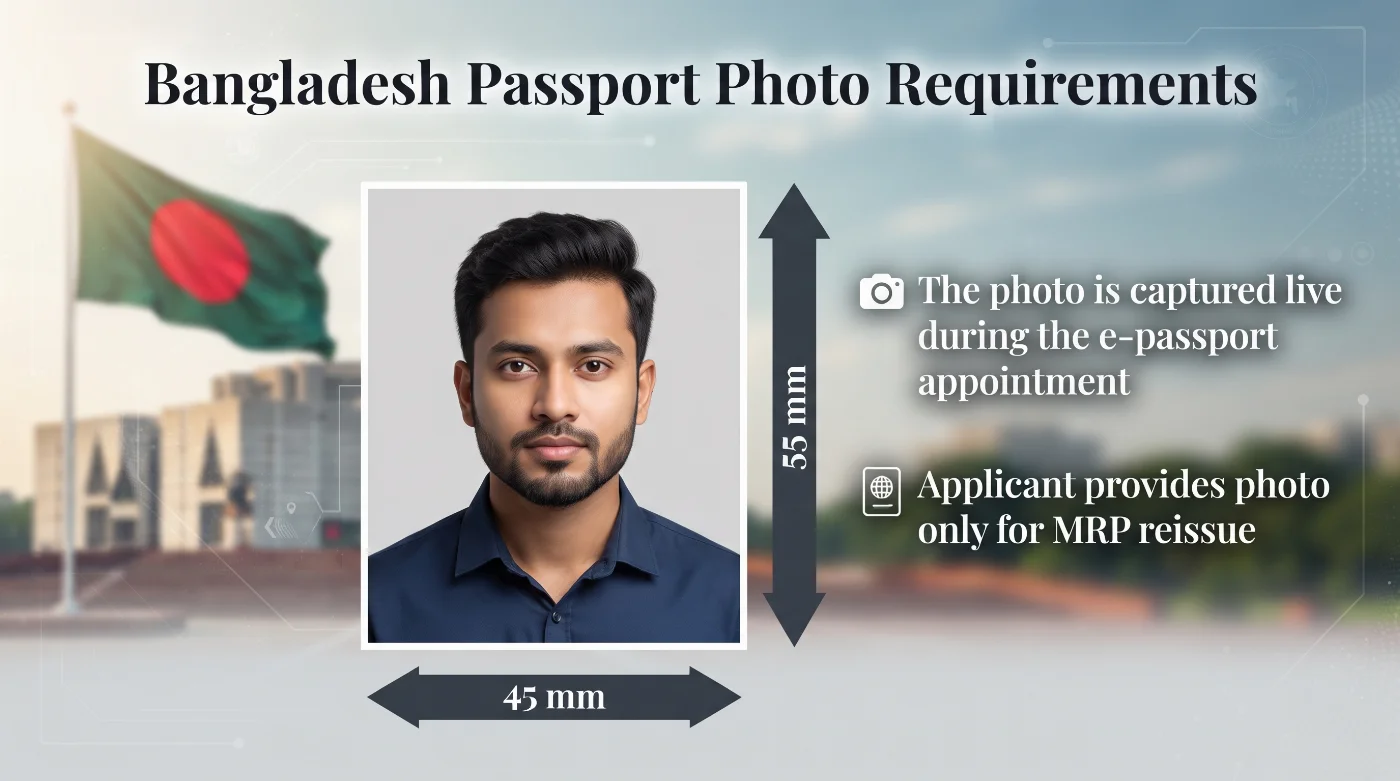
In most cases, you don’t need to provide a photo for your Bangladesh passport in 2026: the enrolment officer captures the biometric photo live at the passport office or a mission abroad. A printed photo is used only in two cases: 3R-print files for children under six, and an older Machine Readable Passport (MRP) reissue that requires 45 × 55 mm printed photos. Always double-check the instructions if you’re applying from the Bangladesh mission abroad — the specs may differ. This guide covers all official Bangladesh photo rules in 2026 so you submit the correct photo, or get ready for an in-office capture, avoiding delays or rejections.
12 Key Bangladesh Passport Photo Requirements: a Checklist
The Department of Immigration and Passports (DIP) and the Bangladesh e-Passport Portal set the national specifications for passport photos. These rules are based on the International Civil Aviation Organization (ICAO) Document 9303 biometric photo standards.
Bangladesh began issuing e-Passports on 22 January 2020, becoming the first South Asian country to roll them out nationwide. Today, the e-Passport is Bangladesh’s standard format for new applications and renewals. Limited MRP reissue services may still be available in specific cases. An e-Passport carries an embedded chip that stores the holder's photo, fingerprints, and iris scan, all captured during a biometric enrolment appointment.
The older Machine Readable Passport (MRP) is being phased out and can no longer be requested as a fresh application. An older MRP has no chip. It relies on a printed, machine-readable data page. Bangladesh no longer issues new MRPs, and this format now applies to a narrow group only — applicants completing an MRP reissue on a passport they already hold. In these cases, a photo still has to be submitted with the paper application but not captured live, because there's no biometric enrolment step to capture it.
The same applies to children under six — a child that age can't reliably complete biometric enrolment, so this application uses a printed 3R photo instead of live capture — even though the document being issued is still an e-Passport.
Below are the 12 official requirements that every photo submitted with a passport application must meet exactly, no matter the submission method.
Requirement | Details |
|---|---|
1. Number of Photos | One photo is required per applicant. Add one photo of each parent when the applicant is 15 or younger. |
2. Recency | The photo must be taken specifically for this application. An old passport or ID photo is not accepted. |
3. Photo Size | Live capture is sized and framed automatically by the enrolment system. A 3R print for children under 6 measures 3.5 × 5 in (9 × 13 cm). An MRP-printed photo must be 55 × 45 mm. |
4. Colour | The photo must be in full colour, with accurate skin tone and clear facial detail. |
5. Background | A plain grey background is officially required for e-Passports. A Bangladesh mission abroad may require a different colour; always double-check it. |
6. Lighting | Lighting must be even and free of shadows. The eyes, nose, mouth, chin, and full facial outline must stay clearly visible. |
7. Positioning and Framing | The camera must face the applicant directly. The head must be upright and centred, with both sides of the face visible and clear space around the head. |
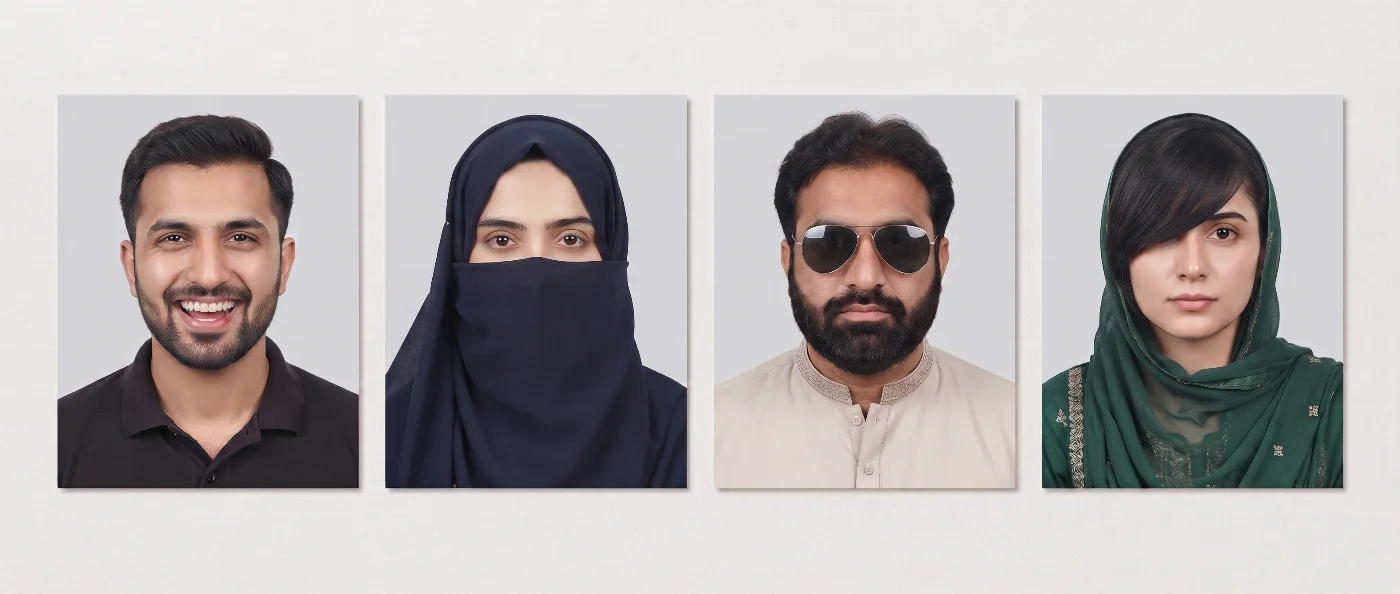
8. Facial Expression | A neutral expression is required: mouth closed, both eyes open, gaze on the camera. Smiling, frowning, and raised eyebrows are not permitted. |
9. Attire, Head Covering, and Accessories | Clothing must contrast with the background. Hair and any head covering must leave the forehead, cheeks, chin, eyes, and facial outline visible. Full requirements below. |
10. Glasses | Glasses come off for live capture if the officer asks. In a printed photo, both eyes must be fully visible, free of glare and frame obstruction. Full requirements below. |
11. Digital Quality | Live capture is stored automatically by the enrolment system. A digital MRP photo must be a genuine, unaltered image, sized for the lab to print at 45 × 55 mm. |
12. Print Quality | Every printed photo must come from a professional photo lab. It must be sharp and evenly coloured, with no creases or damaged edges. |
Clothing, Head Coverings, and Glasses in Bangladesh Passport Photos
What Clothes Should I Wear in a Bangladesh Passport Photo?
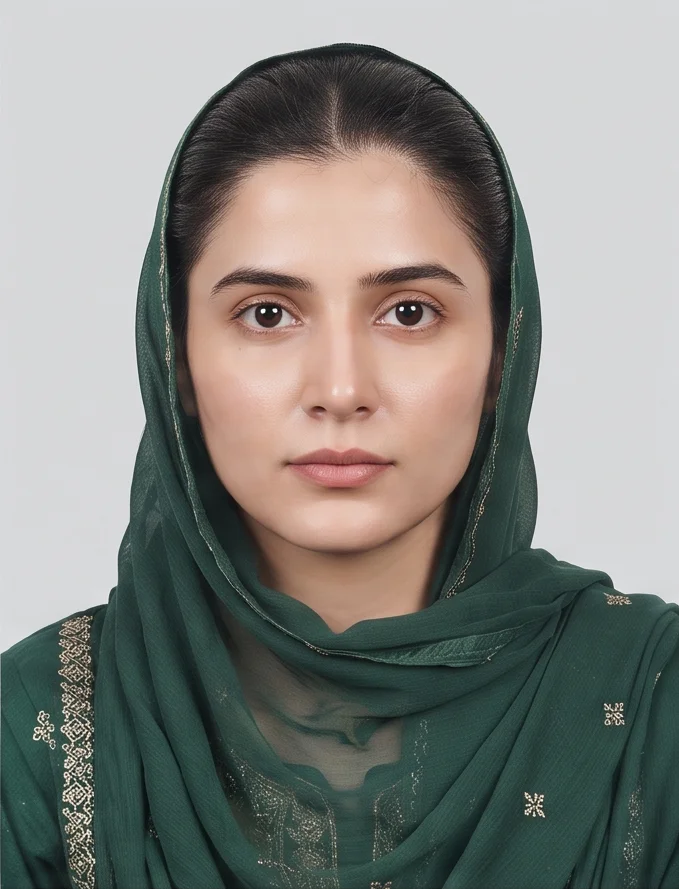
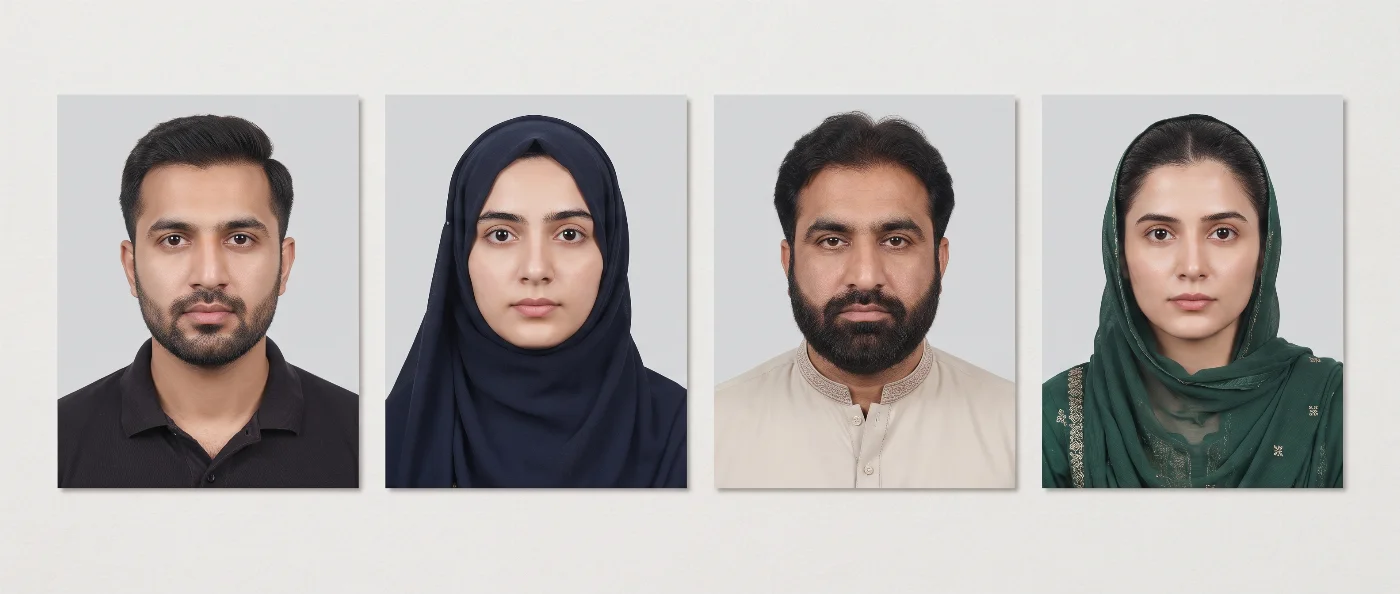
Your clothing needs to contrast with the photo's grey background, so the outline of your shoulders and collar stays distinct from the backdrop behind you. White, cream, and other pale tones blend into the background and are one of the most common reasons a printed photo is rejected. Uniforms, camouflage patterns, and any clothing that resembles official government or military dress are not accepted, regardless of the applicant's profession. Beyond colour, the requirement is straightforward: everyday clothing, worn as you normally would, is what the passport office expects to see.
Are Head Coverings Allowed in a Bangladesh Passport Photo?
Religious and medical head coverings are both fully permitted, and an applicant is never asked to remove one for a Bangladesh passport photo. The requirement that applies to every head covering, whatever the reason it is worn, is visibility: the face must remain completely visible from the hairline to the bottom of the chin, with no shadow or fabric crossing the forehead, cheeks, or chin.
For a hijab, veil, turban, or patka worn daily for religious reasons, the fabric should frame the face rather than cross into it — the edge should sit at the hairline, not lower. The same standard applies to a medical head covering, such as a surgical cap, a bandage, or a wig or scarf worn after hair loss from treatment: the face still needs to be fully visible, because a medical reason does not relax the biometric standard.
What is not accepted is a head covering worn for style rather than a religious or medical reason — a hat, cap, headband, or fashion scarf, for example. And regardless of why it is worn, any covering that casts a shadow across the face or covers the forehead, cheeks, chin, eyes, or jawline will cause the photo to be rejected.
Can I Wear Glasses in a Bangladesh Passport Photo?
Glasses are allowed in a Bangladesh passport photo, provided both eyes remain completely visible: no glare across either lens, and no part of the frame covering the eyes. This applies regardless of why the applicant wears them. What is not accepted is glare or reflection on the lenses, a frame thick enough to cross the eye or pupil, tinted or photochromic lenses that darken the eyes, and sunglasses of any kind — all of these cause rejection, prescription or not.
For live capture, the enrolment officer makes this call in the moment. If the applicant is asked to remove their glasses, they will need to do so before the image is captured.
Acceptable Bangladesh Passport Photo Examples
Unacceptable Bangladesh Passport Photo Examples
What Type of Photo Do I Need for My Bangladesh Passport?
The type of photo (printed or captured at the moment of physical passport application) depends on your application type:
Application Type | Photo Required |
|---|---|
Standard e-Passport application, age six and above (first-time or renewal) | Live capture at the enrolment appointment. No photo is prepared or brought in advance. |
Passport application for a child under six | A printed 3R photo, 3.5 × 5 in (9 × 13 cm), prepared before the appointment and brought to enrolment for scanning. |
MRP reissue (existing MRP holders only — Bangladesh no longer issues new MRPs) | A printed 55 × 45 mm photo, with 30 × 25 mm spaces for each parent's photo when the applicant is 15 or younger. |
Application through a Bangladesh mission abroad | Live capture at the mission, following the same rule as a domestic application. Where a 3R print is required instead, the mission's own published checklist sets the background and size to follow. |
Photo Captured Live During the Appointment
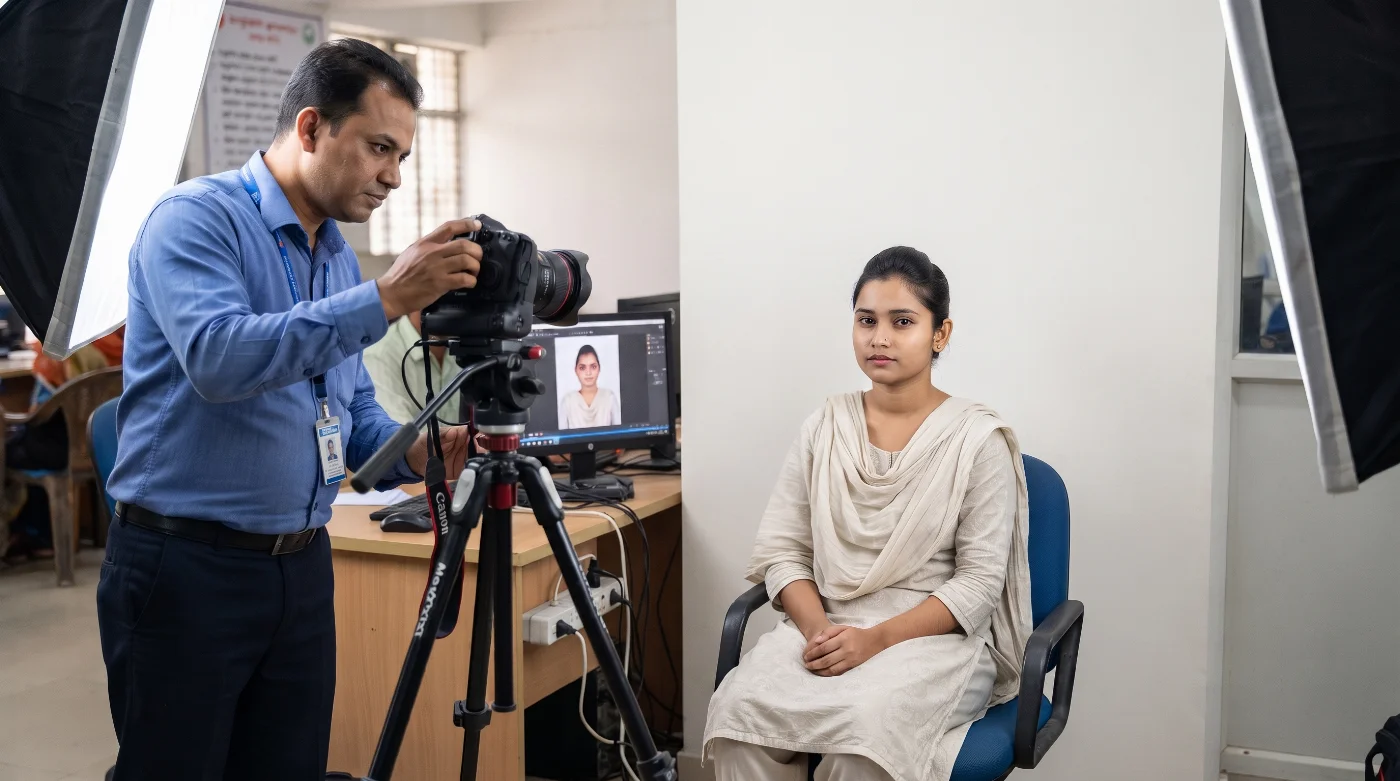
Live capture happens at the enrolment appointment: the officer photographs the applicant on the spot, using the equipment installed at that office or mission, with no printed photo needed. However, if your application requires a printed photo — it is your responsibility to have the photo taken and printed in advance.
Regional and Divisional Passport Offices
Applicants in Bangladesh go to the regional or divisional passport office assigned through their e-Passport application. Wear clothing that contrasts with the background before arriving, and once seated, follow the officer's instructions on posture and where to look — live capture happens right there, during the appointment.
Missions Abroad
Applicants outside Bangladesh go to the Bangladesh mission listed in their application instead of a domestic passport office. Before arranging a 3R print, check that mission's own published checklist: the background colour is set centrally, but individual missions may specify a different one, and shooting to the wrong colour means a reprint.
RPO Bangladesh Secretariat and Dhaka Cantonment
Applicants using the dedicated Bangladesh Secretariat or Dhaka Cantonment form go through the identical live-capture process as everyone else, once the responsible office has confirmed their eligibility for that specific appointment.
Preparing a Printed Photo for Children Under Six or MRP Applications
Only two cases require preparing a photo in advance: a child under six, or an MRP application. Every other applicant simply attends their enrolment appointment for live capture.
Confirm the background required. Grey under the central rule, the specific colour required by the mission for applicants abroad, or whatever the MRP form specifies.
Light the shot evenly and position the camera at eye level, facing the subject directly. For a child, have another adult hold the camera and keep the child alone in frame.
Keep the head upright and centred, with hair and any head covering clear of the forehead, cheeks, chin, and eyes.
Choose clothing that contrasts with the background. Avoid large prints, grey, white, bright colours, large logos, camouflage, and military-looking wear.
Take several photographs and select the sharpest, most evenly lit one. Beauty filters and edits that alter facial features are not permitted. Basic cropping, resizing, and background preparation are acceptable when the final image remains natural and meets the required specifications.
Order the correct print: a 3R print (3.5 × 5 in) or an MRP print (55 × 45 mm), depending on the application. For the MRP print, our Bangladesh passport size photo tool crops a phone picture to 55 × 45 mm without retouching, so the file is ready for the lab.
Getting a Printed Bangladesh Passport Photo at a Photo Studio
If you are required to bring in a printed photo, a professional photo studio is a reliable choice. The staff is familiar with Bangladesh passport photo requirements and will professionally print out the ready shot in a required format — either at 3R or 55 × 45 mm. It's worth checking the print before submitting it: the dimensions should be exact, the colour accurate, the detail sharp, and the surface free of creases or damage.
Getting a Printable MRP Photo Online
For applicants who prefer not to spend time and money on a studio visit, PhotoGov's Bangladesh passport photo maker is a reliable choice. All you need is a good-quality input selfie taken in sufficient daylight. The online tool automatically resizes, frames, and crops it to a 55 × 45 mm file that you download as a professional-grade printable PDF file. This option saves you time and money, providing the output tailored to the exact Bangladesh passport photo standards.
10 Common Reasons for Bangladesh Passport Photo Rejection
Wrong photo type submitted. A studio print is provided when live capture applies; it must come from the enrolment officer instead.
Incorrect print size. A 3R print that isn't exactly 3.5 × 5 in (9 × 13 cm) is rejected.
Wrong background colour. Grey is required, unless the mission abroad specifies otherwise.
Dark or blurred image. Uneven lighting or soft focus causes rejection.
Tilted or turned head. The camera must face the applicant directly, with eyes level and the head upright.
Unsuitable expression. Anything other than a calm face, closed mouth, open eyes, and a direct gaze is rejected.
Glasses obscuring the eyes. Glare, tinted lenses, or a frame crossing the eyes causes rejection.
Face partially covered. Hair or a head covering crossing the forehead, cheeks, chin, eyes, or jawline is rejected.
Filters or retouching applied. The photo must be a genuine, unaltered capture.
Print sizes confused. 3R and MRP serve different forms; ordering the wrong one means a reshoot.
What to Do if a Bangladesh Passport Photo Is Rejected
The enrolment officer explains exactly what needs to change, and the fix depends on which type of photo failed. For live capture, the applicant follows the officer's correction — posture, clothing, glasses, hair, or expression — and a new photo is taken on the spot. For a printed photo, the applicant confirms the size and background with the officer, then orders a fresh print from a professional lab. A blurred, unevenly lit, poorly framed, or retouched image always needs a new photograph; the rejected file cannot be corrected after the fact. If PhotoGov prepared the MRP file, send the officer's exact correction to PhotoGov support before ordering another print.
Frequently Asked Questions
What is the Bangladesh Passport Photo Size and Format?
Live capture is sized and formatted automatically at enrolment. A child under six needs a 3R colour print measuring 3.5 × 5 in, roughly 9 × 13 cm. An MRP application uses a 55 × 45 mm photo where the issued form requires it, with 30 × 25 mm spaces for the parents' photos when the applicant is under 15.
What are the Essential Bangladesh Passport Photo Requirements?
Four things determine acceptance for a printed photo: a grey background (or the colour set by the mission abroad), even lighting with the full facial outline visible, an upright head with a neutral expression, and clothing that contrasts with the background. Live capture applies the identical standard automatically.
Where to Take a Bangladesh Passport Photo?
Live capture takes place at the regional or divisional passport office inside Bangladesh, or at the Bangladesh mission abroad. A studio or photo lab is only involved for the printed-photo cases.
How to Prepare for Live Bangladesh e-Passport Capture?
Wear clothing that contrasts with the background, and keep the forehead, cheeks, chin, eyes, and facial outline visible. Glasses come off if the officer asks. Head upright, gaze directed at the lens, expression neutral.
What are the Bangladesh Passport Photo Rules for Children Under Six?
A studio or photo lab produces the 3R print, matching the background specified by the processing office or mission. Another adult holds the camera at the child's eye level, keeps the child alone in frame under even lighting, and sends the sharpest frame to the lab for printing.
How Many Photos are Required for My Bangladesh Passport Application?
Live capture covers most applicants. A printed photo needs one copy — 3R or MRP — plus one photo of each parent when the applicant is 15 or younger.
How Much is the Bangladesh Passport Photo?
Live capture is included in the application fee. Printed-photo cases run on the rate charged by the studio, lab, or online tool used to produce them.
Can You Wear Glasses in a Bangladesh Passport Photo?
Yes, provided both eyes are fully visible, free of glare, and unobstructed by the frame. Glasses come off for live capture if the officer asks, and sunglasses or tinted lenses are never accepted.
Are Religious Head Coverings Allowed in Bangladesh Passport Photos?
Yes. A hijab, veil, turban, or patka worn daily for religious reasons is permitted, provided the face stays fully visible from hairline to chin.
Are Medical Head Coverings Allowed in Bangladesh Passport Photos?
Yes, under the same standard as a religious head covering. A surgical cap, bandage, or covering worn for hair loss or a scalp condition is accepted as long as the face remains fully visible.
Can You Smile in a Bangladesh Passport Photo?
No. A neutral expression is required — mouth closed, both eyes open, gaze on the camera. Smiling, frowning, and a tilted head all cause rejection.
What Background Is Required for a Bangladesh Passport Photo?
Plain grey, under the central e-Passport rule. A Bangladesh mission abroad may require a different colour, so its published checklist should be checked before arranging a printed photo.
What Happens if a Bangladesh Passport Photo is Rejected?
The enrolment officer explains exactly what needs to change. For live capture, a new photo is taken on the spot. For a printed photo, a new print is ordered from a professional lab once the correction is confirmed.
Can You Use an Old Passport Photo for a New Application?
No. Every photo must be taken specifically for the current application — a photo from a previous passport, visa, or ID is not accepted.
Where to Find the Official Bangladesh Passport Photo Rules?
The Bangladesh e-Passport Portal's Photo FAQ publishes the official rules. Applicants abroad should also check the passport page published by their specific Bangladesh mission.
Official Sources
Bangladesh e-Passport Photos, general information: Bangladesh e-Passport Portal
Bangladesh Passport Photo FAQs: Bangladesh e-Passport Portal
International Biometric ID Photo Specifications: ICAO Document 9303
Was this helpful?
15 found this helpful
Top expert
Based on official government sources
Helpful votes: 15
Was this helpful?
15 found this helpful
Service provided by Y VISION TECHNOLOGIES LLP · Stoney Works 8 Stoney Lane, London, England, SE19 3BD · Terms · Refund policy · Contact
We value your Privacy
We use cookies to enhance your browsing experience, serve personalized ads or content. By clicking “Accept All”, you consent to our use of cookies.