German Passport Photo Requirements in 2026 — Learn New All-Digital Rules
Table of contents:
- 12 Key German Passport Photo Requirements: a Checklist
- Acceptable German Passport Photos
- Unacceptable German Passport Photos
- Germany’s Digital-Only Passport Photo Rule: What Changed in 2025
- German Passport Photo Background: Grey, Not White
- Glasses in German Passport Photos
- Where to Get a Compliant German Passport Photo in 2026 (and How Much It Costs)
- German Passport Photos for Minors: BMI Guidelines by Age
- Common Reasons for a German Passport Photo Rejection
- What to Do If Your German Passport Photo Is Rejected
- Frequently Asked Questions
Planning to submit a photo and need to know the current German passport photo requirements? Since 1 May 2025, German passport photos (Biometrisches Passbild) are submitted only in electronic format — there is no printed photo to hand in at the counter.
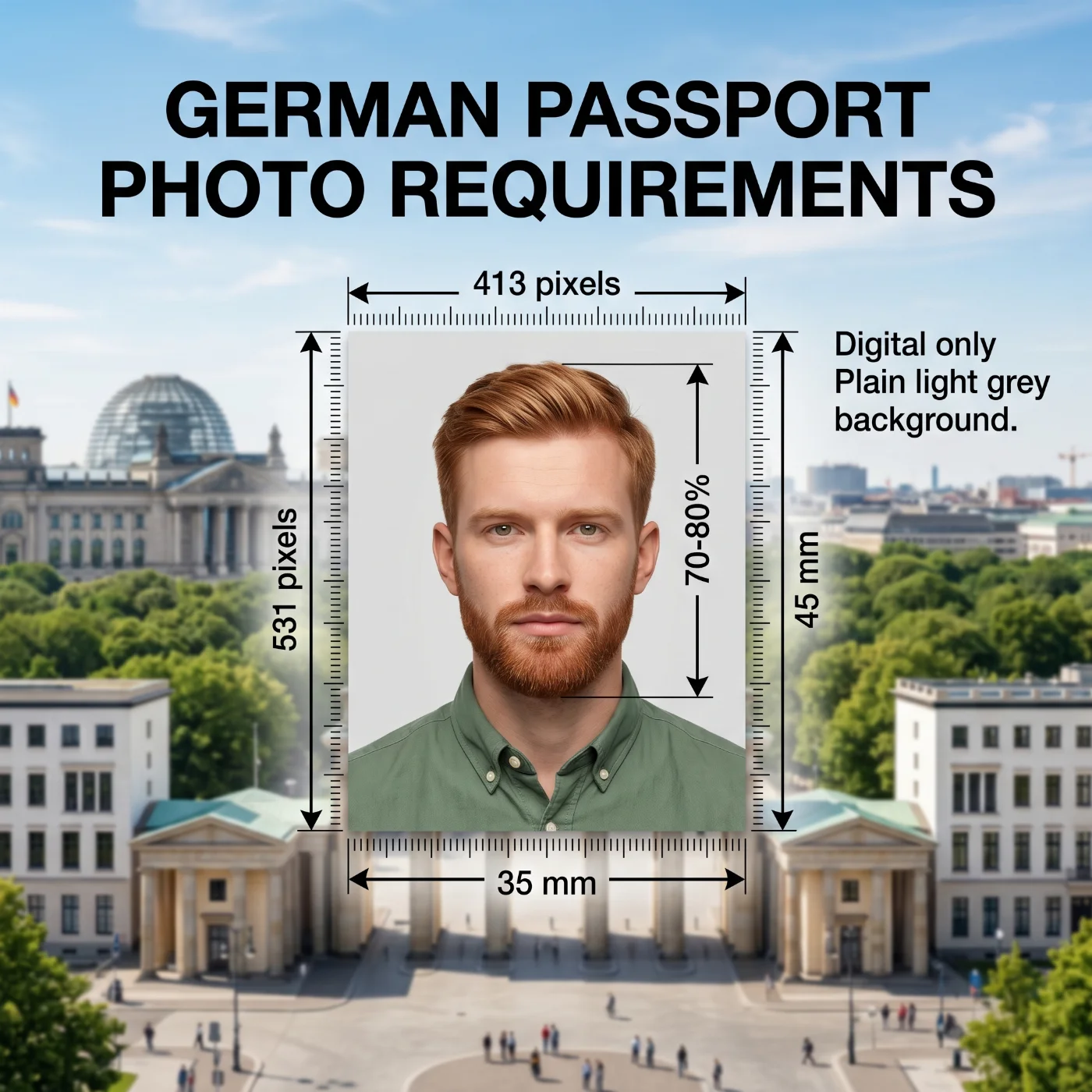
Your German passport photo must be a colour image in the 35 × 45 mm format (413 × 531 pixels), with a plain light-grey background, and the face taking 70–80% of the frame. The photo is submitted online to your local citizens’ office (Bürgeramt / Passbehörde) with a QR code from a certified photographer or a Bürgeramt self-service terminal.
In this guide, we cover everything you need to know about German passport photos in 2026 — each requirement has been checked and verified by our compliance team against official sources.
12 Key German Passport Photo Requirements: a Checklist
German biometric photo requirements are set by the Federal Ministry of the Interior (BMI) and Bundesdruckerei and align with the international biometric standard International Civil Aviation Organization (ICAO) Document 9303. The table below consolidates all official specifications — covering size, background, colour, recency, and the digital submission channel.
Parameter | Requirement |
|---|---|
1. Number of photos | One digital biometric photo. There is no printed copy to hand over — the image is captured and transmitted electronically. |
2. Recency | Taken within the last 6 months, reflecting your current appearance. A new photo is required after any significant change in looks. |
3. Size and head position | 35 × 45 mm format (413 × 531 pixels). The face must fill 70–80% of the height — 32–36 mm from chin to crown (tolerance 27–40 mm) — centred and upright, neither tilted nor turned. |
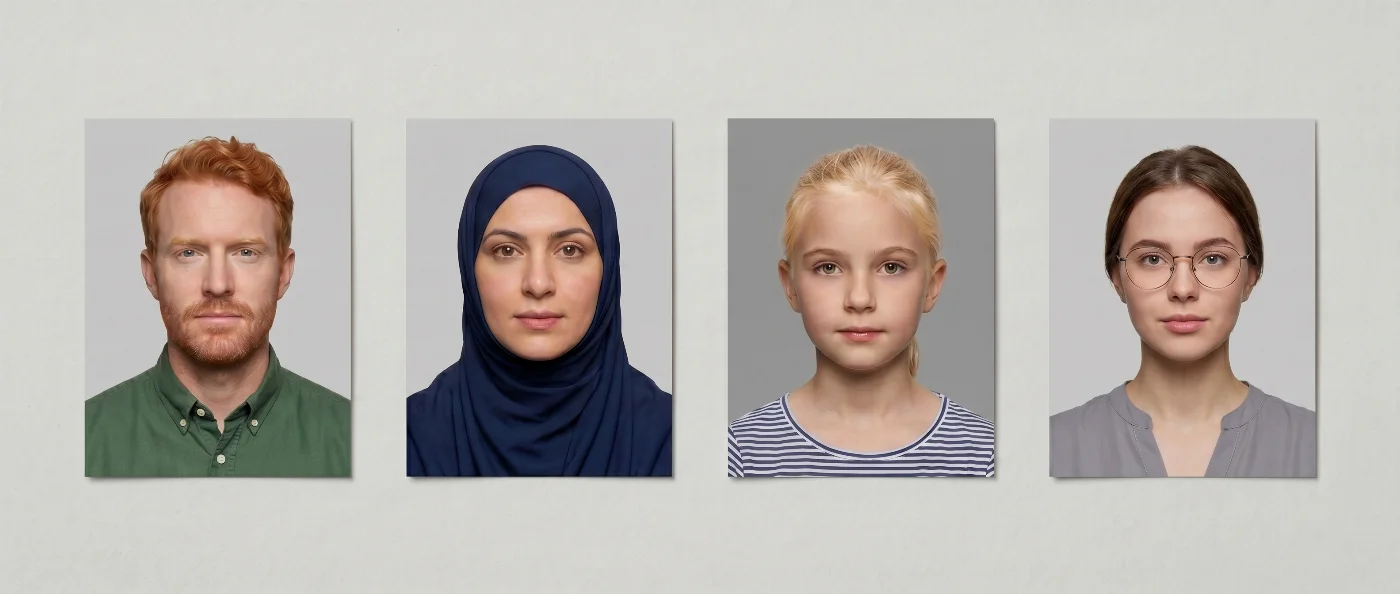
4. Background | Plain, light/neutral grey — not white. Medium grey for light or blonde hair, light grey for dark hair. No patterns, shadows, objects, or other people in the frame. |
5. Lighting | Even lighting with natural skin tones. No shadows or reflections on the face or background, and no red-eye. |
6. Facial expression and positioning | Look straight at the camera with a neutral expression, eyes open and clearly visible, mouth closed. |
7. Clothing | Everyday clothing in colours that contrast with the grey background. No uniforms. Daily religious clothing is allowed if the full face stays visible. |
8. Head coverings | Not permitted, except when worn daily for religious reasons, in which case the full face from chin to forehead must be visible, with no shadows. |
9. Eyeglasses | Allowed only if the eyes are fully visible — no glare or reflection, no tinted lenses or sunglasses, and frames must not cover any part of the eyes. If unsure, remove them. |
10. Appearance change | The photo must match your current appearance. After facial surgery or another significant change in looks, submit a new photo. |
11. Submission format | Digital only — via a QR code or a biometric terminal. Since 1 May 2025 the image is sent through the encrypted government system; photos handed over on paper are rejected. |
12. File and image quality | A colour JPEG, 413 × 531 pixels, sharp and high-contrast. Clean and undamaged, with no pixelation, filters, or AI editing. The certified system handles the file encoding automatically. |
Use PhotoGov’s German Passport Photo Maker to turn a selfie into a compliance-aligned photo in under a minute — formatted to the official 35 × 45 mm (413 × 531 px) size, grey background, and face-coverage rules.
Acceptable German Passport Photos
Unacceptable German Passport Photos
Germany’s Digital-Only Passport Photo Rule: What Changed in 2025
Germany implemented the most significant passport photo reform in its history on 1 May 2025. From that date, all applications for passports, national ID cards, and residence permits must include a digitally submitted biometric photo.
Printed photos handed over at the counter are no longer accepted under any circumstances. This makes Germany one of the first countries in the world to fully eliminate printed passport photo submissions.
How to Submit a Digital Photo for a German Passport
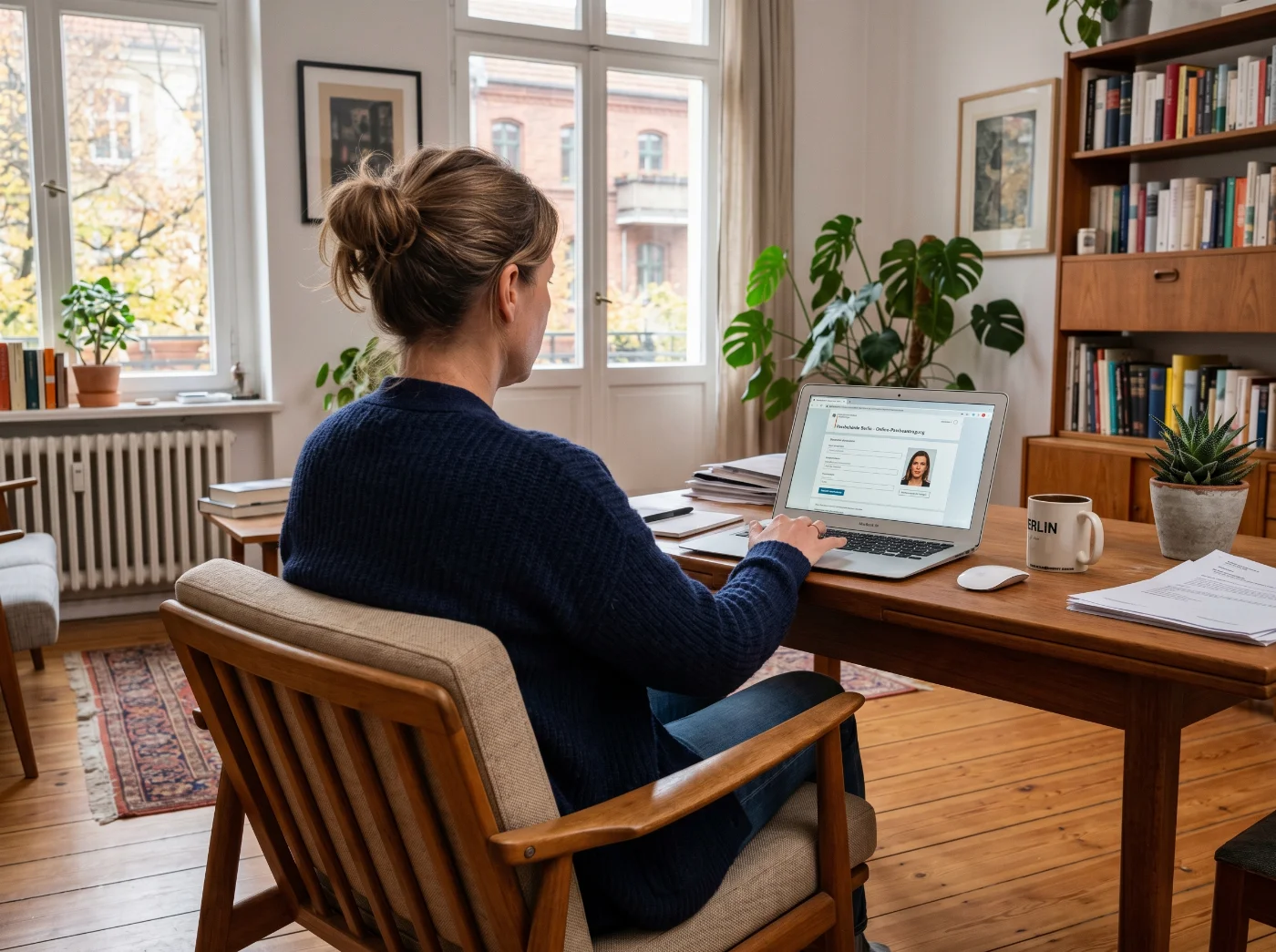
There are two approved routes for submitting a digital biometric photo in Germany:
Self-service biometric terminals (Selbstbedienungsterminals) are installed at Bürgerämter in most major cities. The applicant photographs themselves directly at the terminal; the system checks compliance and uploads the image automatically.
Certified photographers who have registered with the official e-passport photo system. The photographer captures the photo, encrypts and uploads it to the secure government platform (a cloud procedure certified by the Federal Office for Information Security, BSI), and gives the applicant a QR code (data-matrix code). The applicant presents this QR code at the Bürgeramt when submitting their application.
The encrypted photo transfer system is designed to prevent photo manipulation — specifically morphing attacks in which multiple faces are digitally blended to create fraudulent identity documents. The legal framework is the Act to Strengthen Security in Passport, ID and Foreigner Documentation (Gesetz zur Stärkung der Sicherheit im Pass-, Ausweis- und Ausländerdokumentenwesen), passed in 2020 and implemented in stages.
Germany Digital Passport Photos: Key Dates
1 May 2025 — Digital-only requirement came into force
31 July 2025 — Three-month transition period ended; printed photos rejected under all circumstances from this date
If you had passport photos professionally printed before May 2025 and have not yet used them, they cannot be accepted for a German identity document application.
German Passport Photo Background: Grey, Not White
Germany’s background requirement is one of the most commonly misunderstood specifications in German passport photography. It fundamentally differs from many other countries, which require a pure white background.
The official Bundesdruckerei specification requires a plain, uniform, neutral grey background. The official sample photo guidance explicitly states that the background must be in a contrasting colour to the face and hair:
For applicants with light or blonde hair: a medium-grey background is specified, to provide sufficient contrast.
For applicants with dark hair: a light-grey background is specified.
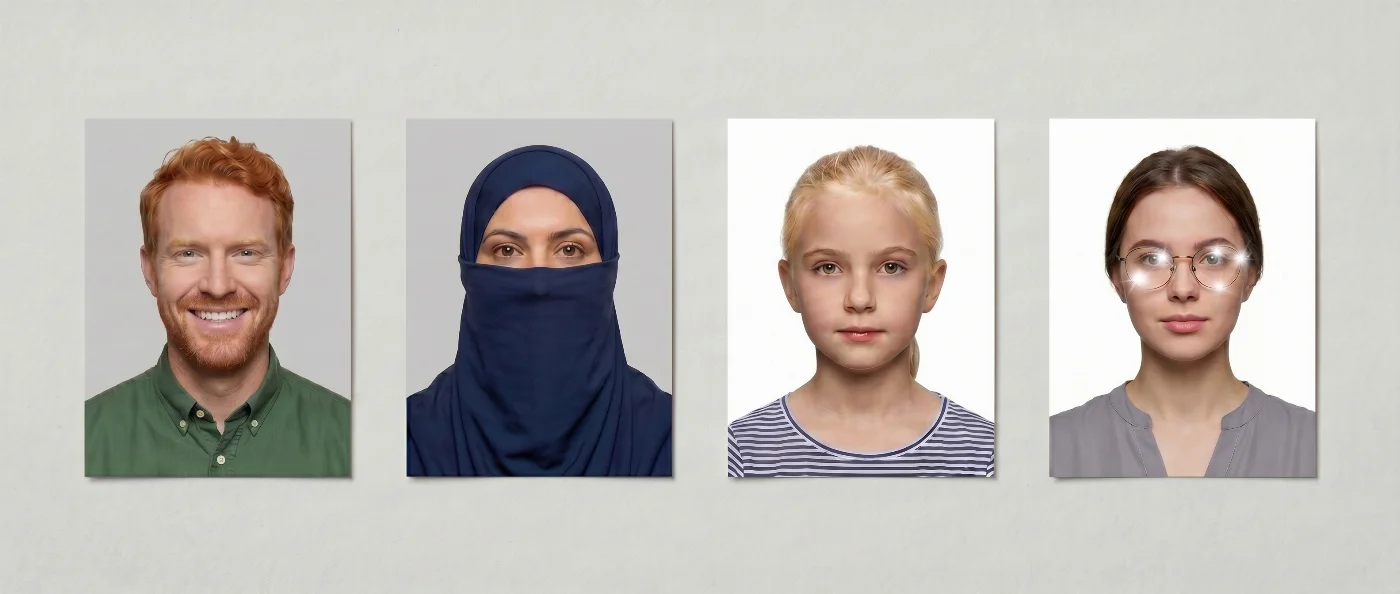
A pure white background is not accepted as it may actually reduce contrast for light-haired applicants. A patterned background, shadows on the background, a second person, or an object visible in the frame are all grounds for rejection. The background must be of solid colour throughout with no gradients, textures, or shadows.
Glasses in German Passport Photos
Unlike India (which introduced an absolute glasses ban in September 2025) or the United States (which banned glasses in 2016), Germany’s official specification permits glasses under specific conditions. The eyes must be clearly visible in the photograph. This means:
No flash reflection or glare on the lenses
No tinted lenses or sunglasses of any kind
The edge of the lenses or frames must not cover any part of the eyes
In practice, compliance with all three conditions simultaneously can be difficult to achieve, especially with modern anti-reflective coatings. Certified photographers are trained to manage lighting to avoid reflection. If any of the three conditions cannot be met, removing glasses before the photo is taken is the simplest solution and guarantees compliance.
Where to Get a Compliant German Passport Photo in 2026 (and How Much It Costs)
Getting a compliant German biometric photo is cheap and fast — and the cheapest option is also one of the most reliable. You can photograph yourself at a Bürgeramt terminal, visit a certified photographer or drugstore that uploads the image for you, or prepare a fully compliant image online with PhotoGov before your appointment. Below are the key options for your German digital passport photo to consider in 2026.
Service | Time | Price | Chance of approval |
|---|---|---|---|
PhotoGov online passport photo maker | Under 30 seconds | €3.90 for a digital photo (two free ID photos per day, depending on your location) | High |
Bürgeramt self-service terminal | A few minutes | Small fee per session (≈ €6) | Very high |
Certified photographer (QR upload) | Appointment | €8–€15 | Very high |
Pharmacies & drugstores (dm, Müller, Rossmann) | 10–20 minutes | €8–€15 | Moderate |
Deutsche Post branches | 10–20 minutes | €8–€15 | Moderate |
Self-service photo stations (FotoFix, PhotoMe, CEWE) | 5–10 minutes | €5–€10 | Low |
Professional photo studio | 1 hour to 1–2 days | €20–€35+ | High |
For German identity documents, remember that the final image must reach the authority digitally — either through a certified provider that uploads it and issues a QR code, or via a Bürgeramt self-service terminal.
PhotoGov Online Passport Photo Maker
PhotoGov’s German passport photo maker turns a smartphone selfie into a fully compliant colour image that meets the 35 × 45 mm format (413 × 531 px), light-grey background, 70–80% face coverage, and lighting specifications. Upload your selfie, and the German passport photo maker automatically adjusts it to all official German passport photo requirements, with two free ID photos per day, depending on your location.
In under a minute, you get a guaranteed-compliant image — ready for the official QR upload with your certified photographer, for online and visa applications that accept a supplied file, or as a foolproof reference before your Bürgeramt appointment.
German Passport Photos for Minors: BMI Guidelines by Age
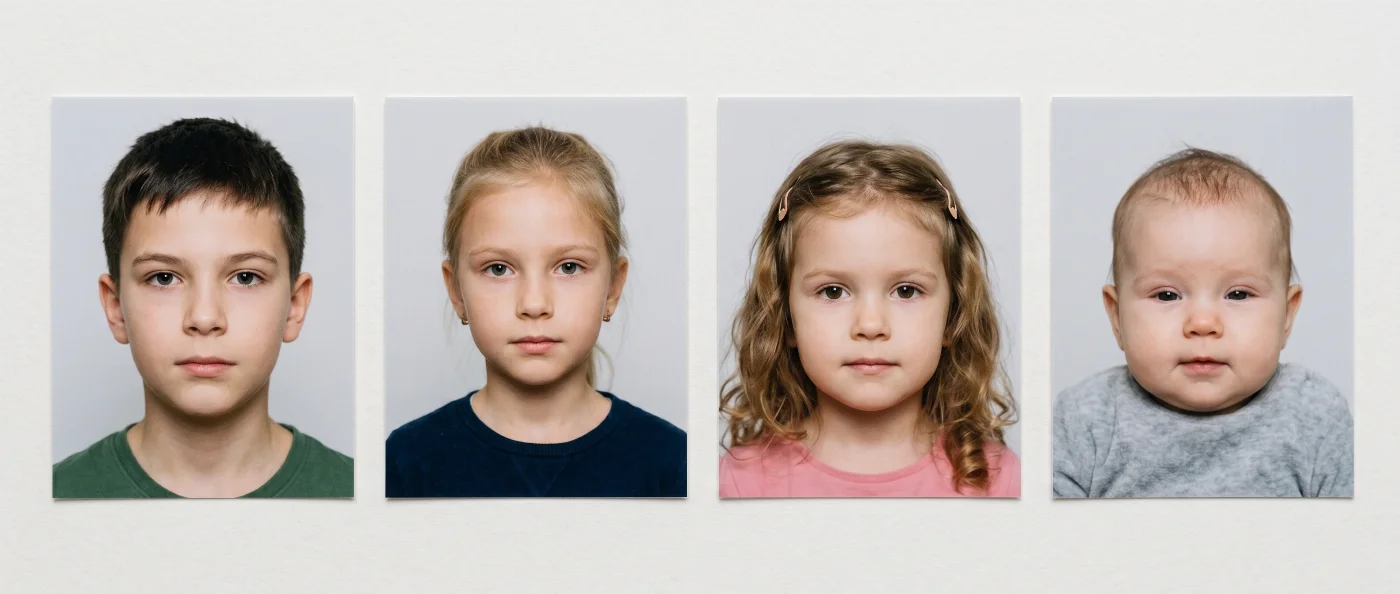
Children Aged 10 to 17: Full Adult Specifications Apply
From age 10, all standard specifications apply without modification. The child must face the camera directly, maintain a neutral expression with the mouth closed, and keep the eyes fully open. The face must take up 70–80% of the photo (face height 32–36 mm). No glasses are recommended to avoid compliance risk. Religious head coverings follow the same rules as for adults.
Children Aged 6 to 9
The face may take up 50–80% of the photo, with the head height (chin to crown) between 22 and 36 mm; photos are rejected only below 17 mm or above 40 mm. A neutral expression, direct gaze at the camera, and a centred head are still required at this age.
Children Aged 5 and Under
The same facial-size measurements apply (face 50–80%, height 22–36 mm). Children in this age group do not need to maintain a neutral expression, look directly at the camera, or have their heads centred in the frame.
Babies Under 1 Year
All the same specifications as for children aged 5 and under apply. Additionally, babies under one year do not need to have their eyes open. Photos of babies may be taken lying on a plain grey or white sheet with the camera directly overhead, or held upright with both supporting hands completely out of the frame. No toys, dummies, or other objects may be visible.
Common Reasons for a German Passport Photo Rejection
1. Submission of a printed photo. Since 31 July 2025, paper photos are no longer accepted. A QR code from a certified photographer or a terminal-captured image is required.
2. Incorrect or low-contrast background. A white or cream background may fail the contrast check, particularly for light-haired applicants. Use a proper neutral grey backdrop.
3. Shadows on the background. The applicant must stand far enough from the backdrop that their body casts no shadow onto it.
4. Glare or reflection on eyeglasses. The most common glasses-related rejection. Lighting must be even and positioned to eliminate lens glare entirely.
5. Insufficient face height. A face below the 32 mm optimum (or below 22 mm for children aged 9 and under; hard rejection below 27 mm, or below 17 mm for young children). Move closer to the camera.
6. Excessive face height. A face above 36 mm (or above 40 mm, the absolute tolerance limit). Increase the distance between the applicant and the camera.
7. Incorrect head position. The face must be photographed en face — both ears at the same height, looking straight into the lens, neither tilted nor turned.
8. Non-neutral facial expression. An open mouth or even a slight smile changes facial geometry and can fail automated biometric checks.
9. Uneven facial lighting and shadows. Uneven lighting creates shadows across the nose, chin, or forehead. Two light sources positioned symmetrically on either side of the camera prevent this.
10. Insufficient image quality or resolution. Blurred or pixelated images are explicitly rejected. Submit a sharp, high-quality 413 × 531-pixel image.
What to Do If Your German Passport Photo Is Rejected
A rejection is rarely the end of the process. Because the compliance check happens before your document is produced — at the terminal, in the photographer’s software, or at the counter — you can correct the issue quickly. Follow these steps.
1. Identify the exact reason. A biometric self-service terminal or a certified photographer’s software flags the specific fault (background, head size, glare, expression, sharpness). If the photo is rejected at the counter, the official will tell you which rule was not met.
2. Retake the photo — do not edit it. German biometric photos must be genuine and unaltered, and retouched or AI-edited images are detectable and rejected. Capture a new photo that corrects the flagged issue rather than trying to “fix” the old one.
3. Re-capture through an approved channel. Photograph yourself again at the Bürgeramt terminal, or ask your certified photographer to re-shoot and re-upload the image; they will issue a new QR code at no extra charge in most studios.
4. Pre-check before you submit. To avoid a repeat rejection, run your image through an automated compliance check — such as PhotoGov’s German passport photo maker — which verifies size, background, head position, and lighting before your appointment.
PhotoGov is an independent service and is not affiliated with any government body, embassy, or consulate. All information is based on official government requirements and verified primary sources. Final acceptance is determined solely by the issuing authority.
Frequently Asked Questions
What Are the Official German Passport Photo Requirements?
A German biometric passport photo (Biometrisches Passbild) must use the 35 × 45 mm format (413 × 531 pixels), with the face occupying 70–80% of the photo (height 32–36 mm from chin to crown). The background must be plain and bright — ideally neutral grey, contrasting with the applicant’s hair colour. The photo must be taken en face with a neutral expression, mouth closed, and eyes fully open. Since 1 May 2025, photos must be submitted digitally as a colour image via a QR code from a certified photographer or a biometric self-service terminal. Paper photos are no longer accepted.
What Is the German Passport Photo Size in Pixels?
The German passport photo is 413 × 531 pixels. This is the standard digital size of the 35 × 45 mm format at 300 dpi, the resolution used for German ID photographs. The official BMI Fotomustertafel and the Federal Foreign Office sample sheet define the photo in millimetres (35 × 45 mm) and require a sharp, high-quality image with no pixelation; 413 × 531 px is the corresponding digital pixel size. Submit the image as a colour JPEG.
Can I Still Hand In a Printed Photo at the Bürgeramt?
No. Germany ended paper passport photo submissions on 1 May 2025, with strict enforcement from 31 July 2025. All photo submissions must now be digital. You either photograph yourself at a biometric self-service terminal at the Bürgeramt or visit a certified photographer who uploads the image to the government system and provides you with a QR code.
Does Germany Require a White or a Grey Background for Passport Photos?
Germany requires a grey background, not a white one — one of the biggest differences from countries such as the United States or India. The official Bundesdruckerei and Federal Foreign Office specifications call for a plain, uniform, bright background in a colour that contrasts with the applicant’s face and hair: a medium-grey background is specified for light or blonde hair, and a light-grey background for dark hair. A pure white background is not prescribed and can actually fail the contrast check for fair-haired applicants. The background must be a single colour throughout, with no patterns, gradients, shadows, or other people or objects in the frame.
Are Glasses Allowed in German Passport Photos?
Yes, but only if all conditions are met: the eyes must be fully and clearly visible, there must be no flash reflection or glare on the lenses, no tinted lenses or sunglasses are worn, and the frames must not cover any part of the eyes. In practice, if any condition cannot be guaranteed, removing glasses before the photo is the safest approach.
How Large Must the Face Be in a German Passport Photo?
The face — measured from the bottom of the chin to the crown of the head (not the top of the hair) — must be between 32 and 36 mm within the 35 × 45 mm format. This represents 70–80% of the photo height. Photos are only rejected at the hard tolerance limits of below 27 mm or above 40 mm, but the optimum range of 32–36 mm should always be targeted.
What Are the Rules for Children’s German Passport Photos?
For children aged 10 and above, adult specifications apply in full (face 70–80%, height 32–36 mm, neutral expression, direct gaze). For children aged 9 and under, the face may occupy 50–80% of the photo, with a face-height range of 22–36 mm (rejected below 17 mm or above 40 mm). For children aged 5 and under, a neutral expression, direct gaze, and centred head are not required. Babies under 1 year do not need to have their eyes open.
How Recent Must a German Passport Photo Be?
The photo must accurately reflect the applicant’s current appearance and be taken within the last 6 months. If your appearance has changed significantly since the photo was taken, a new photo should be obtained.
How Is a German Passport Photo Different From a Schengen Visa Photo?
The German passport and the Schengen visa photos share most specifications (35 × 45 mm format, 70–80% face coverage, neutral expression) but differ in the background colour requirement. Depending on the consulate processing the Schengen visa, a white background is required, but the background of a German passport may be only grey. Always check the specific consulate’s current requirements. The digital-only submission rule applies specifically to German identity document applications and does not apply to visa photos submitted on paper. For a Schengen application, the Germany visa photo page prepares the 35 x 45 mm image with the white background.
How Much Does a German Passport Photo Cost in 2026?
Self-service photo stations (FotoFix, PhotoMe, CEWE) charge €5–€10; pharmacies and drugstores (dm, Müller, Rossmann) and Deutsche Post branches charge €8–€15; a professional studio costs €20–€35+. Bürgeramt self-service terminals charge only a small fee per session. The most affordable option is a reliable online passport photo maker — PhotoGov prepares a digital photo for €3.90; you get two free ID photos per day, depending on your location.
Can I Use a Smartphone Selfie for My German Passport Photo?
Yes — a smartphone selfie can become a fully compliant image when processed by an online passport-photo maker that applies the official 35 × 45 mm format, grey-background, and face-coverage rules. Keep in mind that for German ID documents, the final transfer to the authority must still happen via a certified photographer’s encrypted QR upload or a Bürgeramt terminal, so the compliant image is used for that upload (or for visa and online applications that accept a supplied file).
Are AI-Generated or AI-Edited Passport Photos Allowed in Germany?
No. German biometric photos must be a genuine, unaltered photograph of the applicant. The entire digital-submission system was built to prevent image manipulation and morphing, and retouched or filtered images are explicitly rejected. Automatic cropping, resizing, and neutral lighting or background adjustment are acceptable; generating, beautifying, or otherwise digitally altering the face is not.
How Long Is the Digital Photo QR Code Valid?
The official specification does not set a separate expiry for the QR code beyond the general rule that the photo must reflect your current appearance, for which a photo taken within the last 6 months is recommended. Use the QR code at your Bürgeramt appointment promptly, and obtain a new photo if your appearance changes significantly.
Can I Smile in a German Passport Photo?
No. The expression must be neutral with the mouth closed and eyes open, looking straight at the camera. Even a slight smile alters facial geometry and can fail the automated biometric check, which is one of the most common reasons for rejection.
Official Government Sources
Photo Sample Board — German Passport Biometric Photo Requirements: Federal Ministry of the Interior (BMI) — Fotomustertafel
Sample Photos — Biometric Photo Requirements for ID Documents: Federal Foreign Office (Auswärtiges Amt) — German Embassy
Quality Attributes of Biometric Photos for Documents: Bundesdruckerei GmbH
Biometric Specifications for Machine Readable Travel Documents: ICAO Biometric Standards Document 9303, Part 3
Was this helpful?
61 found this helpful
Top expert
Based on official government sources
Helpful votes: 61
Was this helpful?
61 found this helpful
Service provided by Y VISION TECHNOLOGIES LLP · Stoney Works 8 Stoney Lane, London, England, SE19 3BD · Terms · Refund policy · Contact
We value your Privacy
We use cookies to enhance your browsing experience, serve personalized ads or content. By clicking “Accept All”, you consent to our use of cookies.